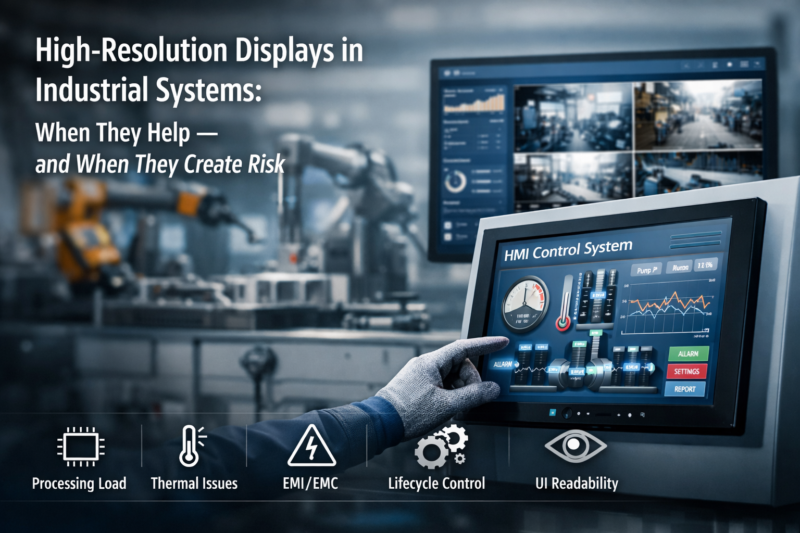
Las pantallas industriales de alta resolución se especifican cada vez más en los equipos industriales modernos. A medida que el software de interfaz hombre-máquina (HMI) evoluciona hacia interfaces gráficas más ricas, cuadros de mando multiventana y herramientas de visualización de datos, los equipos de ingeniería suelen solicitar pantallas con mayor densidad de píxeles.
A primera vista, aumentar la resolución de la pantalla parece una mejora sencilla. Un mayor número de píxeles permite mostrar simultáneamente más información gráfica, lo que puede mejorar la percepción del operador y la capacidad de supervisión.
Sin embargo, en los sistemas industriales, la resolución de la pantalla no es sólo una especificación visual. Afecta a varios aspectos de la arquitectura del sistema, entre ellos:
carga de trabajo de procesamiento de gráficos integrados
ancho de banda de la memoria y tamaño del búfer de trama
comportamiento térmico en el interior de recintos estancos
integridad de la interfaz de visualización de alta velocidad
disponibilidad a largo plazo del panel de visualización
Los equipos industriales suelen funcionar de forma continua durante muchos años, a menudo en entornos con vibraciones, variaciones de temperatura e interferencias electromagnéticas.
Para los fabricantes de equipos originales y los integradores de sistemas, la resolución de la pantalla debe evaluarse como parte del proceso de selección. arquitectura general del sistema, en lugar de tratarlo como un parámetro de visualización aislado.
¿Qué es una pantalla industrial de alta resolución?
Por pantalla industrial de alta resolución se entiende una pantalla HMI o un monitor industrial con una densidad de píxeles significativamente superior a los estándares de las pantallas industriales tradicionales.
Históricamente, muchos HMI industriales utilizaban resoluciones moderadas como:
800 × 600 (SVGA)
1024 × 768 (XGA)
Estas resoluciones eran suficientes para las interfaces de máquina que mostraban alarmas, estados de máquina y elementos de control sencillos.
Los sistemas industriales modernos adoptan cada vez resoluciones más altas:
paneles PCdonde el hardware informático y la pantalla están integrados
En muchos proyectos, el requisito de resolución tiene su origen en el software HMI desarrollado originalmente para entornos de escritorio. Estos marcos de software asumen espacios de trabajo gráficos más grandes y una densidad de píxeles superior a la de las pantallas industriales heredadas.
Sin embargo, las plataformas informáticas integradas que se utilizan en los equipos industriales -a menudo procesadores ARM o sistemas x86 de bajo consumo- no siempre se adaptan con eficacia al aumento de la resolución de la pantalla.
Tecnologías básicas de los monitores industriales de alta resolución
Varios subsistemas de hardware determinan si un sistema puede soportar eficazmente una mayor resolución de pantalla.
Ancho de banda de la interfaz de visualización
Las pantallas industriales modernas suelen utilizar interfaces de alta velocidad como:
LVDS (señalización diferencial de bajo voltaje)
eDP (DisplayPort integrado)
HDMI
DisplayPort
Una mayor resolución aumenta el rendimiento de píxeles necesario.
Resolución
Píxeles por fotograma
Carga relativa de píxeles
1024×768
~0,79 MP
Línea de base
1280×800
~1,02 MP
~1.3×
1920×1080
~2,07 MP
~2.6×
Por tanto, una pantalla Full HD requiere más del doble de procesamiento de píxeles de una pantalla XGA tradicional.
A 60 Hz de frecuencia de refresco, un La interfaz de 1920×1080 suele requerir un reloj de píxeles de unos 148,5 MHz. Dependiendo de la profundidad del color y de la codificación, la velocidad efectiva de transmisión de datos puede alcanzar varios gigabits por segundo.
A medida que aumenta el ancho de banda, la interfaz de visualización se vuelve más sensible:
calidad del tendido de cables
adaptación de impedancia
fiabilidad de los conectores
interferencias electromagnéticas
Estos factores son especialmente importantes en los equipos industriales que contienen motores, accionamientos o largos recorridos internos de cables.
Carga de trabajo del procesamiento gráfico integrado
Una mayor resolución de pantalla aumenta significativamente la carga de trabajo de los gráficos.
La tubería de gráficos debe manejar:
almacenamiento en memoria intermedia
Representación de la interfaz de usuario
escalado de imágenes
composición de ventanas
superposiciones gráficas
Por ejemplo, un Una pantalla de 1920 × 1080 con una memoria de vídeo de 32 bits requiere aproximadamente:
1920 × 1080 × 4 bytes ≈ 8 MB por fotograma
Con doble búfer y capas gráficas adicionales, el consumo de memoria puede llegar a 16-32 MB de espacio de memoria intermedia de trama activa.
En muchos sistemas embebidos, el rendimiento de la pantalla no está limitado por el propio panel, sino por Capacidad de la GPU y ancho de banda de la memoria.
Si el conducto de gráficos se acerca a sus límites, los operadores pueden observar:
retraso en las actualizaciones de la interfaz de usuario
reducción de la suavidad de la animación
desfase temporal de la interfaz
Mantener un margen de procesamiento suficiente es, por tanto, importante para los sistemas que funcionan de forma continua.
Potencia de la retroiluminación y consumo de energía
Las pantallas de mayor resolución suelen asociarse a:
pantallas más grandes
mayores requisitos de luminosidad
sistemas de retroiluminación LED multicanal
Estos factores aumentan el consumo total de energía.
En los equipos industriales sin ventilador o sellados, la disipación de potencia adicional contribuye directamente a generación interna de calor. Incluso pequeños aumentos de la potencia calorífica pueden influir en las temperaturas internas del recinto.
Por tanto, deben verificarse los márgenes de diseño térmico al actualizar la resolución de la pantalla.
Densidad de píxeles frente a tamaño de pantalla en HMI industriales
La resolución de la pantalla debe evaluarse siempre junto con tamaño de la pantalla y distancia de visualización.
Un mayor número de píxeles en una pantalla pequeña aumenta la densidad de píxeles, pero esto no siempre mejora la usabilidad para los operadores que se encuentran a varios metros de distancia del equipo.
En muchos entornos industriales, la usabilidad se ve influida en mayor medida por:
Escalado de la interfaz de usuario
contraste y brillo
ángulo de visión
diseño de interfaz
y no sólo la densidad de píxeles.
Para las HMI de fábrica vistas desde distancias de alrededor de un metro o más, Los elementos más grandes de la interfaz de usuario y una jerarquía gráfica clara suelen mejorar la usabilidad más que una mayor densidad de píxeles.
Consideraciones técnicas para pantallas industriales de alta resolución
Margen de procesamiento y estabilidad del sistema
Una mayor resolución aumenta tanto Carga de trabajo de la GPU y tráfico de memoria.
Los procesadores embebidos de bajo consumo pueden tener dificultades para controlar las pantallas de alta resolución y, al mismo tiempo, el software de control:
comunicación de bus de campo
gestión de alarmas
registro de datos
supervisión de redes
En la práctica, los problemas de rendimiento de la pantalla en los HMI industriales suelen deberse a limitaciones de ancho de banda de la memoria en lugar de la velocidad de la CPU.
Mantener un margen suficiente de procesamiento de gráficos ayuda a garantizar una capacidad de respuesta estable de la interfaz bajo cargas de trabajo máximas.
Comportamiento térmico en sistemas sin ventilador
Muchas plataformas industriales recurren a estrategias de refrigeración pasiva:
ordenadores integrados sin ventilador
paneles de mando sellados
armarios para equipos de exterior
Estos diseños ofrecen un margen térmico limitado.
Una mayor resolución aumenta indirectamente la generación de calor a través de:
mayor actividad de la GPU
mayor uso del ancho de banda de la memoria
mayor potencia de retroiluminación de la pantalla
Durante largos periodos de funcionamiento, la elevada temperatura interna acelera el envejecimiento de los componentes. Por tanto, unos márgenes de diseño térmico conservadores mejoran la fiabilidad a largo plazo.
Integridad de la señal y compatibilidad electromagnética
Las interfaces de visualización de alta resolución funcionan a velocidades de transmisión de datos del orden del gama multigigabit.
Los entornos industriales pueden presentar retos adicionales como:
conectores que afectan a las vibraciones
interferencias electromagnéticas de motores o accionamientos
largos recorridos de los cables en el interior de los equipos
Un mayor ancho de banda reduce la tolerancia a la degradación de la señal.
Durante las pruebas de CEM, las interfaces de pantalla de alta velocidad pueden convertirse ocasionalmente en fuentes de emisiones radiadas o inestabilidad de la señal, El cableado y el apantallamiento deben ser cuidadosos.
Ciclo de vida de los paneles y suministro a largo plazo
Los equipos industriales OEM suelen requerir la disponibilidad de componentes durante muchos años.
Los paneles de visualización desarrollados para los mercados de electrónica de consumo pueden tener ciclos de vida de producto más cortos.
Los riesgos potenciales incluyen:
interrupción del panel durante la producción
disponibilidad limitada de segundas fuentes
rediseño mecánico si los paneles de recambio difieren en dimensiones
Al seleccionar una resolución de pantalla, los fabricantes de equipos originales también deben evaluar estabilidad del ciclo de vida de los paneles y hoja de ruta de los proveedores.
Aplicaciones típicas
Sistemas de visión artificial
Los sistemas de visión artificial suelen mostrar:
cámaras de alta resolución
superposiciones de inspección
resultados de la detección de defectos
Una mayor resolución conserva los detalles de la imagen y mejora la visibilidad de las características de la inspección.
Sistemas de vigilancia multiventana
Las salas de control y los puestos de vigilancia suelen mostrar varias fuentes de información simultáneamente, entre ellas:
cuadros de mando de procesos
paneles de alarma
diagnóstico del sistema
fuentes de vídeo
Los monitores industriales de alta resolución permiten a los operarios observar varias ventanas de datos sin necesidad de cambiar frecuentemente de interfaz.
IHM de equipos avanzados
Algunas máquinas industriales complejas requieren interfaces gráficas detalladas:
sistemas robóticos
equipos de fabricación de semiconductores
plataformas de pruebas automatizadas
Estas aplicaciones se benefician de un mayor espacio de trabajo en pantalla para diagramas, herramientas de configuración y paneles de visualización.
Infraestructura y terminales de servicio
Los sistemas de infraestructuras públicas a veces incluyen pantallas de servicio o diagnóstico, como:
quioscos inteligentes
sistemas de vigilancia del transporte
terminales de diagnóstico en red
En estos entornos, una mayor resolución puede mejorar la densidad de la información y la claridad de la visualización.
Cuando las pantallas de alta resolución encajan bien
Una mayor resolución suele ser adecuada cuando:
el procesador integrado incluye suficiente capacidad de GPU
el ancho de banda de la memoria admite el rendimiento de píxeles necesario
el diseño térmico se ha validado para un funcionamiento continuo
el software HMI está optimizado para pantallas de alta densidad de PPP
se confirma la estabilidad del ciclo de vida de los paneles
En estas condiciones, una mayor resolución puede mejorar la visualización y admitir interfaces de usuario más complejas.
Cuándo una mayor resolución puede introducir riesgos
Una mayor resolución puede introducir una complejidad innecesaria en el sistema cuando:
el sistema se basa en procesadores de bajo consumo
los márgenes térmicos ya son limitados
el equipo funciona sin vigilancia durante periodos prolongados
la estabilidad a largo plazo de la lista de materiales es fundamental
la interfaz muestra información de estado sencilla
En muchos sistemas industriales, una resolución moderada combinada con un buen diseño de la HMI proporciona un rendimiento más estable a largo plazo.
Conclusión
En el diseño de equipos industriales, la resolución de la pantalla debe tratarse como un parámetro de ingeniería a nivel de sistema, no sólo una mejora visual.
El aumento de la densidad de píxeles afecta:
carga de trabajo de procesamiento gráfico
requisitos de ancho de banda de memoria
comportamiento térmico
integridad de la señal
gestión del ciclo de vida de los paneles a largo plazo
Para muchas plataformas industriales, una resolución moderada combinada con diseños de HMI bien concebidos proporciona una solución estable y fácil de mantener.
Una mayor resolución resulta beneficiosa cuando es directamente compatible con las necesidades operativas -como la visualización de visión artificial o la supervisión multiventana- y cuando la arquitectura del sistema ofrece suficiente margen térmico y de procesamiento.
Evaluar la resolución de la pantalla en una fase temprana del diseño del sistema ayuda a evitar problemas de integración y favorece la fiabilidad de los equipos a largo plazo.
PREGUNTAS FRECUENTES
¿Se benefician siempre los HMI industriales de una mayor resolución de pantalla?
No necesariamente. Muchas interfaces de máquinas muestran información relativamente sencilla en resoluciones como 1024×768 o 1280×800 proporcionar una usabilidad suficiente.
¿Cuál es la resolución típica de las HMI industriales?
Muchas IHM industriales suelen utilizar 1024×768 (XGA) o 1280×800 (WXGA) porque estas resoluciones equilibran la legibilidad, los requisitos de procesamiento y la disponibilidad del panel.
¿Cómo afecta una mayor resolución de pantalla a los procesadores integrados?
Una mayor resolución aumenta el número de píxeles procesados en cada fotograma, lo que incrementa Carga de trabajo de la GPU, tamaño del búfer de fotogramas y requisitos de ancho de banda de la memoria..
¿Una mayor resolución aumenta el consumo de energía del sistema?
Sí. Una mayor resolución suele aumentar Actividad de la GPU, uso del ancho de banda de la memoria y potencia de la retroiluminación de la pantalla., que pueden influir en el rendimiento térmico de los sistemas industriales sin ventilador.
¿Pueden las pantallas de alta resolución afectar al rendimiento del CEM?
Potencialmente. Las interfaces de visualización de alta velocidad que funcionan a velocidades de datos más elevadas pueden aumentar la sensibilidad a los problemas de integridad de la señal y a las emisiones electromagnéticas.
Introducción En el diseño de sistemas industriales, la selección de la arquitectura informática adecuada afecta directamente a la fiabilidad del sistema y a la complejidad de su integración, ...
Introducción En el diseño de equipos industriales, la interfaz hombre-máquina (IHM) afecta directamente a la facilidad de uso, la fiabilidad y el mantenimiento del sistema. ...
Introducción Las interfaces hombre-máquina (IHM) son actualmente componentes estándar de los equipos industriales modernos. Las pantallas permiten a los operarios ...
CONTACTO
Revisión de ingeniería
Envíe los detalles de su solicitud. Le responderemos con la dirección de configuración y los siguientes pasos.
Ideal para proyectos OEM/ODM y de integración. Tiempo de respuesta: 1 día laborable (GMT+8).
Para la RFQ, incluya tamaño/brillo, interfaces, montaje, temperatura de funcionamiento y fecha de entrega prevista.