産業用パネルPCに適したOSの選び方
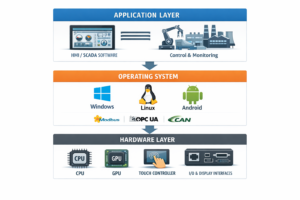
はじめに 産業用パネルPCは、現代のHMI(ヒューマン・マシン・インターフェース)システムの中核をなすコンポーネントであり、ビジュアライゼーションを可能にする、, ...
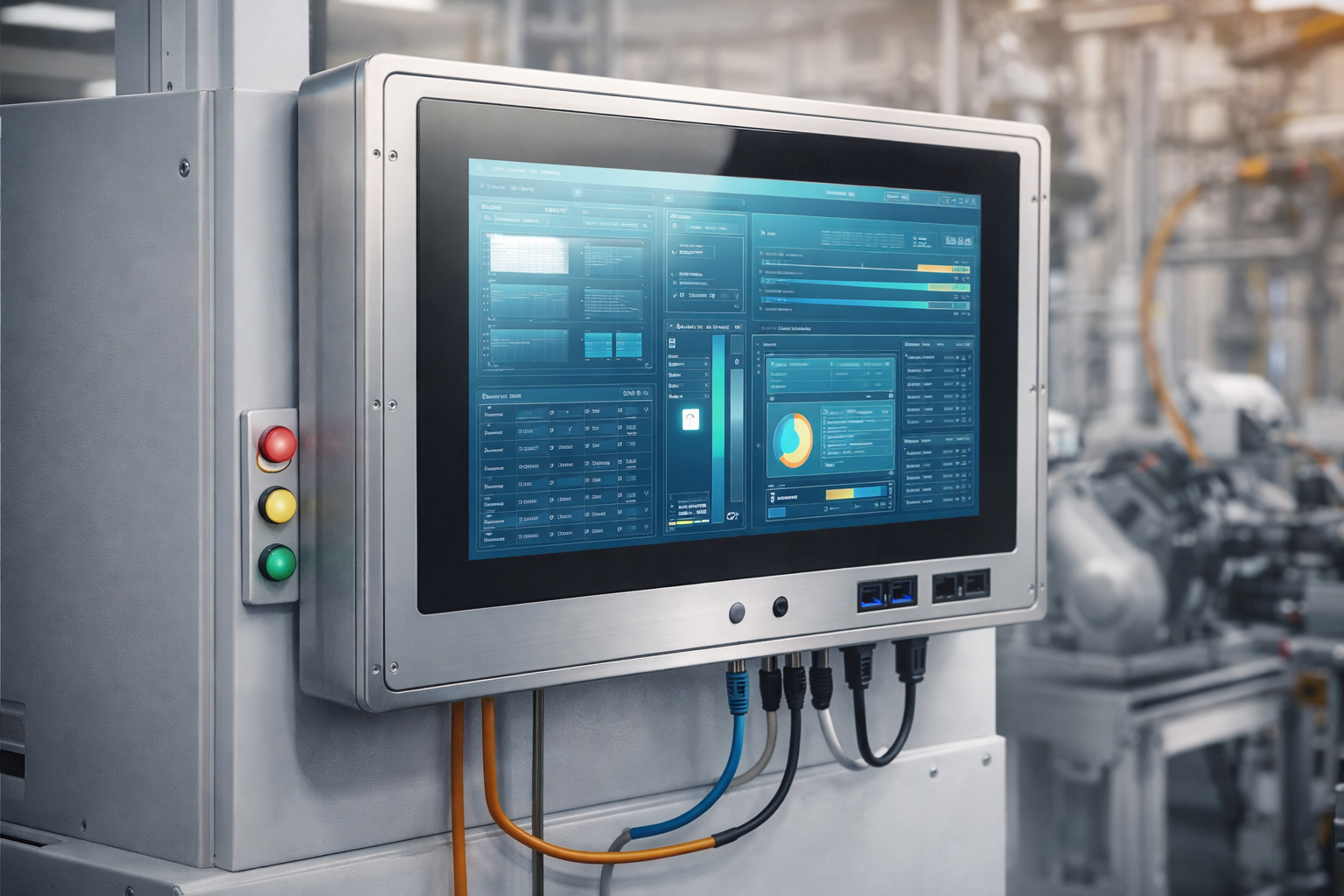
In OEM equipment development, selecting an 産業用パネルPC supplier is not simply a purchasing task. It is a decision that directly affects production consistency, system reliability, and long-term maintenance.
Panel PCs are not standalone components. They function as integrated human-machine interfaces within equipment systems. Any variation in hardware design, component sourcing, or lifecycle control can lead to system-level instability.
For a broader understanding of how panel PCs function within industrial systems, refer to this industrial HMI system architecture guide.
Selecting a panel PC supplier should be approached as a risk control process rather than a specification comparison.
In OEM deployments, the main risks are not always visible during evaluation:
A reliable industrial panel PC supplier reduces these risks through controlled processes, traceability, and engineering validation.
Understanding supplier categories helps define expectations for engineering support and lifecycle stability.
These roles are often grouped together, but their engineering responsibility and control levels differ significantly.
A manufacturer typically owns design, validation, and production.
A supplier may provide access to products without full engineering control.
An integrator focuses on combining subsystems rather than controlling hardware design.
| 基準 | Supplier | メーカー | Integrator |
|---|---|---|---|
| Primary role | Provides product supply and commercial support | Designs, validates, and produces hardware | Combines subsystems into application-level solutions |
| Hardware design control | Limited or variable | Direct control | Usually limited |
| Production control | Partial or indirect | Full control | Dependent on partners |
| カスタマイズ機能 | 中程度 | 高い | Moderate (system-level) |
| ライフサイクル管理 | Varies | Structured and controlled | Dependent on supply chain |
| BOM control | Often limited | Direct control | 間接的 |
| エンジニアリング・サポート | Basic to moderate | Strong hardware-level support | Strong system-level support |
| Best fit | Standard sourcing | OEM customization and long lifecycle | Multi-system integration projects |
| Main risk | Limited upstream visibility | Longer development cycles | Hardware inconsistency |
For OEM projects requiring strict lifecycle control and customization, working directly with an industrial panel PC manufacturer generally reduces long-term risk.
Industrial systems require consistent behavior across all deployed units.
Variations in display brightness, touch response, or thermal performance can affect usability and system operation.
Panel PCs must align with system-level architecture, including:
These requirements are typical in panel PC based HMI systems, where interface stability is critical.
Industrial deployments often require 5–10 years of consistent operation.
Suppliers must provide:
Without lifecycle control, deployed systems may diverge over time.
Manufacturing consistency directly impacts reliability.
Uncontrolled component substitution is a common source of field issues.
Suppliers with custom OEM touch solutions capability are typically better suited for integration-heavy projects.
Panel PCs depend on stable interaction between display and touch subsystems.
重要な考慮事項
These are typically addressed through integrated industrial touch screen solutions.
Evaluation samples may not represent production units due to process variation or component changes.
Suppliers relying on external partners may lack control over:
Testing under laboratory conditions may not reflect real environments such as:
Lower-cost suppliers may reduce initial investment but increase long-term variability.
Typical trade-off:
In industrial deployments, field failures and maintenance costs often exceed initial savings.
Industrial panel PC suppliers support applications such as:
In these cases, working directly with a manufacturer is often more appropriate.
A reliable industrial panel PC supplier for OEM projects should be evaluated based on production consistency, lifecycle control, and system integration capability rather than product specifications alone.
Selecting an industrial panel PC supplier is a critical step in managing both engineering and operational risk.
A structured evaluation approach—focused on consistency, lifecycle management, and integration capability—helps ensure stable performance throughout the system lifecycle.
Q1: What is the main difference between a supplier and a manufacturer?
A manufacturer controls design and production, while a supplier may only provide access to products.
Q2: Why is BOM control important?
It prevents unexpected component changes that can affect system compatibility and performance.
Q3: What is a common sourcing risk in OEM projects?
Inconsistency between prototype units and mass production systems.
Q4: How should panel PC suppliers be evaluated?
Through manufacturing control, lifecycle management, and integration capability.
Q5: Can suppliers support customization?
Some can, but capability depends on their engineering and production resources.
Have specific system, environmental, or lifecycle requirements?
Early-stage evaluation can help identify supplier-related risks and improve deployment stability.
はじめに 産業用パネルPCは、現代のHMI(ヒューマン・マシン・インターフェース)システムの中核をなすコンポーネントであり、ビジュアライゼーションを可能にする、, ...

はじめに 産業用システムの設計において、パネルPCのI/Oポートは、その設計を決定する主要な要素です。 ...
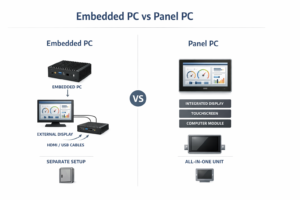
はじめに 産業用システムの設計において、組込みPCとパネルPCのどちらを選択するかは、主に次のようなものである。 ...
はじめに OEM機器開発において、産業用パネルPCサプライヤーを選択することは、単に購入するだけではありません。 ...
アプリケーションの詳細をお送りください。構成の方向性と次のステップを返信します。.