블로그

Resistive Touchscreen: Working Principle, Advantages, and Industrial ApplicationsResistive touchscreen the ultimate guide

게시됨: 1월 14, 2026
산업용 선택 가이드 통합 참고 사항
resistive touch screen

Introduction

Resistive touchscreens remain one of the most reliable and widely used touch technologies in industrial and professional applications.
Unlike consumer-oriented capacitive touchscreens, resistive touchscreens are pressure-activated and work with fingers, gloves, stylus pens, or any solid object.

Because of their stability, predictability, and environmental resistance, resistive touchscreens continue to be a preferred solution for industrial control systems, medical equipment, and OEM projects requiring long-term availability.

This guide explains:

  • What a resistive touchscreen is
  • How it works
  • Key advantages and limitations
  • Typical industrial use cases
  • How to determine if it is right for your project

What Is a Resistive Touchscreen?

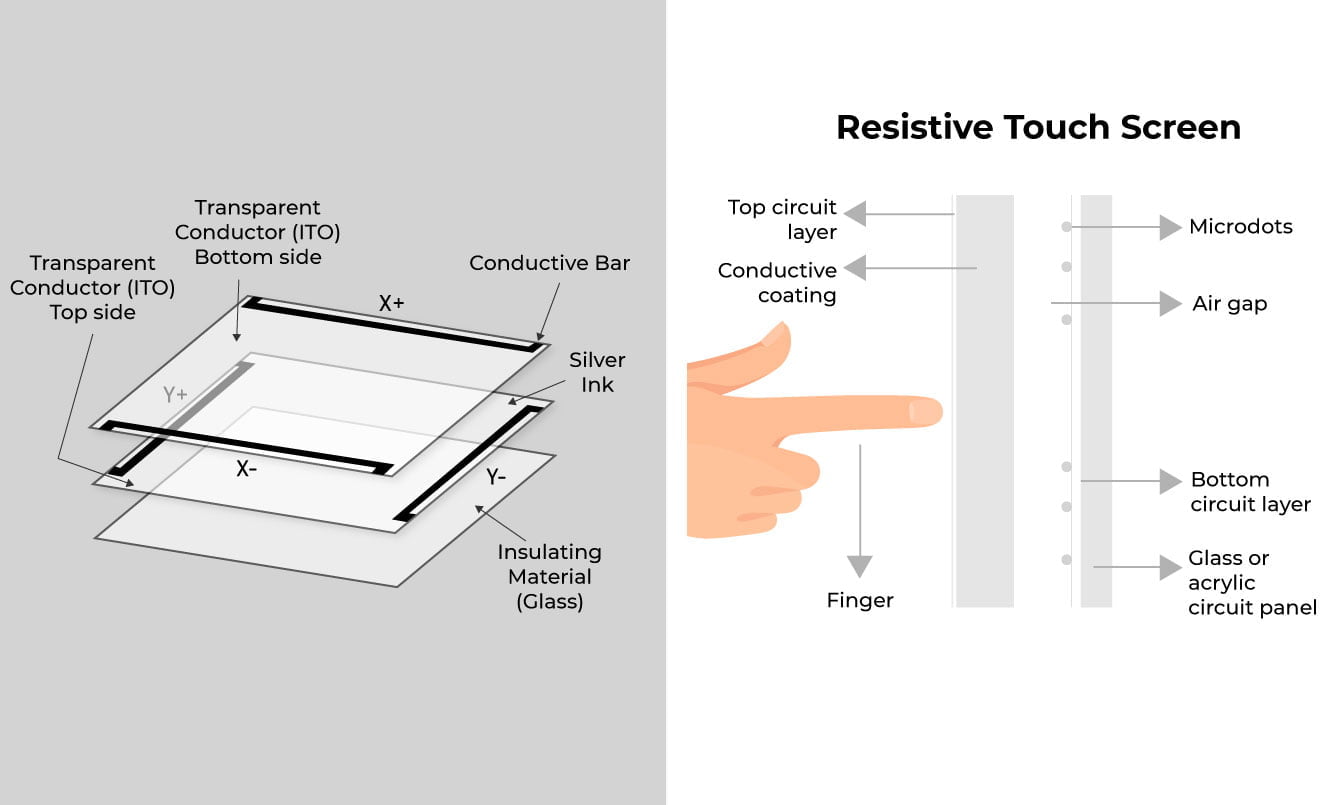
A resistive touchscreen is a pressure-sensitive input device consisting of two transparent conductive layers separated by a thin gap. When pressure is applied, the layers make contact and the controller detects the touch location.

Key characteristics include:

  • Pressure-based input (not dependent on skin conductivity)
  • Operates with gloves, stylus, or tools
  • Stable performance in harsh environments

This makes resistive technology especially suitable for industrial, medical, and outdoor applications.


How Does a Resistive Touchscreen Work?

https://riverdi.com/wp-content/uploads/2019/04/Resistive-Touch-Panel-Construction-and-Working-Principles-image-2.jpg

When pressure is applied to the screen:

  1. The flexible top layer bends
  2. It contacts the bottom conductive layer
  3. Voltage changes are detected by the controller
  4. The exact touch coordinates are calculated

Because the system relies on physical pressure rather than electrical conductivity, resistive touchscreens function reliably in dusty, wet, or electrically noisy environments.


Types of Resistive Touchscreens

4-Wire Resistive Touchscreen

  • Cost-effective solution
  • Suitable for basic industrial interfaces
  • Shorter lifespan compared to 5-wire designs

5-Wire Resistive Touchscreen (Industrial Standard)

  • Higher durability and accuracy
  • Touch input remains stable even as the surface wears
  • Preferred choice for long-term industrial and OEM projects

For applications requiring extended operational life and stable performance, 5-wire resistive technology is generally recommended.


Resistive vs Capacitive Touchscreen

기능Resistive TouchscreenCapacitive Touchscreen
Input MethodPressure-basedConductivity-based
Glove Operation✅ Yes❌ Limited
Stylus Support✅ Yes❌ Limited
Water Resistance✅ High⚠️ Moderate
Multi-touch❌ No✅ Yes
Industrial Stability✅ Excellent⚠️ Medium
Cost Control✅ Easier❌ Higher

Resistive touchscreens are application-driven, while capacitive touchscreens are more common in consumer devices.


Advantages of Resistive Touchscreens

Resistive touchscreens offer several benefits for industrial and professional use:

  • Reliable operation with gloves or tools
  • Excellent resistance to dust and moisture
  • Stable input accuracy over long periods
  • Cost-effective for project-based manufacturing
  • Simple integration with embedded systems

These advantages make resistive technology ideal for mission-critical interfaces.


Limitations to Consider

While resistive touchscreens are highly reliable, they do have limitations:

  • No true multi-touch functionality
  • Slightly lower optical clarity compared to capacitive screens
  • Requires physical pressure for input

For applications where multi-touch gestures or high visual clarity are essential, capacitive technology may be more suitable.


Typical Industrial Applications

Resistive touchscreens are commonly used in:

  • Industrial control panels
  • Medical diagnostic equipment
  • POS terminals
  • Outdoor kiosks
  • Factory automation systems
  • Transportation and logistics devices

These environments prioritize reliability, predictability, and durability over consumer-style interaction.


Why OEM Projects Still Choose Resistive Touchscreens

OEM and industrial projects often require:

  • Stable specifications over many years
  • Controlled supply continuity
  • Predictable user interaction
  • Resistance to environmental interference

Resistive touchscreens meet these requirements by offering long-term availability and consistent performance, which is critical for industrial programs.


Custom Resistive Touch Solutions by Eagle Touch

Eagle Touch provides custom resistive touchscreen solutions designed for industrial and OEM applications, including:

  • Custom panel sizes
  • 4-wire or 5-wire structures
  • Cover glass thickness selection
  • Interface options (USB, RS232, I2C)
  • Touch monitors and integrated systems

Our engineering-led approach ensures that each solution aligns precisely with your application requirements.


Is a Resistive Touchscreen Right for Your Project?

A resistive touchscreen is often the best choice if your project requires:

  • Operation with gloves or stylus
  • Reliable performance in harsh environments
  • Long-term product availability
  • Controlled industrial specifications

If you are evaluating touch technology for an industrial or OEM application, a resistive touchscreen may provide the most dependable solution.

관련 게시물

연락처

엔지니어링 검토를 받을 준비가 되셨나요?

애플리케이션 및 주요 요구 사항 공유 터치 모니터 또는 패널 PC. 엔지니어가 타당성과 위험성을 검토하고 올바른 구성 방향을 추천해 드립니다.

OEM/ODM 및 통합 프로젝트에 가장 적합합니다. 일반적으로 영업일 기준 1일(GMT+8) 이내에 응답합니다.
RFQ에는 크기/밝기, 인터페이스 목록, 장착, 작동 온도, 목표 배송 날짜(긴급한 경우)를 포함해 주세요.