博客

了解丝网粘合技术:光学胶合与空气胶合(完整指南)

Published: 15 1 月, 2026
Industrial Use Selection Guide 整合说明
Screen Bonding Technologies

In modern touch display manufacturing, screen bonding technology plays a critical role in determining display clarity, durability, touch performance, and environmental resistance.
Two bonding methods are widely used today: Air Bonding (Frame Lamination)Optical Bonding (Full Lamination).

This article provides a clear, engineering-focused comparison to help you understand how these technologies work, their differences, and which solution is best suited for industrial and commercial applications.


What Is Screen Bonding in Display Technology?

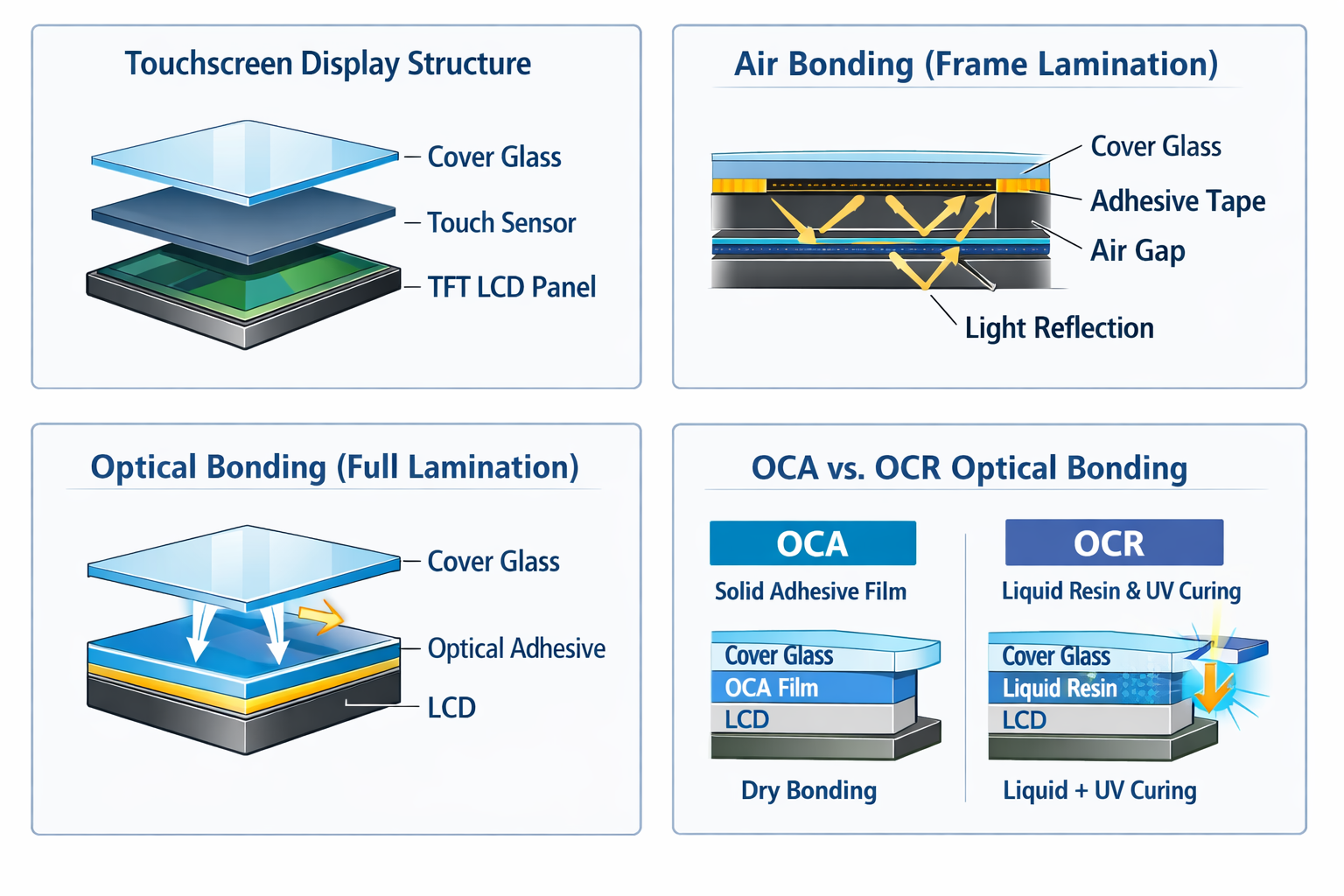
A typical touch display module consists of three main layers:

  • Cover Glass – the top protective layer
  • Touch Sensor – detects user input
  • Display Panel (TFT LCD) – produces visual output

These layers must be laminated together to form a complete display.
Depending on how the layers are bonded, screen bonding can be divided into:

  • Air Bonding (Frame Lamination)
  • Optical Bonding (Full Lamination)

The bonding method directly affects optical performance, durability, touch sensitivity, and reliability, especially in industrial or outdoor environments.


What Is Air Bonding (Frame Lamination)?

Air bonding, also known as frame lamination, is a traditional bonding method where the touchscreen and LCD are bonded only around the edges using adhesive tape.
An air gap remains between the touch panel and the display.

Key Characteristics of Air Bonding

  • Lower manufacturing cost
  • Simpler assembly process
  • Easier disassembly and repair

Limitations of Air Bonding

  • Internal light reflection caused by the air gap
  • Reduced contrast and readability under sunlight
  • Lower touch accuracy due to parallax
  • Increased risk of dust and moisture ingress

Air bonding is commonly used in entry-level or indoor devices where cost is the primary concern and environmental exposure is limited.


What Is Optical Bonding (Full Lamination)?

Optical bonding, also called full lamination or direct bonding, involves bonding the cover glass or touch panel directly to the display using an optically clear adhesive.
This process eliminates the air gap entirely.

By removing the air interface, optical bonding significantly improves both optical and mechanical performance, making it the preferred solution for industrial, outdoor, and mission-critical displays.

Advantages of Optical Bonding

  • Higher brightness and contrast
  • Reduced glare and internal reflections
  • Stronger structural integrity
  • Improved resistance to dust and moisture
  • Enhanced touch sensitivity

Optical bonding is widely applied in industrial equipment, medical devices, automotive displays, kiosks, and outdoor terminals.


Optical Bonding vs. Air Bonding: Key Differences

FeatureOptical Bonding (Full Lamination)Air Bonding (Frame Lamination)
Air GapNonePresent
Display ClarityHigh contrast, low reflectionReduced due to reflections
Touch SensitivityHighModerate
DurabilityStrong structural bondingWeaker over time
Dust & Moisture ResistanceExcellentLimited
户外可读性ExcellentPoor
Repair ComplexityHigherEasier

For industrial and outdoor applications, optical bonding is strongly recommended.


Types of Optical Bonding Adhesives

Optical bonding can be classified based on the adhesive used in the bonding process.

OCA (Optically Clear Adhesive)

OCA is a solid, pre-cured adhesive film used in dry optical bonding.

Key features:

  • Uniform thickness
  • No curing process required
  • Bubble-free results
  • Ideal for small to medium-sized displays

OCA is commonly used in smartphones, tablets, and compact touch displays where precision is critical.

OCR (Optically Clear Resin)

OCR is a liquid adhesive applied between layers and then cured using UV or heat.

Key features:

  • Excellent gap-filling capability
  • Suitable for large or irregular displays
  • Strong, durable bonding after curing

OCR is widely used in large-format displays, industrial monitors, and rugged equipment.


Key Benefits of Optical Bonding

Optical bonding delivers several performance and reliability advantages:

  • Improved Display Clarity
    Eliminates internal reflections, resulting in brighter images and better contrast.
  • Enhanced Durability
    Strengthens the display structure and improves impact resistance.
  • Better Touch Performance
    Reduces parallax and improves touch accuracy.
  • Reduced Glare and Reflection
    Enhances readability in bright or outdoor environments.
  • Reliable Performance in Harsh Conditions
    Suitable for extreme temperatures, vibration, and long-term industrial use.
  • Premium Visual Appearance
    Creates a seamless, high-end display look.

Which Screen Bonding Technology Should You Choose?

Choose Optical Bonding if:

  • The display is used outdoors or in bright environments
  • Reliability and durability are critical
  • Touch accuracy matters
  • Long-term industrial supply is required

Choose Air Bonding if:

  • Cost is the primary factor
  • The device is used indoors
  • Easy repair and replacement are priorities

Final Thoughts

Screen bonding technology directly affects the performance, reliability, and lifespan of a display.
While air bonding remains a cost-effective solution for basic applications, optical bonding has become the industry standard for industrial, outdoor, and high-performance displays.

If you are designing or selecting a display for demanding environments, optical bonding is no longer an upgrade—it is a necessity.


Need help choosing the right bonding technology for your project?
Our engineering team can help evaluate your application requirements and recommend the most suitable solution.

Related Posts

联系

准备好进行工程审查了吗?

分享您的申请和关键要求 触摸显示器面板式 PC. 我们的工程师将审查可行性和风险,并推荐正确的配置方向。.

最适合 OEM/ODM 和集成项目。通常在 1 个工作日内(GMT+8)做出响应。.
请在询价单中注明尺寸/亮度、接口清单、安装方式、工作温度和目标交货日期(如有急事)。.