What Is an Industrial Panel PC? Components, Types and Applications
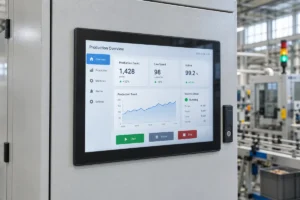
An industrial panel PC is a computer with a built-in display, usually a touchscreen, designed for …
Eagle Touch Engineering Team
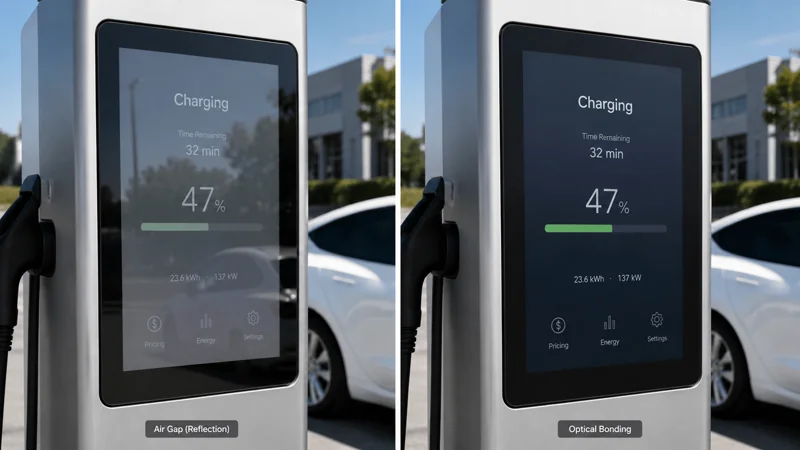
When an industrial display supplier asks whether you need air bonding or optical bonding, the right answer is not automatically “optical.”
Air bonding is usually the practical choice for controlled indoor equipment where cost and repairability matter. Optical bonding becomes valuable when internal reflection, condensation at the display interface, thick protective glass or expensive field replacement creates a greater risk than the bonding cost.
The decision should be based on the finished equipment—not on which method sounds more advanced.
| Project condition | Better starting point | Why |
|---|---|---|
| Indoor HMI under controlled lighting | Air bonding | Lower cost and easier replacement |
| Prototype or low-volume project | Air bonding | Reduces initial tooling and rework risk |
| Equipment designed for component-level repair | Air bonding | The LCD and touch assembly are easier to separate |
| Strong ambient light or direct sunlight | Optical bonding | Reduces reflection at the internal air interface |
| Repeated temperature and humidity cycling | Optical bonding | Removes the air space where internal fogging can develop |
| Thick protective cover glass | Review optical bonding | The air gap can make reflection and visual depth more noticeable |
| Remote or difficult-to-service equipment | Review optical bonding | Field replacement may cost more than the bonding upgrade |
These are starting points. LCD construction, glass thickness, operating environment and service strategy still need to be reviewed together.
Air bonding—also called frame bonding—uses adhesive around the perimeter of the display to attach the touch-panel assembly or front lens to the LCD. The active viewing area remains separated from the LCD by an air gap.
That structure is widely used in industrial monitors. It is economical, mechanically straightforward and usually easier to repair. If the LCD fails, the front touch assembly can often be removed without discarding the complete stack.
The trade-off is optical. Every air-to-glass boundary can reflect part of the light passing through it. Under ordinary factory lighting, the effect may be acceptable. Under strong ambient light, the extra internal reflection can lift the apparent black level and reduce visible contrast.
The air space can also become a location for internal fogging if moisture is present and the assembly is exposed to temperature changes. Air bonding does not cause moisture to enter the enclosure, but it leaves a gap in which condensation can become visible.
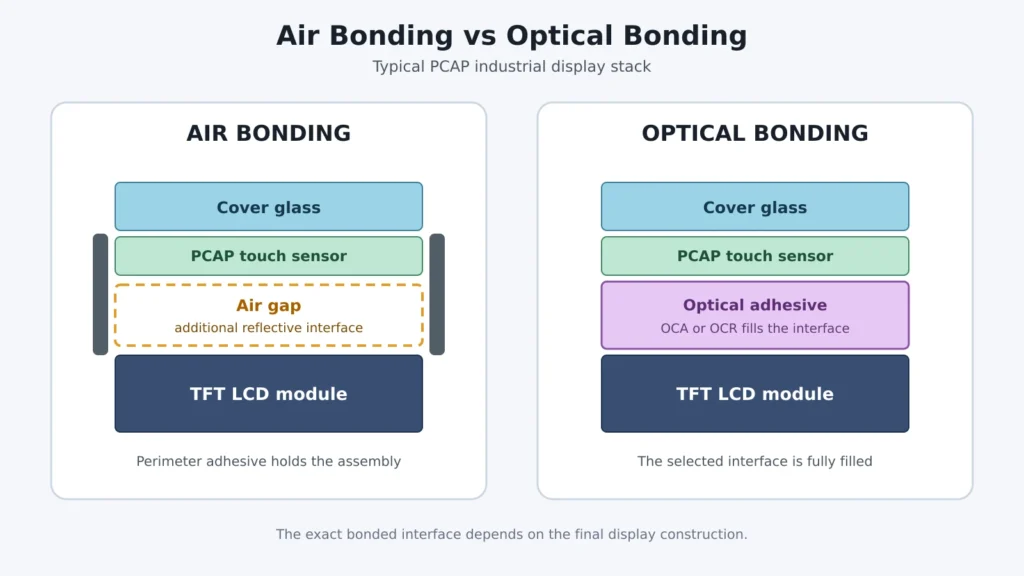
In a typical PCAP industrial display, the cover glass and touch sensor already form a touch-panel assembly. Optical bonding fills the interface between that completed touch assembly and the front surface of the TFT LCD with transparent optical adhesive, removing the air gap at that interface.
Some equipment includes another protective window in front of the display. If that window remains separated by air, optical bonding inside the display does not remove the second reflective interface. Always confirm exactly which two assemblies are being bonded.
Removing the internal air gap can:
Optical bonding does not increase the native brightness of the LCD. It helps preserve more of the display’s usable contrast by reducing reflection inside the stack.
| Decision factor | Air bonding | Optical bonding |
| Structure | Adhesive around the perimeter; air gap remains | Optical adhesive fills the selected display interface |
| Internal reflection | Higher | Lower |
| Bright-light readability | Acceptable in controlled lighting | Usually better in strong ambient light |
| Internal fogging risk | Higher if moisture and temperature cycling are present | Lower at the bonded interface |
| Initial cost | Lower | Higher |
| Component-level repair | Usually easier | More difficult and sometimes uneconomical |
| Process risk | Dust, alignment and gap control | Bubbles, contamination, overflow, curing defects, mura and pressure marks |
| Typical use | Indoor HMI, warehouse terminal, prototype, serviceable equipment | Outdoor terminal, marine equipment, transportation display, rugged public interface |
Optical bonding is not automatically the more reliable choice. A poorly controlled bonded assembly can be worse than a properly built air-bonded one. Material selection, cleaning, dispensing or lamination, curing and inspection all affect the result.
Air bonding makes sense when the display operates indoors, ambient light is controlled and the equipment is easy to service. It is also useful during early prototype stages, when the LCD, touch panel or mechanical structure may still change.
For a factory HMI mounted inside a temperature-controlled cabinet, optical bonding may add cost without solving an important problem. If the machine builder expects to replace the LCD separately during maintenance, air bonding also preserves that option.
Choosing air bonding in these conditions is not cutting quality. It is keeping the display structure appropriate to the job.
Optical bonding becomes easier to justify when poor readability or display replacement would be expensive.
Direct-sun kiosks, EV chargers, marine controls and transport terminals are typical examples. In these applications, internal reflection competes with the LCD image. More backlight helps, but brightness alone does not remove the reflective air interface.
Humidity and temperature cycling are another reason to evaluate bonding. Removing the air gap reduces the specific risk of visible condensation between the touch assembly and LCD. It does not waterproof the enclosure or control humidity elsewhere in the equipment.
Thick protective glass can also make the difference between the two structures more obvious. The image may appear deeper behind an air gap, especially at an angle. Bonding can improve optical integration, but it does not by itself establish an IK rating. IK10 performance depends on the tested complete front assembly, including the glass, edge support, enclosure and mounting structure.
For a detailed outdoor decision guide, see when outdoor industrial displays need optical bonding.
OCA and OCR can both remove the air gap, but they behave differently in production.
OCA (optically clear adhesive) is a solid adhesive film with controlled thickness. It can be an efficient option when the mating surfaces are flat and the required bonding gap matches an available film construction.
OCR (optically clear resin) is applied as a liquid and cured after it fills the bonding interface. The liquid process can accommodate structures or gap conditions that are difficult for a fixed-thickness film. LOCA usually refers to a liquid optically clear adhesive cured by light, commonly UV; the terms LOCA and OCR are often used together in commercial discussions, although they describe the material from slightly different perspectives.
Neither method is universally better. The choice depends on:
OCA demands accurate alignment, clean surfaces and proper lamination. OCR demands control of dispensing, bubbles, overflow, adhesive thickness and curing. Cost also depends on size, material usage, yield and rework—not only on whether the adhesive is film or liquid.
Optical bonding has one primary job: removing an internal air interface. It should not be used as a general claim that a display is outdoor-ready or rugged.
It does not:
Outdoor readability must be reviewed as a complete system. LCD luminance, optical bonding, front-surface treatment and installation angle all matter. Our sunlight-readable monitor selection guide explains how those factors work together. For front-surface reflection, fingerprints and glare, see the differences between AG, AR and AF glass treatments.
Do not approve a bonding method from a specification sheet alone. Inspect and test the completed display stack.
| Check | What to confirm |
| Bonded interface | Identify exactly which layers are bonded and whether another air gap remains |
| Visual inspection | No bubbles, contamination, adhesive overflow or edge defects in the viewing area |
| Display uniformity | No new mura, pressure marks or local brightness changes |
| Finished luminance | Measure through the final touch panel, cover glass and surface treatment |
| Readability | Test representative UI content under the expected ambient light and viewing angle |
| Touch operation | Validate with the final glass, grounding, gloves, water and required operating system |
| Environment | Test the temperature and humidity conditions required by the project |
| Service plan | Decide whether a failed bonded stack will be reworked or replaced as one assembly |
This final inspection matters because a bonding process can look good on a desk and still fail the actual application.
Use air bonding when the environment is controlled, cost matters and component-level repair has value. Use optical bonding when internal reflection, interface fogging or field replacement creates a greater business risk.
Then select OCA or OCR according to the actual LCD and touch-stack construction—not according to a preferred marketing term.
If you are developing an industrial monitor or panel PC, send the LCD size, brightness, cover-glass drawing, application environment, mounting method and expected quantity. Eagle Touch can review whether air bonding is sufficient or whether optical bonding should be included before the mechanical design is released. You can also review our outdoor touch monitor platforms or contact our team with your project requirements.
An industrial panel PC is a computer with a built-in display, usually a touchscreen, designed for …
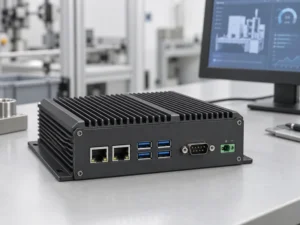
An embedded PC is a computer configured to work as part of a machine or larger …
Start with the software the panel PC must run and the conditions it must fit. Then …
Choosing an industrial panel PC IP rating starts with two questions: what dust and water exposure …
Share your application, requirements, or current challenge. Our team will review the details and recommend a practical way forward.