Introducción
La eficiencia energética se ha convertido en un parámetro de diseño cada vez más importante en los equipos industriales. Muchos sistemas funcionan de forma continua durante largos periodos de tiempo con un acceso limitado para su mantenimiento, lo que hace que el consumo energético, la estabilidad térmica y la vida útil de los componentes sean consideraciones importantes durante el diseño del sistema.
Las pantallas industriales pueden representar una parte apreciable del consumo energético total del sistema. Los paneles LCD de alto brillo utilizados en equipos de exterior, HMI industriales y terminales de infraestructura se basan en sistemas de retroiluminación LED que pueden consumir una parte significativa de la energía de la pantalla.
En las carcasas selladas o sin ventilador, la mayor parte de la energía eléctrica consumida por la retroiluminación de la pantalla se convierte directamente en calor. Como resultado, el brillo de la pantalla no solo afecta al consumo de energía, sino también a la temperatura de la carcasa y a la fiabilidad a largo plazo.
Para hacer frente a estos retos, muchas pantallas industriales incorporan atenuación automática y modos de ahorro de energía. Estas características reducen el consumo medio de energía de la pantalla al tiempo que mantienen la legibilidad en distintas condiciones de iluminación ambiental.
Sin embargo, el comportamiento del brillo en los sistemas industriales debe evaluarse en el nivel de arquitectura del sistema. El control automático del brillo puede influir en la visibilidad del operador, el tiempo de respuesta del sistema y los supuestos de validación de la HMI.
Entender cómo funcionan estos mecanismos ayuda a los diseñadores de OEM a integrar las pantallas industriales de forma más fiable en sus equipos.
¿Qué es la atenuación automática en los monitores industriales?
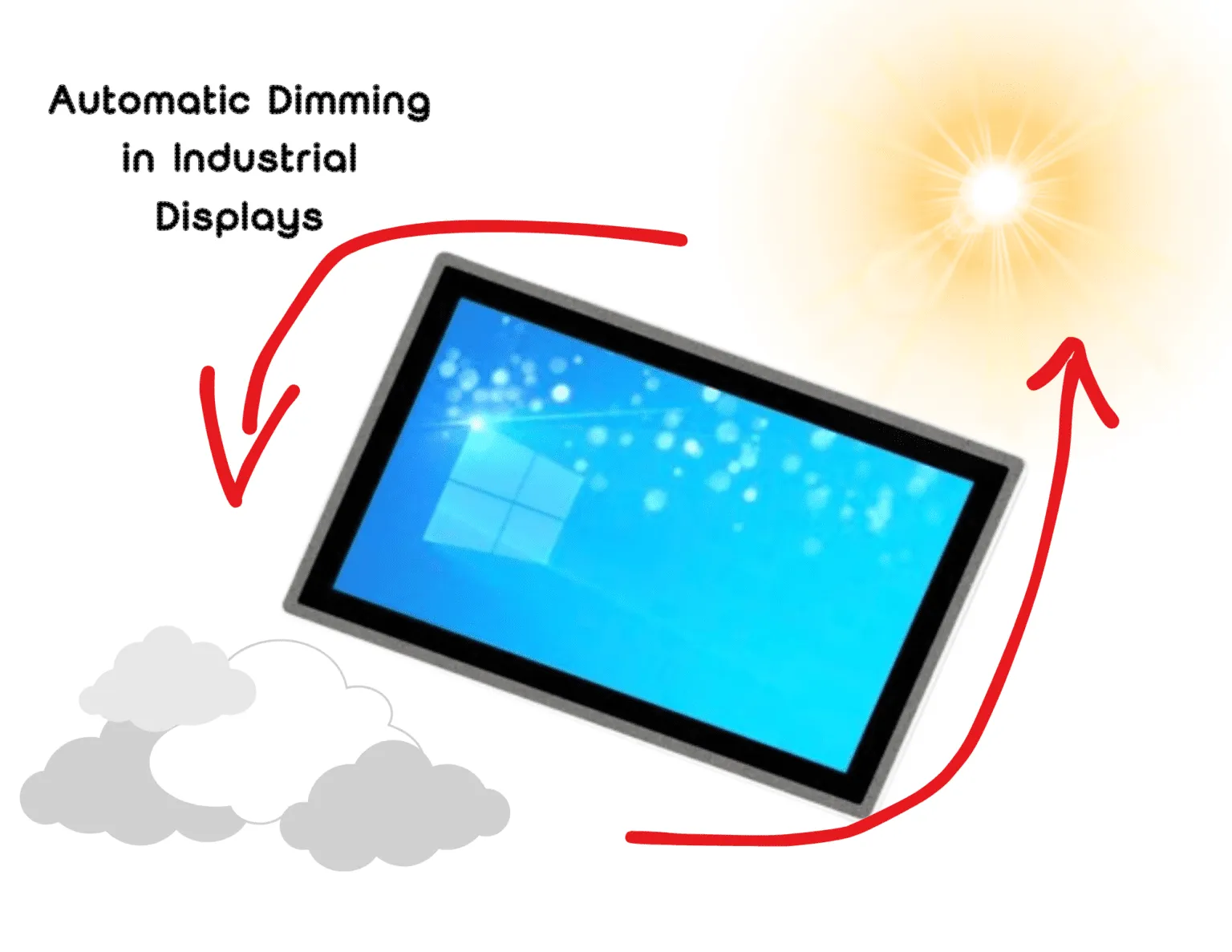
Atenuación automática en expositores industriales es un mecanismo de control del brillo que ajusta la intensidad de la retroiluminación LED en función de las condiciones de iluminación ambiental o del estado de funcionamiento del sistema.
Al reducir el brillo en entornos más oscuros o durante periodos de inactividad, la atenuación automática puede:
- reducir el consumo de energía de la pantalla
- temperaturas internas más bajas
- prolongue la vida útil de la retroiluminación LED
- mantener una visibilidad adecuada para los operadores
Este comportamiento adaptativo del brillo es especialmente útil en sistemas industriales expuestos a condiciones de iluminación cambiantes, como instalaciones exteriores o equipos de infraestructuras públicas.
Atenuación automática y modos de ahorro de energía de la pantalla
La atenuación automática ajusta el brillo dinámicamente en respuesta a las condiciones de iluminación del entorno.
La mayoría de las implementaciones se basan en un sensor de luz ambiental que mide la iluminación del entorno. A continuación, el controlador de la pantalla ajusta la intensidad de la retroiluminación LED para mantener un contraste suficiente sin aplicar un brillo innecesario.
Por ejemplo:
- Los equipos de exterior pueden funcionar a 1000-1500 nits durante el día.
- La misma pantalla puede reducir el brillo a 300-400 nits durante el funcionamiento nocturno.
Este comportamiento adaptativo del brillo reduce tanto consumo de energía y carga térmica.
Los modos de ahorro de energía amplían el control del brillo introduciendo funciones adicionales de gestión de la energía.
Los mecanismos típicos incluyen:
- Reducción de la retroiluminación durante la inactividad
- Estados de pantalla apagada o apagada
- Modos de espera o reposo
- Ciclos de apagado programados
En los sistemas que utilizan ordenadores integrados o PC de panel, la gestión de la energía de la pantalla suele estar coordinada por el sistema operativo anfitrión y no sólo el hardware de la pantalla.
Tecnologías de regulación de las pantallas industriales
Arquitectura de control de la retroiluminación LED
Las pantallas LCD industriales se basan en conjuntos de retroiluminación LED accionados por controladores de corriente constante. El ajuste del brillo suele realizarse mediante dos técnicas principales.
Modulación por ancho de pulsos (PWM)
PWM controla el brillo encendiendo y apagando los LED a alta frecuencia mientras mantiene una corriente constante durante el ciclo activo. Esto permite un amplio rango de luminosidad manteniendo estables las características de color de los LED.
Control analógico de corriente
La atenuación analógica ajusta la corriente suministrada a la retroiluminación LED. Esto permite transiciones de brillo suaves, pero puede reducir la eficiencia a niveles de brillo muy bajos.
Muchas pantallas industriales combinan ambos enfoques en un arquitectura de regulación híbrida para proporcionar un control estable del brillo en un amplio rango de funcionamiento.
La selección de la frecuencia PWM es importante. Si la frecuencia es demasiado baja, pueden producirse parpadeos visibles o interferencias electromagnéticas.
Sensores de luz ambiental
El control automático del brillo depende de la medición precisa de las condiciones de iluminación ambiental.
Los sensores de luz ambiental miden la iluminación del entorno en lux y proporcionan información al controlador de la pantalla o al software del sistema.
La ubicación del sensor afecta significativamente al rendimiento. Si el sensor detecta luz reflejada de la superficie de la pantalla o fuentes de iluminación localizadas, es posible que los ajustes de brillo no coincidan con las condiciones de visión del operador.
En los sistemas que utilizan pantallas táctiles industriales, Por lo general, los sensores se colocan cerca del bisel frontal o del cristal de la cubierta para aproximarse al entorno de visión del operador.
Algoritmos de respuesta al brillo
Las mediciones en bruto de los sensores deben procesarse mediante algoritmos de control de brillo antes de que se produzcan los ajustes.
Las implementaciones típicas incluyen:
- curvas de respuesta lux-luminosidad
- umbrales de luminosidad
- retrasos en la transición
- lógica de histéresis para evitar la oscilación
Sin estos mecanismos, las pequeñas variaciones de la luz ambiente podrían provocar rápidas fluctuaciones del brillo.
El ajuste adecuado del algoritmo garantiza que los cambios de brillo sean graduales y predecibles.
Integración del sistema anfitrión
En muchos diseños OEM, el comportamiento del brillo está coordinado por el sistema anfitrión en lugar de sólo por el firmware de la pantalla.
Por ejemplo, un controlador de máquina puede mantener el brillo al máximo durante el funcionamiento activo y reducir el brillo cuando el sistema entra en estado de reposo.
Este enfoque es habitual cuando monitores LCD industriales se conectan a ordenadores integrados o controladores de máquinas.
El control a nivel de host permite alinear el comportamiento del brillo de la pantalla con el estado de la máquina, los patrones de interacción del usuario y las políticas de gestión de la energía.
Gestión de fallos y comportamiento de emergencia
La regulación automática introduce la dependencia de las entradas de los sensores. Por ello, los diseños industriales incluyen mecanismos de emergencia definidos.
Los sensores de luz ambiental pueden verse afectados por:
- acumulación de polvo
- condensación
- obstrucción física
- degradación del sensor
Entre las estrategias de repliegue típicas se incluyen:
- niveles de brillo por defecto
- ajuste manual del brillo
- detección de fallos del sensor
- modos de funcionamiento seguros cuando los datos del sensor dejan de ser válidos
Estas salvaguardas ayudan a mantener un comportamiento predecible de la pantalla incluso cuando las entradas de los sensores dejan de ser fiables.
Consideraciones de ingeniería para sistemas industriales
Visibilidad del operador
Las HMI industriales deben seguir siendo legibles en todas las condiciones de funcionamiento.
Los cambios bruscos de brillo pueden interferir en el reconocimiento del operador o reducir la visibilidad del contraste.
En las interfaces relacionadas con la seguridad, los niveles de brillo suelen validarse durante las pruebas del sistema. Los ajustes automáticos del brillo pueden entrar en conflicto con esas condiciones validadas.
Por este motivo, las HMI críticas para la seguridad suelen utilizar niveles de brillo fijos.
Variabilidad medioambiental
Las condiciones de iluminación en las instalaciones industriales pueden cambiar rápidamente.
Algunos ejemplos son:
- maquinaria en movimiento que crea sombras
- encendido o apagado de la iluminación del almacén
- equipos de exterior con sombreado parcial
Si los algoritmos de brillo responden con demasiada agresividad, la pantalla puede cambiar de brillo repetidamente. Se necesita una histéresis y una lógica de retardo adecuadas para estabilizar el comportamiento del brillo.
Impacto térmico
El consumo de energía de la retroiluminación contribuye directamente a la generación de calor dentro de los recintos sellados.
Reducir el brillo disminuye la corriente de los LED y puede reducir la temperatura interna y el estrés térmico en los componentes de la pantalla.
Sin embargo, en muchos sistemas industriales, los procesadores o la electrónica de potencia generan más calor que la propia pantalla.
Por tanto, se recomienda un análisis térmico a nivel de sistema antes de confiar en la reducción del brillo como estrategia principal de mitigación térmica.
Consumo de energía de las pantallas industriales
En las pantallas industriales de alto brillo, la retroiluminación LED puede representar la mayor parte del consumo energético total de la pantalla.
Por ejemplo, un Pantalla LCD industrial de 1000-1500 nit puede requerir varias veces más potencia de retroiluminación que una pantalla que funcione a niveles de brillo moderados.
Por ello, a la hora de diseñar un sistema de control de la luminosidad se suelen tener en cuenta estrategias de control de la luminosidad. sistemas HMI industriales energéticamente eficientes y exposición exterior equipo.
Reducir el brillo durante el funcionamiento nocturno o los periodos de inactividad puede disminuir significativamente el consumo medio de energía del sistema.
Consideraciones sobre la integración de OEM
Los fabricantes de equipos originales suelen exigir un control de brillo configurable cuando especifican módulos de visualización industriales.
El control de la luminosidad puede tener que integrarse a través de interfaces de sistema como:
- Señales GPIO
- comandos de comunicación serie
- API de controlador de pantalla
- políticas de gestión de energía del sistema operativo
Las opciones flexibles de control del brillo permiten adaptar el subsistema de visualización al funcionamiento de la máquina, los patrones de interacción de los usuarios y las estrategias de gestión de la energía.
Aplicaciones típicas
Los modos de atenuación automática y ahorro de energía son más útiles en sistemas en los que las condiciones de iluminación varían o la interacción del operador es intermitente.
Las aplicaciones típicas son:
- terminales de información exteriores
- Estaciones de recarga de vehículos eléctricos
- quioscos de autoservicio
- equipamiento de infraestructuras de transporte
- sistemas de aparcamiento y expedición de billetes
- interfaces de supervisión de la automatización industrial
Estos sistemas se benefician de un comportamiento adaptativo del brillo y de un consumo medio de energía reducido.
Cuando la atenuación automática funciona bien
La atenuación automática funciona bien cuando:
- las condiciones de iluminación varían considerablemente
- la interacción con el operador es intermitente
- el brillo puede coordinarse con el estado del sistema
- reducir el consumo de energía mejora la eficiencia del sistema
Aplicaciones como quioscos, estaciones de recarga de vehículos eléctricos y terminales de infraestructura suelen cumplir estas condiciones.
Cuándo es preferible una luminosidad fija
Algunos sistemas industriales requieren un comportamiento predecible del brillo.
Algunos ejemplos son:
- IHM críticas para la seguridad
- equipos que requieren validación reglamentaria
- puestos de trabajo con iluminación interior estable
- sistemas que requieren una disponibilidad inmediata de la pantalla sin retardo de la vigilia
En estos entornos, los ajustes de brillo fijos pueden proporcionar un funcionamiento más fiable.
Conclusión
La atenuación automática y los modos de ahorro de energía pueden mejorar la eficiencia energética de los sistemas de visualización industriales, sobre todo en entornos con condiciones de iluminación variables o de funcionamiento continuo.
Sin embargo, el comportamiento del brillo debe evaluarse en el contexto de la arquitectura completa del sistema. El brillo de la pantalla influye en la facilidad de uso, las condiciones térmicas del recinto y la previsibilidad del sistema.
Para muchos fabricantes de equipos originales e integradores de sistemas, el planteamiento más fiable es integración controlada de sistemas. Se incluye soporte de hardware para el ajuste del brillo, mientras que el comportamiento del brillo se gestiona a través de la lógica de control a nivel de sistema.
Considerar la gestión de la energía de la pantalla en las primeras fases del proceso de diseño permite a los ingenieros equilibrar la eficiencia energética, la fiabilidad y el comportamiento predecible del sistema.
PREGUNTAS FRECUENTES
¿La atenuación automática reduce significativamente el consumo de energía de las pantallas industriales?
Sí. El consumo medio de energía puede disminuir cuando los niveles de brillo se reducen con frecuencia. La cantidad de reducción depende del rango de brillo de la pantalla y de los patrones de uso.
¿Puede la atenuación prolongar la vida útil de la retroiluminación LED?
El funcionamiento de los LED a niveles de corriente más bajos reduce el estrés térmico y puede prolongar su vida útil, en función de la frecuencia con que se utilicen los niveles de brillo más bajos.
¿Por qué algunos HMI industriales evitan el control automático del brillo?
Las interfaces relacionadas con la seguridad suelen requerir una luminosidad constante para garantizar que las alarmas y los indicadores permanezcan claramente visibles en todas las condiciones de funcionamiento.
¿Qué ocurre si falla el sensor de luz ambiental?
La mayoría de las pantallas industriales definen niveles de brillo de reserva y permiten el ajuste manual para que la pantalla siga siendo utilizable incluso si el sensor deja de ser fiable.
¿Cuánta energía consume la retroiluminación de una pantalla industrial?
La retroiluminación LED suele ser el mayor consumidor de energía en una pantalla LCD industrial. En las pantallas de alto brillo para exteriores, la retroiluminación puede representar la mayor parte del consumo de energía de la pantalla.
Reducir el brillo durante el funcionamiento nocturno o los periodos de inactividad puede, por tanto, reducir significativamente el consumo medio de energía.