O que é um PC de painel industrial? Componentes, tipos e aplicações
Um PC de painel industrial é um computador com um ecrã incorporado, normalmente tátil, concebido para ...
Equipa de Engenharia da Eagle Touch
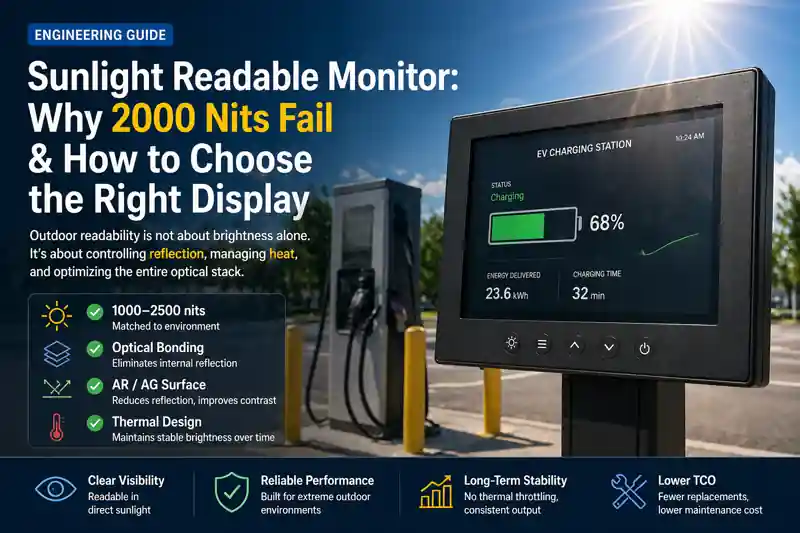
Um monitor legível à luz do sol não deve ser escolhido apenas com base no brilho.
Um ecrã LCD de 2000 nits pode continuar a ser difícil de ler ao ar livre se o vidro frontal refletir demasiada luz, se uma camada de ar reduzir o contraste ou se a retroiluminação não conseguir manter a potência máxima assim que a caixa aquecer.
No caso de uma máquina para uso no exterior, a pergunta mais pertinente é:
O monitor, uma vez concluído, continuará a ser legível, sensível ao toque e termicamente estável no ambiente em que irá efetivamente funcionar?
Isso significa ir além das especificações do ecrã LCD e analisar toda a estrutura do ecrã: brilho, colagem ótica, vidro de proteção, tratamento de superfície, desempenho tátil, vedação e conceção térmica.
Para conhecer as configurações disponíveis, consulte o nosso soluções de monitores legíveis à luz do sol.
O brilho é um ponto de partida útil, mas não deve ser o critério definitivo de seleção.
| Instalação | Intervalo prático de arranque | O que verificar a seguir |
|---|---|---|
| Interior normal | 250-350 nits | Ângulo de visão e iluminação ambiente |
| Espaço interior bem iluminado / fábrica | 350–500 nits | Brilho e ângulo de instalação |
| Semi-exterior / à sombra | 500-800 nits | Vidro AG e reflexão |
| Luz natural no exterior | 800-1500 nits | Colagem ótica e vidro de proteção |
| Luz solar direta | 1000–2000+ nits | Reflexão, calor e luminosidade prolongada |
| Ambiente com exposição solar direta intensa / elevada reflexão | 1500–2500+ nits | Validação óptica e térmica completa |
Estes intervalos não constituem regras fixas.
Um ecrã com 1000–1200 nits e com colagem adequada pode apresentar um desempenho superior ao de um ecrã mais brilhante sem colagem, quando os reflexos são melhor controlados.
Antes de aprovar uma especificação, faça uma pergunta importante:
O brilho indicado é medido no ecrã LCD ou através do painel tátil acabado e do vidro de proteção?
Essa diferença pode ser significativa.
Os nits medem a luminância. Não medem a quantidade de luz solar que é refletida de volta para o operador.
É por isso que dois monitores com o mesmo brilho nominal podem parecer muito diferentes ao ar livre.
A legibilidade final depende de vários fatores:
Aumentar a potência da retroiluminação só ajuda até certo ponto.
Se a superfície frontal refletir uma grande quantidade de luz ambiente, o simples aumento do brilho do ecrã LCD torna-se uma forma ineficaz de resolver o problema.
Um ecrã brilhante atrás de um vidro altamente refletor pode, mesmo assim, comportar-se como um espelho.
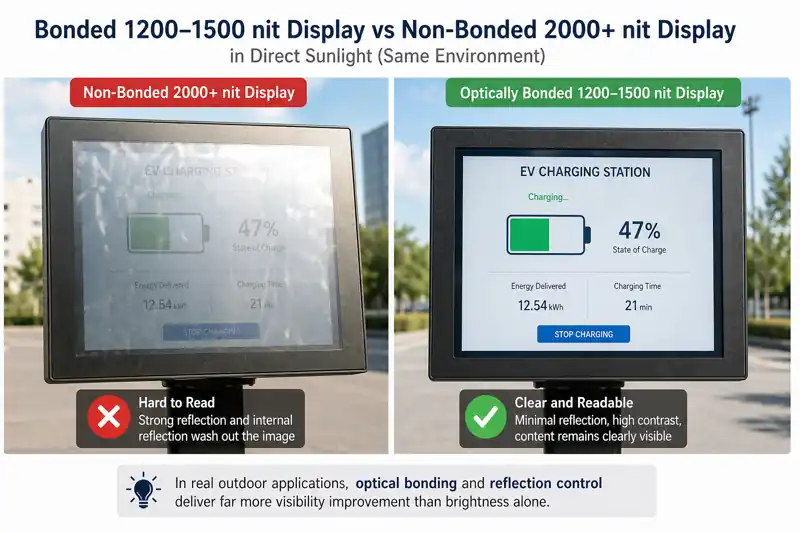
Este é um dos erros mais comuns na seleção de fornecedores.
Um fornecedor pode apresentar uma proposta:
1200 nits
mas esse valor pode provir do próprio painel LCD.
Depois de montado o ecrã, a luz ainda tem de passar por ele:
LCD → material de colagem → sensor tátil → vidro de proteção → tratamento de superfície
Cada camada influencia o resultado ótico final.
No caso de um projeto OEM para utilização no exterior, pergunte se a especificação de brilho se refere a:
Este último é o mais útil quando se comparam monitores já montados.
Isto torna-se ainda mais importante quando o seu equipamento tem uma janela de proteção adicional ou um vidro frontal.
Se for adicionada uma camada de ar ou de vidro adicional após a aprovação da amostra, a legibilidade ao ar livre pode alterar-se substancialmente.
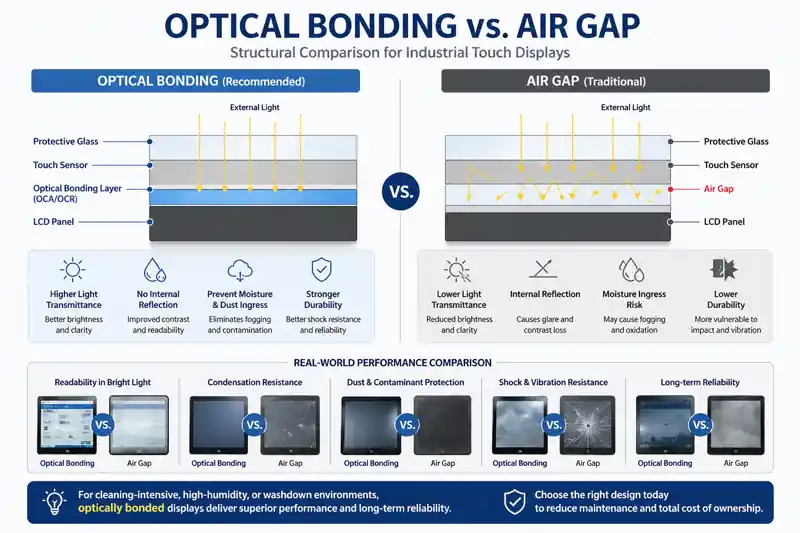
Uma camada de ar cria interfaces refletoras adicionais entre o ecrã LCD, o sensor tátil e o vidro de proteção.
Sob iluminação interior normal, a diferença pode não parecer muito acentuada.
Sob luz solar intensa, isso pode acontecer.
A colagem ótica substitui o espaço de ar por um material de colagem transparente. Isto pode reduzir as reflexões internas e ajudar a preservar o contraste em condições de ambiente com muita luz.
Mas o termo ligação ótica precisa de esclarecimento.
| Estrutura | O que isso significa | Considerações relativas ao ar livre |
|---|---|---|
| Folga de ar | Fica ar entre as camadas do ecrã | Mais reflexão interna |
| Colagem do ecrã LCD ao ecrã tátil | Ecrã LCD integrado num sensor tátil | Melhor desempenho ótico |
| Colagem ótica de pilha completa* | O ecrã LCD, o sensor tátil e o vidro de proteção formam uma pilha ótica colada | Ideal para aplicações ao ar livre exigentes |
| Vidro frontal adicional com câmara de ar | Vidro de proteção separado instalado na parte da frente | Pode suscitar novas reflexões |
*A terminologia relativa à ligação varia consoante os fornecedores. Confirme sempre quais são, exatamente, as interfaces que estão ligadas.
Essa pergunta é mais útil do que simplesmente perguntar:
“Oferecem colagem ótica?”
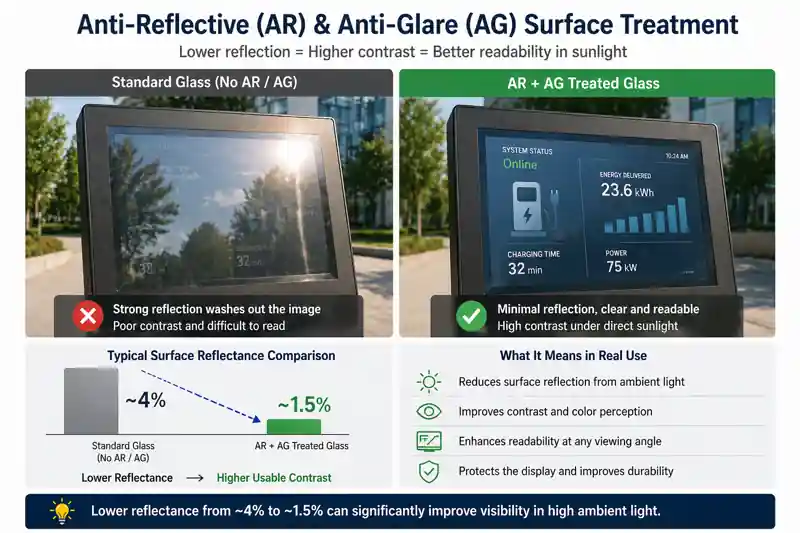
O AG e o AR são frequentemente agrupados, mas resolvem problemas óticos diferentes.
O AG difunde a luz refletida, pelo que a superfície produz menos brilho espelhado.
É útil em situações em que os operadores possam observar reflexos intensos provenientes do céu, da iluminação do teto ou de objetos próximos.
No entanto, um excesso de neblina pode reduzir a nitidez percebida da imagem.
O revestimento AR foi concebido para reduzir a quantidade de luz refletida pela superfície.
Consegue manter uma imagem mais nítida do que uma superfície AG de elevada opacidade, ao mesmo tempo que melhora o contraste no exterior.
Alguns projetos utilizam uma combinação de AG e AR.
| Superfície | Principal benefício | Consideração principal |
|---|---|---|
| Vidro normal | Simples e económico | Reflexos intensos ao ar livre |
| AG | Reduz o brilho visível | O efeito de neblina pode suavizar a imagem |
| AR | Reduz o reflexo na superfície | A qualidade e a durabilidade do revestimento são importantes |
| AG + AR | Controla tanto o brilho como o reflexo | Útil para instalações ao ar livre em condições exigentes |
No caso de um projeto personalizado, solicite as especificações concretas do vidro frontal, em vez de se contentar com uma indicação genérica como “vidro para exterior”.”
Verificar:
Esta é uma especificação que os compradores costumam ignorar.
Um ecrã de alto brilho pode atingir a sua potência nominal imediatamente após o arranque, em condições de temperatura ambiente.
Isso não significa automaticamente que consiga manter o mesmo rendimento após funcionar durante várias horas no interior de um invólucro exterior selado.
As retroiluminações LED de alto brilho geram calor.
A luz solar direta acrescenta mais uma carga térmica.
Um armário estanque pode limitar a circulação de ar.
A questão importante não é, portanto, apenas:
O monitor consegue atingir 1500 ou 2000 nits?
E é:
O monitor consegue manter um brilho adequado durante o ciclo de funcionamento real?
No caso de uma amostra de alto brilho, recomendamos verificar:
| Teste | Porque é que é importante |
|---|---|
| Brilho inicial | Estabelece a linha de base |
| Brilho após funcionamento prolongado | Indica se a saída se mantém estável |
| Temperatura do ecrã LCD / retroiluminação | Indica tensão térmica |
| Temperatura do invólucro | Mostra o calor acumulado |
| Consumo de energia | Ajuda a avaliar o sistema na sua totalidade |
| Comportamento de regulação automática da luminosidade | Evita o funcionamento desnecessário à potência máxima |
| Desempenho após o aumento da temperatura | Indica se o ecrã continua a poder ser utilizado |
Uma breve análise documental não permite responder a estas questões.
Para mais informações, consulte o nosso guia sobre sobreaquecimento e conceção térmica de ecrãs industriais para exterior.
Um monitor legível à luz solar deve ser avaliado como uma unidade completa, e não apenas com base na ficha técnica do ecrã LCD.
Para a aprovação da amostra, coloque o monitor numa condição que seja, na medida do possível, semelhante à instalação final.
Registe, pelo menos:
Tire fotografias a partir da posição normal de visualização do operador.
Não escolha um ângulo apenas porque evita reflexos e faz com que o ecrã fique com melhor aspeto numa fotografia.
Se o produto vier a funcionar num quiosque selado, num carregador de veículos elétricos ou num armário industrial, a avaliação térmica deverá também ser realizada com um invólucro representativo do projeto final.
Num projeto real, o resultado do teste é mais importante do que mais uma linha na ficha técnica.
A proteção IP e a legibilidade à luz solar resolvem problemas diferentes.
Um painel frontal com classificação IP65 pode proteger a superfície frontal exposta contra o pó e a água, desde que seja instalado corretamente.
Não diz nada sobre:
No caso de um monitor incorporado, a classificação IP65 na parte frontal pode ser suficiente, uma vez que o armário do cliente protege a parte traseira.
No caso de um monitor autónomo para uso no exterior, a caixa completa poderá necessitar de um nível mais elevado de proteção ambiental.
Pergunte sempre:
A classificação IP refere-se apenas ao painel frontal ou ao monitor na sua totalidade?
Isto evita um mal-entendido comum durante o processo de seleção de fornecedores.
O desempenho do ecrã tátil em ambientes exteriores não depende apenas do controlador tátil.
A pilha completa pode incluir:
Um vidro mais espesso e a alteração da estrutura de ligação podem afetar a sensibilidade ao toque.
A chuva pode representar um desafio diferente da utilização do dispositivo com os dedos em condições secas.
Se a sua aplicação exigir o manuseamento com luvas ou o funcionamento em condições de humidade, teste essa condição específica durante a aprovação da amostra.
Não valide o sensor tátil sem proteção e, em seguida, substitua o vidro frontal para produção.
A pilha de toques de produção deve ser a pilha que foi testada.
Um fornecedor deve ser capaz de explicar a estrutura completa do ecrã, e não apenas indicar o número do modelo do LCD.
| O fornecedor afirma que | O comprador deve perguntar |
|---|---|
| “1500 nits” | O brilho do LCD ou o brilho medido através do vidro acabado? |
| “Legível à luz do sol” | Em que configuração óptica e em que condições de instalação? |
| “Ligação ótica” | Quais são, de facto, as camadas que estão ligadas entre si? |
| “Vidro AG” | Qual é a espessura do vidro e qual é a especificação de opacidade? |
| “Óculos de RA” | Que especificações de reflexão estão disponíveis? |
| “IP65” | Apenas a parte da frente ou o invólucro completo? |
| “−20 °C a +70 °C” | Especificações do ecrã LCD ou especificações completas de funcionamento do monitor? |
| “PCAP para exterior” | Foi testado através do vidro final nas condições exigidas de humidade/luvas? |
| “2000 nits” | É possível manter o brilho durante um funcionamento prolongado? |
| “IK10” | Existe algum relatório de ensaio relativo à estrutura frontal especificada? |
| “Amplo intervalo de temperaturas” | Já foi tida em conta a condição térmica do invólucro final? |
Um fornecedor que não consiga responder a estas perguntas poderá, mesmo assim, ser capaz de vender um ecrã LCD de alto brilho.
Isso é diferente de conceber um monitor para equipamento de exterior.
Não existe uma única “melhor especificação para monitores de exterior”.”
O que importa é a aplicação.
| Aplicação | O que daríamos prioridade |
|---|---|
| Estação de carregamento de veículos elétricos | Ligação ótica, controlo da reflexão, ajuste do toque húmido, vedação frontal e gestão térmica |
| Quiosque exterior | Legibilidade à luz do sol, vidro resistente ao vandalismo, fiabilidade do ecrã tátil e calor solar |
| HMI industrial | Toque estável, ampla gama de temperaturas de funcionamento, vedação e disponibilidade a longo prazo |
| Terminal de transportes | Ângulo de visão, controlo de reflexos, regulação automática da luminosidade e longas horas de funcionamento |
| Equipamento semi-exterior | Superfície AG, ângulo de visão controlado e brilho adequado |
| Armário exterior estanque | Conceção térmica antes de simplesmente aumentar a potência da retroiluminação |
Um monitor que funciona bem num balcão de bilhetes à sombra pode não ser a configuração adequada para um carregador de veículos elétricos exposto ao sol da tarde.
A instalação deve determinar as especificações.
Não é necessário elaborar um caderno de encargos complexo antes de contactar um fornecedor.
A informação mais útil é:
Se não tiver a certeza se precisa de 1000, 1500 ou 2000 nits, não adivinhe.
Envie primeiro as condições de candidatura.
A escolha do brilho adequado deve fazer parte do processo de conceção do ecrã.
Não escolha um monitor legível à luz do sol baseando-se apenas na seguinte pergunta:
Quantos nits tem?
O brilho determina a intensidade luminosa.
A colagem ótica e o tratamento da superfície determinam a quantidade dessa imagem que permanece visível sob forte luz ambiente.
O projeto térmico determina se o desempenho pode ser mantido.
O vidro de proteção, o conjunto tátil e a caixa determinam se o ecrã irá realmente funcionar como parte da máquina finalizada.
A especificação a aprovar não é, portanto, o ecrã LCD por si só.
É o monitor pronto para utilização na aplicação pretendida.
A Eagle Touch fornece e personaliza monitores táteis legíveis à luz solar para quiosques exteriores, equipamento de carregamento de veículos elétricos, terminais de transportes, IHMs industriais e outros equipamentos OEM.
No caso de projetos personalizados, podemos analisar o monitor em conjunto com a caixa, o vidro de proteção, os requisitos de toque e o ambiente de instalação, em vez de tratar o ecrã LCD como um componente isolado.
Consulte o nosso soluções de monitores legíveis à luz do sol ou envie-nos as dimensões do ecrã, a aplicação, o desenho de instalação, as condições de exposição solar, a temperatura de funcionamento e a quantidade prevista para que possamos analisar a configuração.
É possível. Um ecrã de 1000 nits com uma boa colagem ótica e um bom controlo da reflexão pode ter um bom desempenho em muitas aplicações ao ar livre. No entanto, é necessário ter em conta a luz solar direta, o ângulo de instalação, a estrutura do vidro e as condições térmicas.
Não. Um monitor mais brilhante com reflexos intensos ou com uma camada de ar pode proporcionar um contraste útil inferior ao de um ecrã com menor brilho, mas com uma estrutura ótica bem concebida.
Embora não seja o caso em todas as aplicações, a colagem ótica revela-se cada vez mais vantajosa sob luz solar direta, especialmente quando o monitor inclui um ecrã tátil e um vidro de proteção.
O revestimento AG difunde a luz refletida e reduz o brilho espelhado. O revestimento AR foi concebido para reduzir a quantidade de luz refletida. A escolha do revestimento adequado depende da aplicação, da nitidez de imagem pretendida e da estrutura do vidro.
O calor pode ser uma das razões. As retroiluminações de alto brilho geram calor, enquanto a luz solar e os invólucros selados podem aumentar a carga térmica. É por isso que o funcionamento prolongado deve ser avaliado durante a aprovação da amostra.
Verifique a luminosidade do sistema acabado, a estrutura de ligação, o vidro de proteção, o tratamento de superfície, o desempenho tátil, o nível de proteção IP, a temperatura de funcionamento, o ajuste mecânico e o comportamento térmico em condições de funcionamento contínuo.
Um PC de painel industrial é um computador com um ecrã incorporado, normalmente tátil, concebido para ...
Um PC incorporado é um computador configurado para funcionar como parte de uma máquina ou de um sistema maior ...
Comece por definir o software que o PC de painel deve executar e as condições que deve cumprir. Em seguida, ...
A escolha do índice de proteção IP de um PC de painel industrial começa com duas perguntas: qual é a exposição ao pó e à água ...
Descreva a sua aplicação, os seus requisitos ou o desafio que enfrenta atualmente. A nossa equipa analisará os detalhes e recomendará uma solução prática.