Guide d'achat des fournisseurs d'écrans industriels pour les équipements OEM
Introduction Les interfaces homme-machine (IHM) sont désormais des composants standard des équipements industriels modernes. Les écrans permettent aux opérateurs de ...
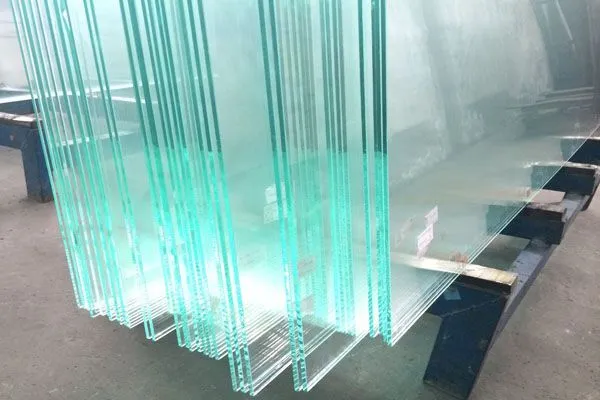
Le verre trempé, également connu sous le nom de verre trempé-est un type de verre de sécurité qui joue un rôle essentiel dans la protection de l'environnement. équipements industriels, écrans tactiles, kiosques et systèmes destinés au public.
Par rapport au verre recuit ordinaire, le verre trempé offre les avantages suivants
Ces caractéristiques en font un choix du matériau standard pour les écrans tactiles industriels, les distributeurs de billets et les systèmes d'affichage extérieurs.
Le verre trempé est une forme de verre de sécurité qui a été traité thermiquement pour améliorer sa résistance et sa durabilité.
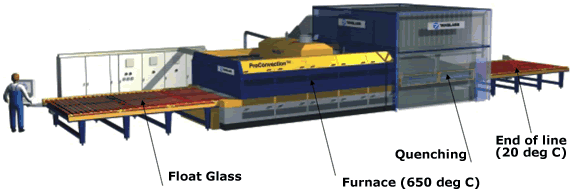
Lors de la fabrication, le verre est chauffé à environ 620-680°C puis refroidir rapidement.
Ce processus crée contrainte de compression sur la surface et la contrainte de traction à l'intérieur du verre.
Par conséquent, le verre trempé devient :
Le processus de durcissement comprend plusieurs étapes clés :
Une fois trempé, le verre ne peuvent être coupés ou percés sans se casser.
Le verre trempé peut résister :
Il est donc idéal pour écrans tactiles utilisés dans des environnements publics ou industriels.
Le verre trempé tolère des différences de température allant jusqu'à 200-250°C, bien plus élevé que le verre standard.
Ceci est essentiel pour des applications telles que :
Lorsqu'il est brisé, le verre trempé se brise en petits fragments émoussés plutôt que des éclats tranchants.
Cela réduit considérablement le risque de blessure, c'est pourquoi il est classé comme verre de sécurité.
| Fonctionnalité | Verre trempé | Verre normal |
|---|---|---|
| La force | Très élevé | Faible |
| Résistance thermique | Haut | Faible |
| Sécurité en cas de rupture | Petits morceaux émoussés | Éclats tranchants |
| Utilisation industrielle | Oui | Non |
Le verre trempé est couramment utilisé dans les écrans tactiles et les écrans industriels :
En fonction du projet, il peut être combiné avec :
Ces améliorations permettent d'améliorer la visibilité, la durabilité et l'utilisation à long terme.
Le verre trempé est largement utilisé dans :
Sa capacité à résister l'utilisation continue, l'impact et le stress environnemental en fait un matériau essentiel dans la conception de systèmes industriels.
Malgré ses avantages, le verre trempé présente certaines limites :
C'est la raison pour laquelle, la validation de la conception avant la production en série est essentielle dans les projets industriels.
Oui, les termes “verre trempé” et “verre durci” désignent le même matériau.
Oui. Avec une épaisseur et des revêtements appropriés, il est largement utilisé dans les domaines suivants applications semi-extérieures et extérieures.
L'épaisseur typique varie de 2 mm à 6 mm, en fonction de la taille du crible et des exigences en matière d'impact.
Le verre trempé n'est pas seulement une amélioration de la sécurité, c'est aussi une amélioration de la sécurité. choix fondamental des matériaux pour les systèmes industriels et tactiles modernes.
Sa résistance, sa stabilité thermique et son comportement sûr en cas de défaillance le rendent indispensable pour.. :
Pour les équipementiers et les intégrateurs de systèmes, le choix de la bonne spécification de verre trempé est une étape clé vers la mise en place d'un système de gestion de la qualité. conception de produits fiables et à longue durée de vie.
Introduction Les interfaces homme-machine (IHM) sont désormais des composants standard des équipements industriels modernes. Les écrans permettent aux opérateurs de ...
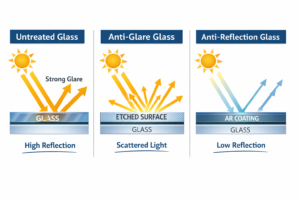
Introduction Les écrans industriels sont souvent déployés dans des environnements où les conditions d'éclairage sont difficiles à contrôler. L'équipement ...
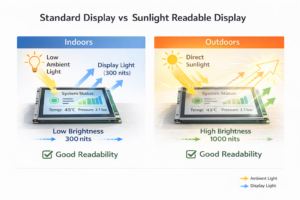
Introduction Les écrans sont des composants d'interface essentiels dans de nombreux types d'équipements industriels. Ils fournissent au système ...
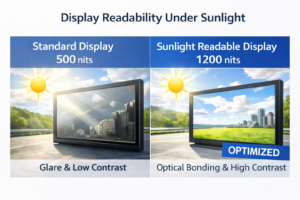
Introduction La visibilité de l'affichage est un paramètre essentiel de la conception des équipements industriels. Les opérateurs s'appuient sur des interfaces graphiques ...
Envoyez les détails de votre demande. Nous vous répondrons en vous indiquant la configuration à suivre et les prochaines étapes.