What Is an Industrial Panel PC? Components, Types and Applications
An industrial panel PC is a computer with a built-in display, usually a touchscreen, designed for …
Eagle Touch Engineering Team
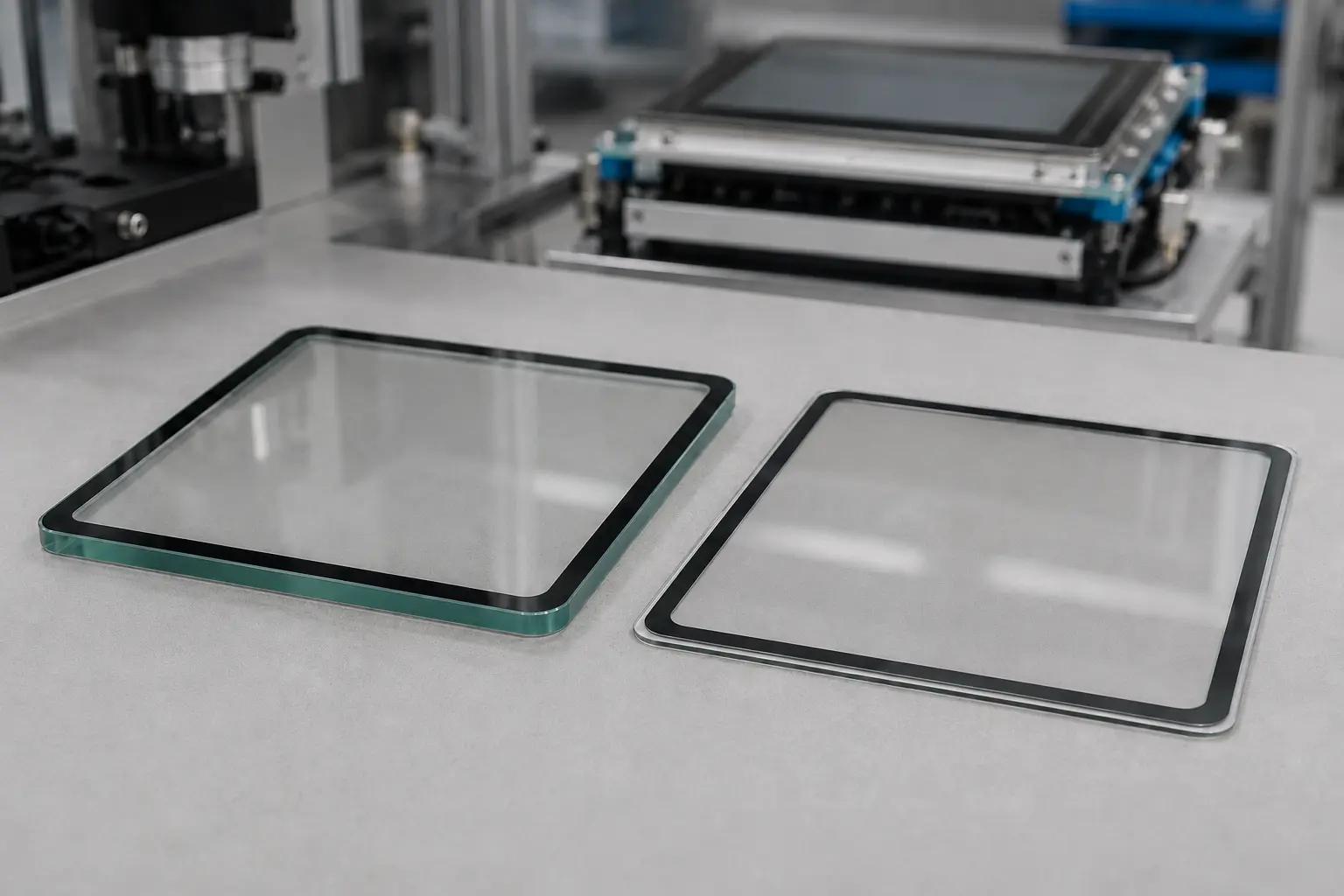
Industrial touchscreen projects often use the terms toughened glass, tempered glass, and chemically strengthened glass as if they mean the same thing. They do not.
Thermal tempering and chemical strengthening both create compressive stress at the glass surface, helping prevent small flaws from developing into cracks. However, the two processes suit different glass thicknesses, product sizes, optical requirements, and breakage expectations.
The practical rule is simple:
Neither process is automatically better. The correct choice depends on the complete touchscreen design.
Thermally tempered glass, commonly called toughened glass, begins as annealed glass. It is cut, shaped, drilled, and edge-finished before entering a tempering furnace.
The glass is heated to approximately 620–680°C and then cooled rapidly with controlled air jets. The surfaces cool and contract first while the centre cools more slowly. This creates compression at the surfaces and balancing tension inside the glass.
The result is typically four to five times stronger than annealed glass of the same thickness. When fully tempered glass breaks, it normally fragments into many small pieces rather than large, sharp shards.
Minimum thickness, maximum size, hole position, and edge distance depend on the glass processor and the required qualification. They should be confirmed before the drawing is released.
Chemical strengthening normally uses ion exchange. The finished glass part is placed in a heated molten salt bath. Larger potassium ions replace smaller sodium ions near the glass surface, creating a compressed surface layer.
This process works below the glass softening temperature, so it causes much less heat-related deformation than furnace tempering. It is especially useful for thin cover glass and applications requiring high optical flatness or tight dimensional control.
Chemical strengthening is commonly associated with aluminosilicate cover glass, although the available process and performance depend on the exact glass composition.
For chemically strengthened glass, two important values are often specified:
A high CS value alone does not define the complete performance. CS, DOL, glass composition, thickness, edge quality, and final assembly support must be evaluated together.
| Factor | Thermally Tempered Glass | Chemically Strengthened Glass |
|---|---|---|
| Strengthening method | Heating followed by rapid air cooling | Ion exchange in a heated salt bath |
| Typical design direction | Thicker and larger protective glass | Thin, light, precision cover glass |
| Common glass substrate | Soda-lime glass | Aluminosilicate or suitable soda-lime glass |
| Optical flatness | Slight roller wave may occur | Very little process-related distortion |
| Surface compression | Deep stress profile through the glass structure | High compression in a controlled surface layer |
| Breakage behaviour | Usually small granular fragments | May form larger, sharper fragments |
| Safety-glass status | Can meet applicable safety-glass standards when tested and certified | Not automatically safety glass |
| Machining after strengthening | Not permitted | Not recommended; it damages the strengthened layer |
| Common industrial fit | Kiosks, EV chargers, public terminals, large HMIs | Slim HMIs, medical interfaces, precise touch modules |
These are selection directions, not universal pass/fail rules. Actual performance must be confirmed with the selected glass, supplier process, mechanical design, and final validation test.
A thicker pane is not automatically a better touchscreen solution. It may improve mechanical protection, but it also increases weight and places greater demands on projected-capacitive touch tuning.
Similarly, chemically strengthened glass is not automatically stronger in every real product. Edge damage, mounting stress, openings, adhesive support, and impact location can change the result.
For thickness, edge design, printing, and surface-treatment decisions, see our industrial touch screen cover glass design guide.
Strengthening places the surface in compression and improves resistance to crack growth. It does not make glass impossible to scratch. Abrasive particles, incorrect cleaning tools, and hard contaminants can still damage the surface.
An IK rating applies to the tested assembly, not to the glass sheet alone. Glass type and thickness matter, but so do edge support, enclosure rigidity, mounting method, and impact location. A 6 mm glass specification by itself does not prove IK10 compliance.
For the complete test logic, see What Is an IK10 Touch Screen?.
PCAP performance is influenced mainly by the complete dielectric stack, including glass thickness, sensor design, bonding structure, controller capability, grounding, gloves, and water conditions.
Both thermally tempered and chemically strengthened glass can work with PCAP. The final touch assembly must be tuned and tested as a complete system. Our industrial PCAP touch screen guide explains this relationship in more detail.
Before approving cover glass for production, confirm:
All cutting, drilling, and edge processing should be completed before strengthening. The sequence for printing, coatings, and bonding must be agreed with the processors because material and curing requirements vary.
In normal technical usage, both terms refer to thermally tempered glass. “Toughened glass” is more common in the UK and Europe, while “tempered glass” is more common in North America. Some suppliers use these terms loosely for chemically strengthened glass, so the actual process should always be stated.
Not necessarily. Chemical strengthening can produce excellent damage resistance, especially in thin glass, but it does not automatically provide the granular breakage pattern associated with fully tempered safety glass.
Thermally tempered glass cannot be cut or drilled after tempering. Chemically strengthened glass should also not be machined afterward because cutting or grinding removes or damages the compressed surface layer.
Use thermal tempering for thicker, larger protective glass when robust front protection and granular breakage are priorities. Use chemical strengthening for thin, precise cover glass when optical quality, low weight, and dimensional control are more important.
Do not specify only “tempered glass” on an industrial touchscreen drawing. That description leaves too much open to interpretation.
Define the glass substrate, strengthening process, thickness, edge condition, dimensional tolerance, breakage requirement, and final validation method. For chemically strengthened glass, also define the required CS and DOL values.
The strongest glass on paper is not always the most reliable touchscreen in the field. The correct glass is the one that works with the final sensor, enclosure, mounting structure, and operating environment.
If you are developing an industrial HMI, kiosk, EV charger, or custom touch display, Eagle Touch can review the cover glass and touch structure as one complete assembly before sample production.
An industrial panel PC is a computer with a built-in display, usually a touchscreen, designed for …
An embedded PC is a computer configured to work as part of a machine or larger …
Start with the software the panel PC must run and the conditions it must fit. Then …
Choosing an industrial panel PC IP rating starts with two questions: what dust and water exposure …
Share your application, requirements, or current challenge. Our team will review the details and recommend a practical way forward.