Guide d'achat des fournisseurs d'écrans industriels pour les équipements OEM

Introduction Les interfaces homme-machine (IHM) sont désormais des composants standard des équipements industriels modernes. Les écrans permettent aux opérateurs de ...
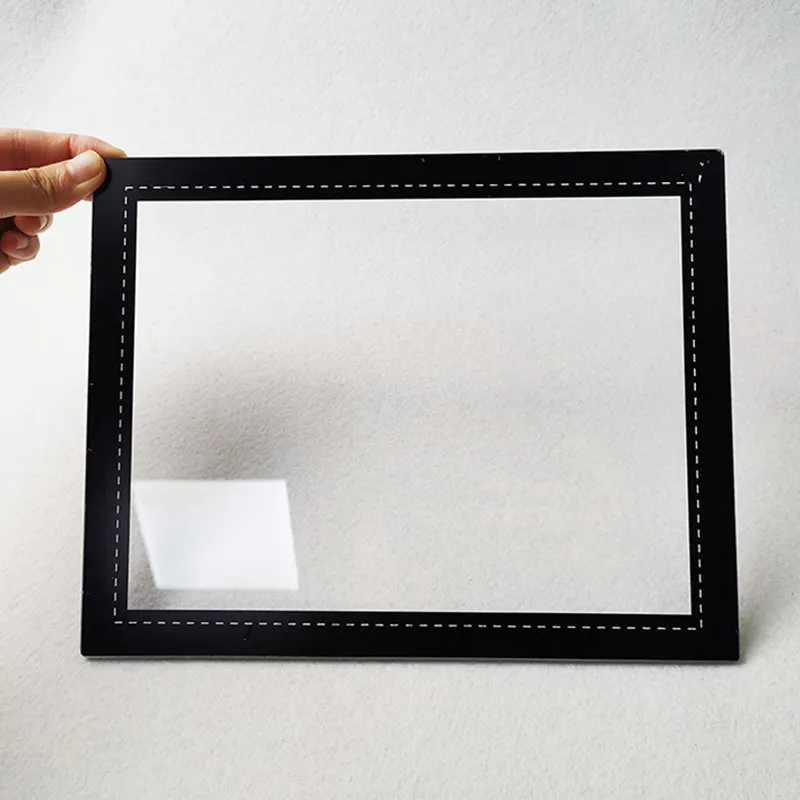
Dans les projets d'affichage industriel et commercial modernes, le traitement de surface du verre joue un rôle essentiel dans la lisibilité, la durabilité et l'utilisation à long terme.
Parmi les solutions les plus couramment utilisées, on peut citer Traitements du verre AG (antireflet), AF (anti-traces de doigts) et AR (anti-reflet). Bien qu'ils soient souvent mentionnés ensemble, chacun d'entre eux répond à un objectif technique et à un scénario d'application différents.
Cet article explique les les différences entre les verres AG, AF et AR, Le traitement de l'eau, le fonctionnement de chaque traitement et le choix de l'option la plus appropriée pour les écrans industriels en 2026.

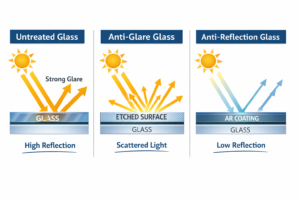
Verre AG, également connu sous le nom de verre antireflet, est conçu pour réduire la réflexion de la surface par diffuser la lumière entrante. Ce résultat est généralement obtenu par une gravure chimique ou une micro-texturation de la surface du verre.
Au lieu de refléter la lumière directement comme un miroir, le verre AG diffuse la lumière dans de multiples directions, ce qui réduit considérablement l'éblouissement causé par la lumière du soleil ou un éclairage artificiel puissant.
Le verre AG est largement utilisé dans Présentoirs industriels extérieurs et semi-extérieurs, où la lisibilité de la lumière du soleil est plus importante que la clarté parfaite de l'image.
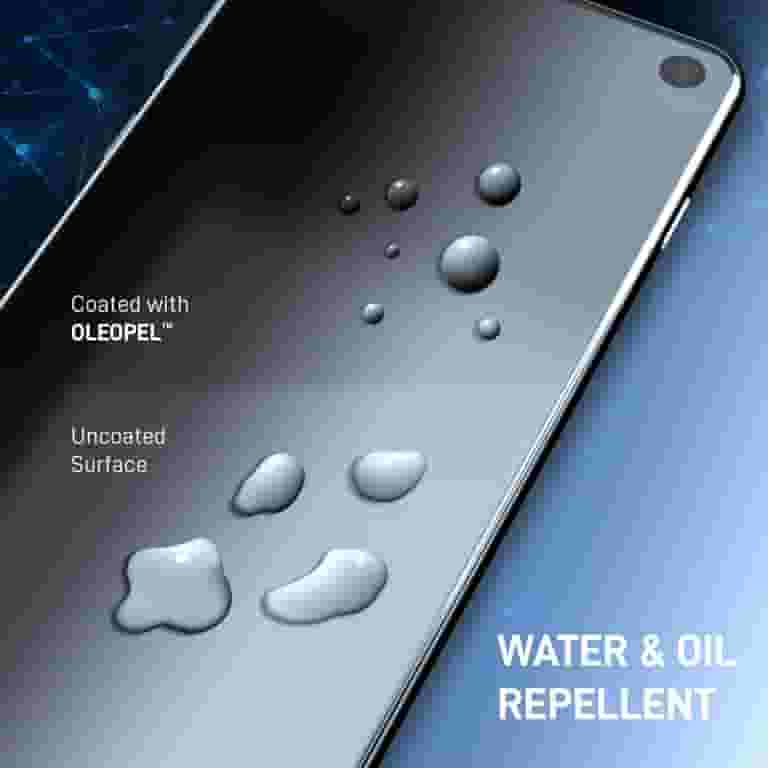
Verre AF, ou verre anti-traces de doigts, est revêtu d'une couche de verre anti-traces de doigts. couche oléophobe qui repousse les huiles, l'humidité et la saleté. Le but premier du traitement AF n'est pas de réduire l'éblouissement, mais de propreté de la surface et facilité d'entretien.
Les revêtements AF réduisent la visibilité des empreintes digitales et permettent d'éliminer plus facilement les taches, ce qui permet de garder la surface de l'écran propre, même dans les environnements où l'on touche beaucoup.
Le verre AF est particulièrement utile dans les cas suivants les systèmes publics ou sans surveillance, où l'interaction fréquente de l'utilisateur entraînerait sinon un aspect visuel médiocre et des coûts d'entretien plus élevés.
Le verre AF est généralement combiné avec AG ou AR, plutôt que d'être utilisés seuls.

Verre AR, ou verre antireflet, utilise revêtements optiques multicouches pour minimiser la réflexion de la surface en contrôlant l'interférence de la lumière. Contrairement au verre AG, le verre AR réduit la réflexion sans diffusion de la lumière, et préserve la netteté et le contraste de l'image.
Les revêtements AR de haute qualité peuvent réduire la réflectance à ci-dessous 1-2%, L'affichage est plus clair et plus net, même en cas de forte luminosité ambiante.
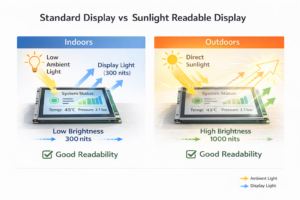
Le verre AR est souvent utilisé dans systèmes d'affichage à haute luminosité ou haut de gamme, surtout lorsque la performance optique est une priorité absolue.
| Fonctionnalité | AG Glass | Verre AF | Verre AR |
|---|---|---|---|
| Réduction de l'éblouissement | Haut | Faible | Très élevé |
| Résistance aux empreintes digitales | Faible | Très élevé | Moyen |
| Netteté de l'image | Moyen | Haut | Très élevé |
| Adaptation à l'extérieur | Haut | Moyen | Très élevé |
| Niveau de coût | Faible | Faible-Moyen | Haut |
Chaque traitement porte sur un problème technique différent, et aucune d'entre elles ne doit être considérée comme une solution universelle.
Oui, dans les projets d'affichage industriel modernes, les traitements combinés sont de plus en plus courants.
Lors de la combinaison des traitements, la compatibilité et la durabilité du revêtement doivent être soigneusement étudiées afin d'éviter les conflits optiques ou la réduction de la durée de vie.
Le choix du traitement du verre dépend des éléments suivants environnement d'application et conditions d'utilisation, et pas seulement des spécifications.
Les traitements du verre AG, AF et AR ont chacun une fonction distincte dans la conception de l'affichage industriel.
La compréhension de leurs différences permet aux ingénieurs et aux équipes chargées des achats de prendre des décisions éclairées qui améliorent la lisibilité, la durabilité et les performances à long terme.
Plutôt que de choisir un traitement du verre de manière isolée, il convient de l'évaluer en même temps que la luminosité de l'écran, la technologie tactile, le collage optique et les conditions environnementales, afin d'obtenir les meilleures performances globales du système.
Introduction Les interfaces homme-machine (IHM) sont désormais des composants standard des équipements industriels modernes. Les écrans permettent aux opérateurs de ...
Introduction Les écrans industriels sont souvent déployés dans des environnements où les conditions d'éclairage sont difficiles à contrôler. L'équipement ...
Introduction Les écrans sont des composants d'interface essentiels dans de nombreux types d'équipements industriels. Ils fournissent au système ...
Introduction La visibilité de l'affichage est un paramètre essentiel de la conception des équipements industriels. Les opérateurs s'appuient sur des interfaces graphiques ...
Envoyez les détails de votre demande. Nous vous répondrons en vous indiquant la configuration à suivre et les prochaines étapes.