What Is an Industrial Panel PC? Components, Types and Applications
An industrial panel PC is a computer with a built-in display, usually a touchscreen, designed for …
Eagle Touch Engineering Team
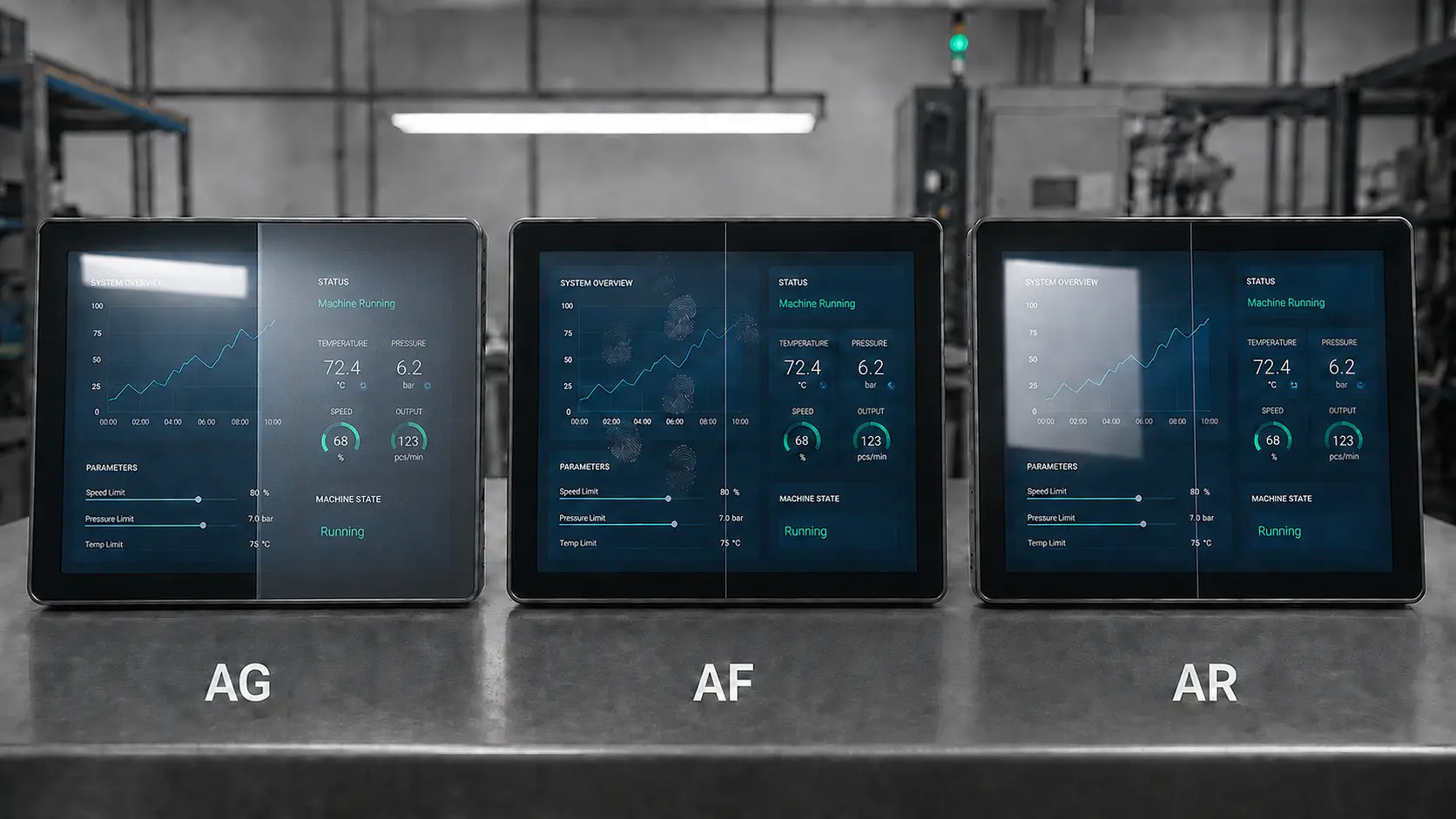
AG, AF and AR are often listed together on a cover-glass specification, but they do different jobs.
AG reduces disturbing glare by diffusing reflected light. AF makes fingerprints and oil easier to remove. AR reduces the amount of light reflected by the glass. None is automatically better than the others, and adding all three does not guarantee a better display.
For an industrial touch display, start with the problem the finished equipment must solve. Consider the lighting, user interface, cleaning method, cover-glass structure and required service life. Then qualify the treatment on a representative sample.
| Treatment | Main purpose | Good starting point for | Main trade-off |
|---|---|---|---|
| AG — Anti-Glare | Diffuses sharp reflections from lamps, windows and surrounding objects | Factory HMIs, control panels and equipment under directional lighting | Excessive haze can soften fine text and graphics |
| AF — Anti-Fingerprint | Reduces oil adhesion and makes the surface easier to clean | Public touchscreens, medical panels, kiosks and frequently touched HMIs | Does not provide impact or scratch protection by itself |
| AR — Anti-Reflective | Reduces surface reflectance while preserving image clarity | High-clarity interfaces, professional displays and selected outdoor systems | Higher cost and stricter coating, handling and durability requirements |
| AG + AF | Combines glare control with easier cleaning | Industrial HMIs, kiosks and public terminals | Both the optical result and AF durability must be verified |
| AR + AF | Combines low reflection with easier cleaning | Medical, premium and high-clarity touch displays | The complete coating stack requires controlled processing and validation |
The short version is simple: AG for glare, AF for touch marks and AR for reflection. The final specification still depends on the complete display.
AG, or anti-glare, treatment gives the glass a finely textured surface. Instead of returning a sharp image of an overhead lamp or nearby window, the surface spreads the reflected light over a wider area. The reflection becomes less defined and less distracting to the operator.
AG is useful when a visible reflection moves across the screen as the operator changes position, particularly on HMIs installed below strong lighting.
More haze is not always better. A stronger diffusing surface may suppress reflections, but it can also scatter light coming from the LCD. The result may be softer text, reduced contrast, visible sparkle or poorer QR-code readability.
The risk is greater with high-resolution displays, small text and thin lines. Instead of requesting the highest available haze, compare samples using the final screen content and normal viewing distance. Also check gloss and sparkle where relevant.
AG can be created by etching the glass or applying a surface coating. Selection depends on the optical target, glass material, cleaning process and abrasion exposure. Identify the process and qualify a production-representative sample; not every product sold as “AG glass” has the same appearance or service life.
AF means anti-fingerprint. It is normally an oleophobic surface treatment that reduces the tendency of skin oil and fingerprints to spread and remain visible. Marks can still appear, but they are usually easier to wipe away.
This matters on public terminals and operator panels cleaned many times each day. Water contact angle is often used as an AF quality-control indicator, but an initial value does not describe service life. Where durability matters, define the test method and the required result after abrasion or cleaning cycles.
AF does not make glass scratch-proof or increase impact resistance. Those properties depend on the glass material, thickness, strengthening, edge support, bonding and enclosure. If the product needs an IK rating, treat it as a separate cover-glass design requirement. Also test the actual cloth and cleaning chemicals; coating compatibility varies.
AR, or anti-reflective, treatment normally uses thin optical layers to make reflected light waves partially cancel one another. More display light passes through the cover glass and less ambient light returns to the viewer.
At normal incidence, an untreated air-to-glass interface typically reflects about 4% of visible light. A separate sheet of glass has more than one optical interface, so total reflection depends on the complete structure. AR performance must therefore be stated with its measurement conditions.
AR is useful when a project needs low reflection without the image softening associated with a highly diffusive surface, such as medical equipment, high-resolution HMIs and selected outdoor displays.
“AR coating” is not a complete specification. Ask the supplier to state:
A low value at one wavelength is not the same as low average reflection across the visible range. Check the appearance at normal viewing angles. If a coated surface will be bonded, confirm coating and adhesive compatibility.
AG and AR are not two grades of the same treatment.
AG changes the appearance of a reflection. A sharp image of a lamp becomes a broad, soft patch. AR reduces the intensity of the reflection and usually maintains higher apparent sharpness.
| Decision factor | AG glass | AR glass |
|---|---|---|
| Main optical action | Diffuses reflected light | Reduces reflected light |
| Surface appearance | Matte or satin | Clear, usually glossy |
| Image detail | May soften with higher haze | Normally preserves clarity better |
| Strong overhead lamp | Often a practical choice | Can help, but cost may not be justified |
| High-resolution interface | Use low-haze, low-sparkle AG and test it | Often preferable when clarity is critical |
| Outdoor use | Can reduce distracting mirror images | Can improve contrast by lowering reflection |
| Main qualification risk | Haze, sparkle and loss of detail | Reflectance consistency, colour and coating durability |
For outdoor equipment, begin with the complete optical system. LCD brightness, internal reflections, optical bonding, cover glass, angle and shading all affect readability. AR cannot compensate for an underpowered backlight, and AG alone does not make a display sunlight readable.
Yes, but the combination must have a clear purpose.
Treatments may be applied to different surfaces or arranged in a controlled stack. Confirm the coating order, process compatibility and bonding requirements. More treatments increase cost and validation work; they do not automatically improve the display.
| Application | Practical starting point | Confirm before approval |
|---|---|---|
| Factory HMI under overhead lighting | AG | Lamp direction, haze, sparkle, text clarity and glove use |
| Outdoor kiosk or EV charger | AG, AG + AF or a validated AR solution | LCD brightness, optical bonding, sunlight direction, enclosure shading and cleaning |
| Public self-service touchscreen | AF or AG + AF | Touch frequency, fingerprints, cleaning method and abrasion durability |
| Medical touch panel | AF or AR + AF | Disinfectant compatibility, image clarity and coating life |
| High-resolution professional HMI | AR or low-haze AG | Fine text, colour, reflectance and viewing angle |
| IK-rated touchscreen | Mechanical design first | Glass thickness, strengthening, edge support, bonding and touch tuning |
| Outdoor non-touch display | AG or AR according to the reflection problem | Brightness, optical stack, installation angle and thermal design |
Two machines using the same LCD can require different cover glass because one faces a window and the other faces a wall. Application conditions should decide the treatment.
Do not send only “AG glass required” or “AR coating required.” Give the supplier enough information to recommend and quote the correct structure.
Provide the application information first:
For AG, request the haze or gloss range, process type, low-sparkle requirement and samples. For AF, state the contact-angle test method, cleaning compatibility and durability. For AR, state the reflectance target, wavelength range, measurement angle, coated side and whether the value applies per surface or to the complete glass.
Approve measurable performance and a representative sample—not the label alone.
A loose piece of treated glass under office lighting cannot represent the finished product. Test the complete display stack where possible, using the same screen content and brightness for every sample. Check it under normal lighting, strong overhead lamps and daylight where relevant, from the operator’s position and realistic off-axis angles.
Use dark screens to reveal reflections, then inspect small text, thin lines and QR codes for haze or sparkle. On AR samples, look for residual colour and coating non-uniformity.
If the product requires thick glass, gloves, wet operation or edge touch, test those conditions on the finished structure. Finally, use the actual cleaning cloth and chemicals. A coating that looks excellent on day one may still fail after repeated cleaning.
Higher haze can reduce a sharp reflection but also make small text, fine graphics and QR codes harder to read. Select haze by testing the real interface.
AR can reduce surface reflection, but outdoor readability still depends on brightness, optical bonding, internal reflections and installation. See the complete sunlight-readable monitor selection guide before finalising the glass.
AF improves cleanability. It does not replace strengthened glass, suitable thickness or mechanical impact design.
Glass, coating, touch sensor, bonding, LCD and enclosure work as one system. Freezing one component too early creates unnecessary optical, mechanical and touch risks.
AG diffuses distracting reflections, AF reduces fingerprint and oil adhesion, and AR reduces the amount of light reflected by the glass. They address different problems and should be specified separately.
Not in general. AG is often practical when directional glare is the main problem. AR is useful when low reflection and image clarity are priorities. Compare complete display samples under the real installation lighting.
Yes. AG + AF and AR + AF are common functional combinations, while AG + AR and three-treatment stacks require careful process and optical validation. Use a combination only when every treatment solves a defined requirement.
No. AR can improve outdoor contrast by reducing surface reflection, but sunlight readability also depends on LCD brightness, optical bonding, internal reflections, shading and thermal design.
AG, AF and AR are not upgrades on a single scale. AG manages distracting glare, AF improves cleanability and AR lowers surface reflection. The right choice is the one that keeps the screen readable, touchable and maintainable after it is installed in the real machine.
For an OEM project, send Eagle Touch the display size, lighting environment, LCD brightness, cover-glass thickness, bonding method, cleaning process and expected quantity. We can recommend a practical treatment and prepare a representative sample for evaluation before mass production.
An industrial panel PC is a computer with a built-in display, usually a touchscreen, designed for …
An embedded PC is a computer configured to work as part of a machine or larger …
Start with the software the panel PC must run and the conditions it must fit. Then …
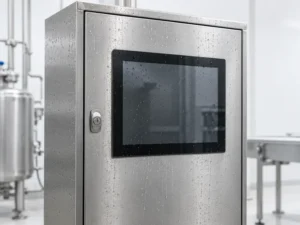
Choosing an industrial panel PC IP rating starts with two questions: what dust and water exposure …
Share your application, requirements, or current challenge. Our team will review the details and recommend a practical way forward.