博客

AG、AF 与 AR 玻璃:工业触摸屏如何选择

已出版: 13 1 月, 2026
工业用途 选择指南 整合说明
AG AF and AR glass treatments for industrial touch displays

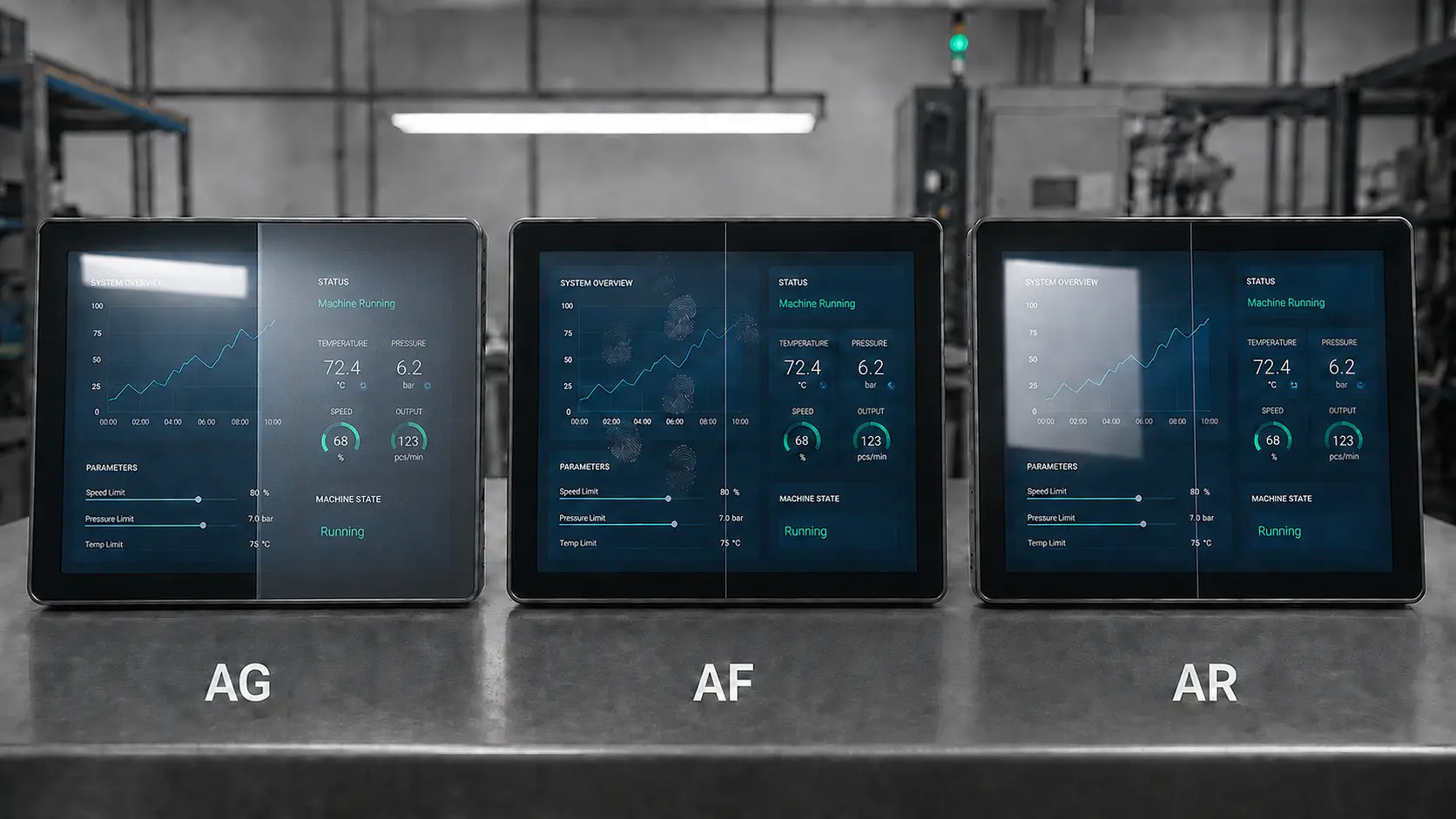
AG, AF and AR are often grouped together on a display specification sheet, but they solve different problems.

AG reduces glare. AF helps with fingerprints and cleaning. AR reduces surface reflection.

That sounds simple. In a real industrial display project, it rarely is.

A coating that looks impressive on a datasheet can still be the wrong choice once the display is installed behind thick cover glass, exposed to sunlight, cleaned several times a day, or tuned for glove and wet touch.

Our rule is straightforward:

If you cannot say what problem a coating is solving, do not add it to the BOM.

For industrial touch displays, the right decision should consider the complete front structure: LCD brightness, cover glass, touch sensor, bonding method, coating, installation angle and the actual environment.


AG vs AF vs AR Glass: Quick Comparison

治疗Main Job最合适Main Trade-Off
AG – Anti-GlareMakes strong reflections less disturbingSunlight, factory lighting, overhead lampsToo much haze can soften fine detail
AF – Anti-Fingerprint减少指纹和油渍附着Frequently touched or cleaned screensDoes not provide impact or scratch protection by itself
AR – Anti-ReflectiveReduces surface reflectionApplications requiring low reflection and high image clarityHigher cost and more coating/process control
AG + AFGlare control plus easier cleaningKiosks, HMIs, public touchscreensBoth optical result and coating durability need checking
AR + AFLow reflection plus easier cleaningMedical, professional and premium interfacesMore demanding coating specification and validation

A useful shortcut is:

AG for glare. AF for touch marks. AR for reflection.

The shortcut tells you where to start. It should not be the final specification.

工业触摸显示屏中AG、AF和AR玻璃的对比

AG Glass: When Glare Is the Real Problem

AG, or anti-glare glass, changes the way reflected light appears to the viewer.

Instead of seeing a sharp reflection of a lamp, window or surrounding object, the reflection becomes more diffused. That can make an industrial screen easier to read under strong ambient light.

典型应用包括

  • factory HMIs
  • 户外信息亭
  • EV chargers
  • ticketing machines
  • industrial control panels
  • equipment installed below strong overhead lighting

But specifying only “AG glass” is not enough.

Haze Matters

Haze is one of the first parameters we would check on an AG sample.

More haze can suppress obvious reflections, but more is not always better. An aggressive AG surface can also affect:

  • small text
  • thin lines
  • high-resolution graphics
  • QR codes
  • perceived contrast
  • image sharpness

This becomes more noticeable as display resolution and pixel density increase.

So instead of asking:

What is your highest-haze AG glass?

A better question is:

Which AG surface gives enough glare control without making our interface look soft?

That is a sample decision, not just a datasheet decision.

Coated or Etched AG?

AG can be produced using different surface processes.

For an OEM project, do not assume one process is automatically superior. Ask how the AG surface is made and qualify the things that matter in your application:

  • cleaning
  • outdoor exposure
  • optical consistency
  • expected service life

If the product will stay outdoors for years or be cleaned every day, these questions matter more than the words “anti-glare” printed on the quotation.


AF Glass: More About Maintenance Than Optics

AF means anti-fingerprint.

Its job is not to make fingerprints disappear. It reduces the tendency of oils and fingerprints to remain obvious on the glass and makes the surface easier to wipe clean.

That makes AF particularly useful for:

  • 自助服务亭
  • POS equipment
  • access-control terminals
  • vending machines
  • medical touch panels
  • public operator interfaces

For a screen touched hundreds of times per day, AF is not simply a cosmetic option.

它是一个 maintenance decision.

A cleaner-looking screen improves the user experience, but more importantly, easier cleaning can reduce the effort needed to keep public equipment presentable.

AF Is Not Scratch Protection

This is one specification mistake worth avoiding.

Anti-fingerprint is not the same as anti-scratch.

If the project needs mechanical surface protection, review it separately:

  • 盖板厚度
  • 钢化玻璃或化学强化玻璃
  • surface hardness
  • abrasion resistance
  • hard coating where required
  • front mechanical structure

A display can have excellent AF performance and still require a much stronger cover-glass design.


AR Glass: When Reflection and Image Clarity Matter

AR, or anti-reflective treatment, tackles the problem differently from AG.

AG makes reflections less distinct.

AR aims to reduce the reflection itself.

That can help the image behind the glass maintain better perceived contrast and clarity, particularly when a dark screen is competing with bright ambient light.

AR is often considered for:

  • medical displays
  • professional control systems
  • premium HMIs
  • high-clarity interfaces
  • selected outdoor applications

AG vs AR Glass: They Are Not Two Grades of the Same Product

This distinction matters.

AG changes the appearance of reflected light. AR reduces the amount of reflected light.

That is why the choice should not simply be:

AG is cheaper, AR is better.

They solve the optical problem differently.

There are also combined AG + AR solutions. The fact that the technologies can be combined is another reason not to treat them as mutually exclusive categories.

The right answer depends on what the final machine needs to achieve.


For Outdoor Displays, Do Not Start With “AG or AR?”

This is where many specifications go wrong.

If an outdoor screen is difficult to read, changing the glass coating may help—but it may not be the main problem.

Before choosing AG or AR, we would first look at:

  1. LCD亮度
  2. direct sunlight direction
  3. 内部反射
  4. 光学粘接
  5. 盖板
  6. installation angle
  7. front mechanical structure

For a true sunlight-readable monitor, these elements work together.

A 1000-nit or 1500-nit LCD behind a poor optical stack can still look disappointing in sunlight. In the same way, an expensive AR coating cannot compensate for every limitation in the display underneath it.

For many rugged 户外触摸显示器 projects, AG combined with appropriate LCD brightness and optical bonding is a sensible starting point.

AR can be added when lower reflection or higher visual clarity justifies it.

Choose the optical system first. Choose the acronym second.


The Glass Is Only the Top Layer of the System

A finished industrial touch display normally contains several optical and mechanical layers:

  • 盖板
  • AG / AF / AR treatment where required
  • PCAP touch sensor
  • bonding layer or air gap
  • LCD
  • backlight

This is why coating selection cannot be isolated from the display construction.

Industrial touch display optical stack with cover glass PCAP sensor optical bonding and LCD

全贴

An air gap between the LCD, touch panel and cover glass creates additional optical interfaces.

光学粘接 removes the air gap by bonding the layers with transparent optical adhesive. This can reduce internal reflection and improve perceived contrast in demanding lighting conditions.

If sunlight readability is important, comparing bonded and non-bonded samples can be more useful than arguing over AG versus AR on paper.

Thick Cover Glass

Industrial and public equipment often uses thicker glass for impact resistance.

That changes more than mechanical strength.

With PCAP touch, the final design may also need to consider:

  • controller tuning
  • edge touch
  • 手套操作
  • wet touch
  • grounding
  • 電磁干擾
  • bonding structure

对于一个 IK10 触摸屏, coating should therefore come after the front structure and touch requirements have been understood.

A beautifully coated screen that does not touch reliably is not a successful design.


Which Glass Treatment Should You Choose?

Here is how we would normally start the discussion.

应用Starting PointCheck Before Approval
工厂人机界面AGLighting direction, haze, text clarity, glove use
Outdoor kiosk / EV chargerAG or AG + AFBrightness, bonding, sunlight direction, IP/IK requirements
Public touchscreenAF 或 AG + AF清洁方法、触摸频率、涂层耐久性
Medical touch panelAF or AR + AFChemical cleaning, abrasion, image clarity
Premium indoor HMIAR 或 AR + AFReflection target and coating durability
High-resolution displayLow-haze AG or ARText sharpness, sparkle and viewing distance
IK08 / IK10 screenMechanical structure firstGlass thickness, bonding and touch tuning
Outdoor non-touch displayAG or AR depending on the optical problemBrightness, bonding, thermal design and installation angle

There is no universal “best” treatment.

Two machines using exactly the same LCD may need different glass simply because one faces a window and the other faces a wall.


What Buyers Should Put on the RFQ

“We need AG glass” is not a complete specification.

For an OEM project, give the supplier enough information to make a real recommendation.

For AG

Ask for:

  • haze
  • gloss where relevant
  • AG process
  • sample availability
  • expected cleaning and abrasion resistance

For AF

Ask for:

  • AF specification
  • cleaning compatibility
  • abrasion durability
  • contact angle if your project has a defined requirement

For AR

Ask for:

  • reflectance specification
  • coating construction
  • cleaning instructions
  • handling requirements
  • durability qualification

And for the complete display, confirm:

  • LCD size
  • 亮度
  • 盖板厚度
  • 粘接方法
  • PCAP controller
  • glove or wet-touch requirement
  • IP / IK requirement
  • 工作温度
  • 安装方法

If the project needs a custom PCAP 触摸屏, glass thickness and touch-controller tuning should be reviewed together rather than separately.

Approve the performance, not the label.


How We Would Test a Sample Before Mass Production

A sample under comfortable office lighting tells you very little about how it will behave inside the finished machine.

Before approving the glass, test the complete display—or at least a representative optical stack—under conditions close to actual use.

Check the Screen Under Real Light

Test:

  • normal indoor lighting
  • strong overhead lamps
  • direct or indirect sunlight where applicable
  • different viewing angles
  • dark and bright screen content

Dark interfaces are useful because unwanted reflections often become much easier to see.

Check Fine Detail

Look at:

  • small text
  • thin lines
  • icons
  • QR codes
  • high-resolution graphics

This is particularly important when evaluating AG haze.

Touch It the Way the Customer Will

If the product requires:

  • thick cover glass
  • gloves
  • wet touch
  • water-droplet tolerance
  • edge operation

test those conditions with the final structure.

Do not validate a bare touch sensor and assume the result will remain identical after adding thick cover glass and a different enclosure.

Clean It the Way It Will Be Cleaned

Use the actual cleaning process expected in service.

If the customer intends to use alcohol, disinfectants or another chemical cleaner, verify coating compatibility before the specification is frozen.

A surface can look excellent on day one and still be the wrong choice for a machine cleaned several times every day.


Four Mistakes We See in Glass Specifications

1. “Use the Highest Haze AG You Have”

More haze does not automatically mean better readability.

If the interface uses small text or high-resolution graphics, too much haze can create another problem while solving the first one.

2. “Use AR and the Screen Will Be Sunlight Readable”

AR can reduce reflection.

Sunlight readability still depends on the complete display.

3. “AF Means the Surface Is Scratch-Proof”

It does not.

Fingerprint resistance and mechanical protection are separate specifications.

4. “Finalize the Glass First, Tune the Touch Later”

For thick glass and rugged touch systems, that order creates unnecessary risk.

Glass, sensor, bonding, controller and front enclosure should be treated as one system.


Our Recommendation

For most industrial projects, we would begin with the actual problem rather than a predetermined coating package.

Strong factory lighting?
Evaluate AG and choose haze based on the actual interface.

Outdoor equipment?
Review brightness, optical bonding, glass, sunlight direction and thermal design before deciding whether AG, AR or both are justified.

High-frequency public touch?
AF can make more practical sense than another optical treatment.

High-clarity professional display?
AR or AR + AF may be worth the additional cost.

IK-rated thick-glass touchscreen?
Get the mechanical structure and touch tuning right first.

There is no prize for putting AG + AF + AR on every specification.

There is only one result that matters:

Can the operator still read it, touch it and maintain it after the display is installed in the real machine?

That is the specification worth approving.


常见问题

AG、AF 和 AR 玻璃之间有什么区别?

AG reduces glare by making reflected light less visually disturbing. AF reduces fingerprint and oil adhesion and makes cleaning easier. AR reduces surface reflection and helps preserve image clarity and contrast.

Is AG better than AR?

Not generally.

AG and AR solve different problems. AG is useful where glare is disruptive, while AR is useful where lower reflection and high image clarity are priorities.

For industrial equipment, choose based on the lighting environment and the complete optical structure.

Can AG and AF be combined?

是的。.

AG + AF is useful for touchscreens that need both glare control and easier cleaning, such as kiosks, industrial HMIs and public terminals.

Can AG and AR be combined?

是的。.

AG + AR solutions can combine glare reduction with lower reflection, but the final optical result should still be validated using samples.

Does AF make a screen fingerprint-proof?

不.

It reduces fingerprint visibility and makes oils easier to clean. It does not make the glass permanently free of fingerprints.

Does AG reduce image quality?

It can if the haze is not appropriate for the display.

That is why high-resolution screens should be checked using the actual AG sample rather than selecting glass only from a haze number.

Is AR required for an outdoor display?

不.

AR may help, but outdoor readability also depends on LCD brightness, bonding, cover glass, sunlight direction and installation.

Do AG, AF or AR treatments affect PCAP touch?

The surface treatment itself is normally only one part of the final touch structure.

Cover glass thickness, sensor design, bonding, controller tuning, grounding and enclosure design are usually more important when validating touch performance.


Need to Select Glass for an Industrial Display Project?

If you are developing an 工业触摸显示器, kiosk, EV charger, HMI, medical terminal or another OEM display, send us the actual application rather than only the coating name.

实用信息包括

  • display size
  • indoor / semi-outdoor / outdoor use
  • 目标亮度
  • 盖板厚度
  • AG / AF / AR requirement if already defined
  • glove or wet-touch requirement
  • 光学粘合要求
  • IP / IK target
  • 工作温度
  • 安装结构
  • estimated quantity

Eagle Touch can review the cover glass, touch structure, LCD, bonding and mechanical requirements together before sample production.

The goal is not to add more coatings. The goal is to build a display that works in the environment it was designed for.

相关帖子

联系EAGLE TOUCH

让我们聊聊您的项目需求

请告诉我们您的应用、具体需求或当前面临的问题。我们的团队将评估详细信息,并提供切实可行的下一步建议。

1个工作日内回复(GMT+8)。.