Industrial Display Supplier Buyer Guide for OEM Equipment

Introduction Human-machine interfaces (HMIs) are now standard components in modern industrial equipment. Displays allow operators to …

Human-machine interfaces (HMIs) are now standard components in modern industrial equipment. Displays allow operators to view machine status, configure operating parameters, and access diagnostic information during maintenance or troubleshooting.
As industrial systems increasingly rely on digital interfaces, the display subsystem becomes an important part of overall equipment usability and reliability. Display failures or poor visibility can directly affect operator efficiency and serviceability.
Most OEM manufacturers do not develop display hardware internally. Instead, they collaborate with a specialized industrial display supplier that provides display modules, engineering support, and lifecycle management.
Unlike consumer electronics, industrial equipment may remain in service for many years while operating in demanding environments that include temperature variation, vibration, humidity, and continuous daily operation.
For this reason, selecting an industrial display supplier is not only a procurement decision. It is also an engineering decision that influences product reliability, system integration complexity, and long-term component availability.
This guide explains how engineers and procurement teams typically evaluate an industrial display supplier when designing OEM equipment platforms.
An industrial display supplier typically provides integrated display subsystems designed for embedded equipment rather than consumer electronics.
Instead of supplying only an LCD panel, most suppliers deliver complete display assemblies that combine multiple components required for system integration.
Typical elements include:
Many suppliers also provide customization services that allow the display subsystem to match the enclosure geometry and electrical architecture of OEM equipment.
Industrial display suppliers often support several related product categories, including:
Because of this integration role, industrial display suppliers often function as engineering partners rather than simple component vendors.
OEM equipment manufacturers frequently work with a specialized industrial display supplier to address integration challenges that arise during product development.
Compared with sourcing individual components independently, working with an experienced supplier can simplify several aspects of system design.
Typical advantages include:
For equipment platforms intended to remain in production for many years, supplier lifecycle support becomes particularly important.
Industrial displays combine multiple technologies that affect visibility, durability, and system compatibility.
Understanding these technologies helps engineers evaluate whether a supplier’s solutions match the requirements of the equipment platform.
Most industrial display modules use TFT LCD panels, which offer stable performance across a wide range of sizes and brightness levels.
Common evaluation parameters include:
For outdoor infrastructure such as EV charging stations or transportation terminals, brightness levels above 1000 cd/m² are often required to maintain readability in direct sunlight.
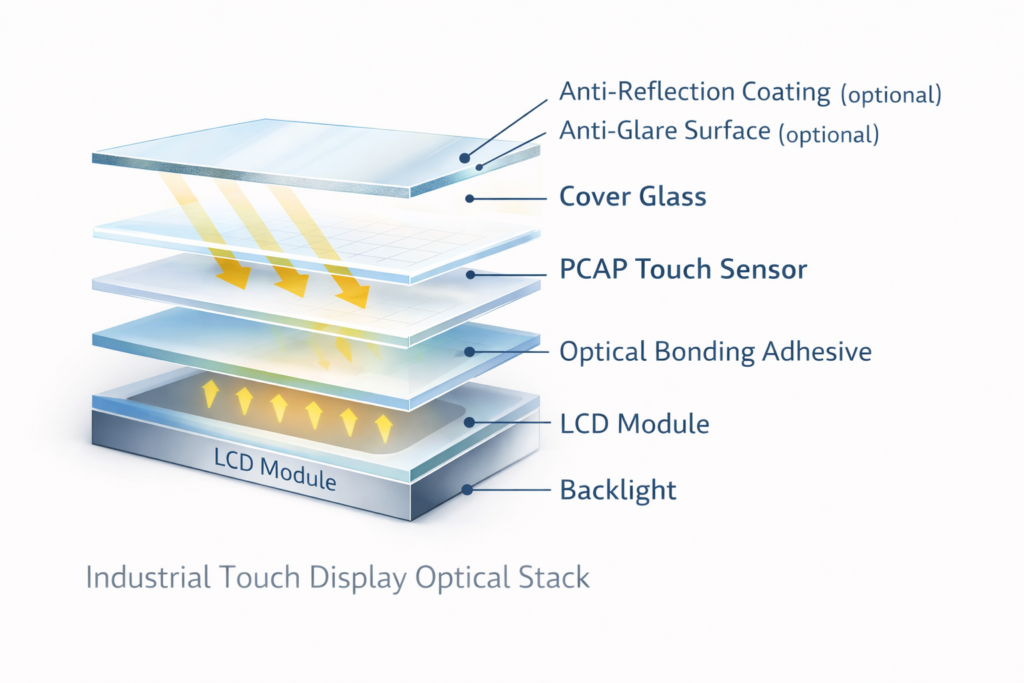
Many industrial HMIs rely on touch input for operator interaction.
Two technologies are commonly used.
Projected capacitive touch supports multi-touch interaction and is commonly paired with glass surfaces. It is widely used in modern industrial operator interfaces.
Resistive touch systems can be operated with gloves or stylus input and are less sensitive to water or contaminants. Some legacy equipment platforms still rely on this technology.
The supplier’s experience with touch controller tuning and environmental calibration can influence long-term reliability.
Optical bonding improves display readability and structural durability.
During this process, the air gap between the LCD panel and protective glass is filled with a transparent adhesive.
Benefits include:
Optical bonding is widely used in outdoor equipment and transportation systems.
Industrial displays typically include controller boards that convert system signals into the format required by the LCD panel.
Controller electronics may manage:
Suppliers that provide validated controller boards and firmware support can simplify integration with embedded computing platforms.
When evaluating a potential industrial display supplier, engineers typically examine several technical and operational factors.
The table below summarizes common evaluation criteria.
| Evaluation Factor | Why It Matters for OEM Equipment |
|---|---|
| Engineering support | Simplifies electrical and mechanical integration |
| Customization capability | Allows display module to match enclosure design |
| Lifecycle management | Reduces risk of panel discontinuation |
| Environmental testing | Ensures reliability under vibration and temperature cycling |
| Supply chain stability | Supports long-term equipment production |
Evaluating these factors early during product development helps prevent redesigns later in the equipment lifecycle.
Selecting a supplier also requires evaluating environmental, mechanical, and electrical constraints.
Industrial equipment may operate in environments that include:
Displays designed for consumer electronics often cannot tolerate these conditions.
Industrial display modules typically support wider temperature ranges and more robust mechanical structures.
Outdoor equipment may require specifications such as −20°C to +70°C operating range, combined with UV-resistant materials and sealed enclosures.
Industrial equipment platforms often remain in production for 5–10 years or longer.
However, consumer LCD panels may be discontinued within a few years. This mismatch can introduce supply-chain risk.
Engineers evaluating an industrial display supplier should therefore review:
Suppliers that actively manage panel lifecycle transitions help reduce unexpected redesign work.
Display modules must integrate mechanically with the equipment enclosure.
Important factors include:
Industrial display suppliers typically provide CAD models and mechanical drawings to support enclosure design.
Displays must operate reliably with embedded computing systems.
Integration considerations may include:
Suppliers that provide reference designs and controller validation can significantly reduce development time.
Industrial display modules are used across many equipment categories.
EV charging stations often integrate outdoor displays used for user interaction and payment interfaces.
These systems require displays that tolerate:
High-brightness displays combined with optical bonding are commonly used.
Factory automation equipment frequently integrates displays for:
Reliability during continuous industrial operation is an important requirement.
Transportation kiosks and ticketing machines often use industrial touch displays designed for frequent public interaction.
These systems typically require:
Infrastructure equipment such as parking systems, ticketing terminals, and access control devices may remain installed for many years.
Long lifecycle support from the industrial display supplier is therefore especially important.
Working with a specialized industrial display supplier is usually beneficial when equipment requires:
OEM manufacturers producing equipment platforms at moderate or high volume often benefit from long-term supplier collaboration.
Displays are a critical part of modern industrial equipment interfaces. Selecting the right industrial display supplier requires evaluating display technology, system integration requirements, and long-term component availability.
Early collaboration with an experienced supplier can simplify integration, reduce development risk, and support reliable equipment operation throughout the product lifecycle.
By considering both technical and lifecycle factors, OEM manufacturers can design equipment platforms intended for long-term industrial deployment.
What distinguishes an industrial display supplier from a consumer display vendor?
Industrial display suppliers typically support longer product lifecycles, wider operating temperature ranges, and customization for embedded equipment.
What brightness level is needed for outdoor industrial displays?
Outdoor industrial displays commonly require brightness levels above 1000 cd/m² to maintain readability under direct sunlight.
How long do industrial display modules typically remain available?
Industrial display modules are often supported for 5–10 years, depending on the LCD panel manufacturer and supplier lifecycle strategy.
Can industrial displays be customized for OEM equipment?
Yes. Suppliers often provide customization options including cover glass thickness, brightness adjustments, and mechanical mounting modifications.
When should a display supplier be involved in equipment development?
Ideally during early system design, when enclosure dimensions, controller interfaces, and environmental requirements are being defined.
Introduction Human-machine interfaces (HMIs) are now standard components in modern industrial equipment. Displays allow operators to …
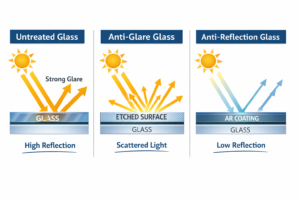
Introduction Industrial displays are frequently deployed in environments where lighting conditions are difficult to control. Equipment …
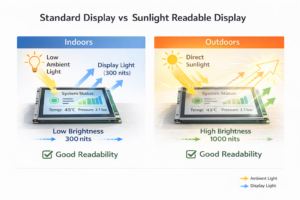
Introduction Displays are a critical interface component in many types of industrial equipment. They provide system …
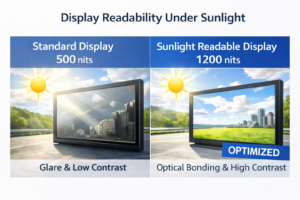
Introduction Display visibility is a critical design parameter in industrial equipment. Operators rely on graphical interfaces …
Send your application details. We respond with configuration direction and next steps.