Sunlight Readable Industrial Displays: Engineering Guide
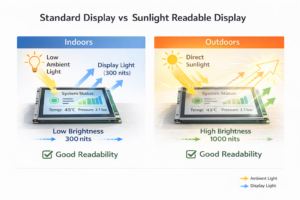
Introduction Displays are a critical interface component in many types of industrial equipment. They provide system …
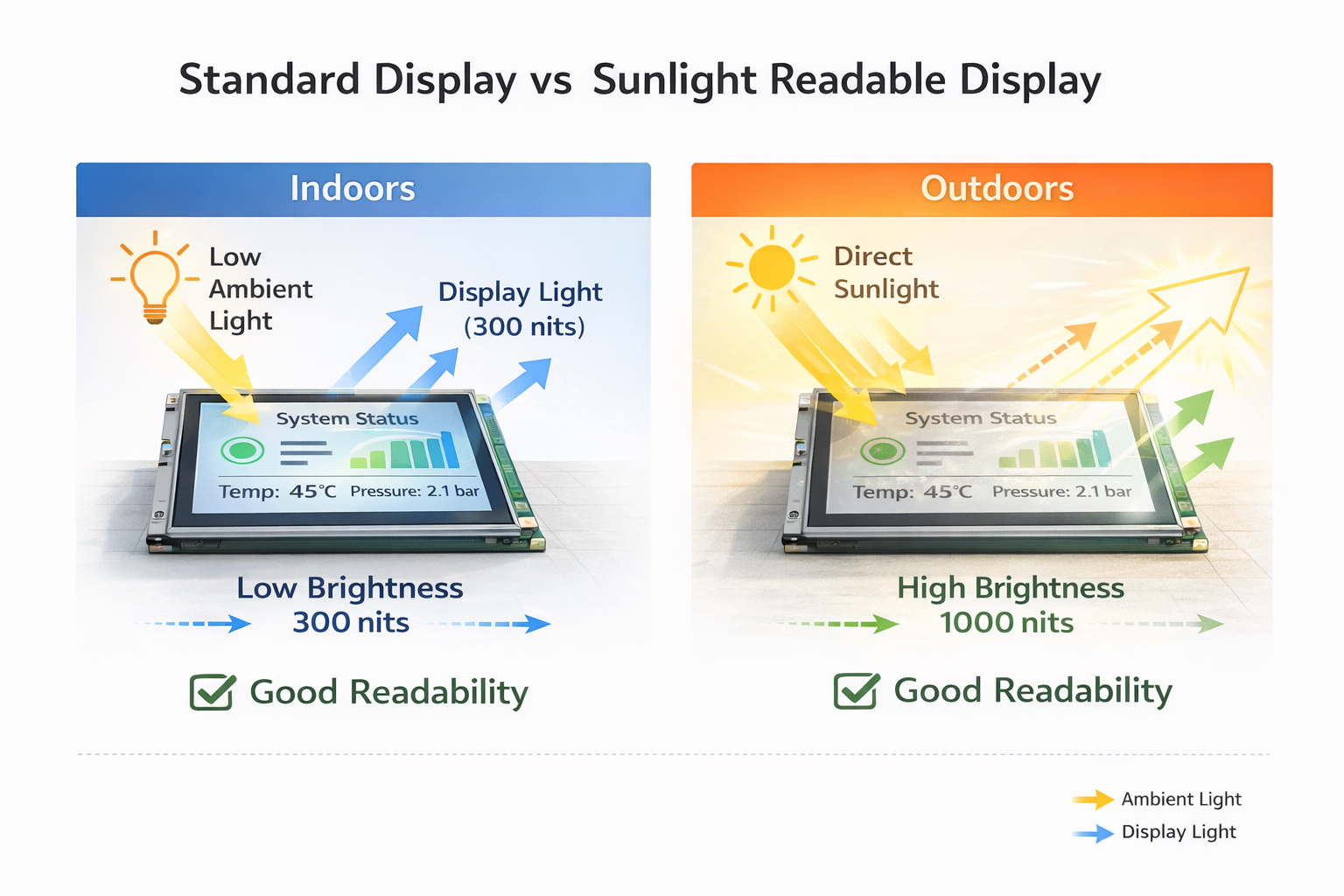
Displays are a critical interface component in many types of industrial equipment. They provide system status information, diagnostics, configuration interfaces, and operational feedback for operators and maintenance personnel.
In controlled indoor environments, standard LCD displays usually provide sufficient visibility. However, many industrial systems are deployed in environments where ambient lighting conditions are significantly more demanding.
Examples include:
In these environments, direct sunlight and strong ambient light can significantly reduce display readability.
Two optical challenges are typically involved:
When ambient light intensity approaches or exceeds the light emitted by the display panel, the screen may appear washed out and difficult to read.
A sunlight readable display addresses these challenges through a combination of:
For engineers designing outdoor industrial equipment, selecting the appropriate display architecture is important for maintaining reliable human-machine interaction.
A sunlight readable display is a display designed to remain visible under high ambient light conditions, including direct sunlight.
These displays typically combine multiple technologies:
The objective is not only to increase brightness but also to reduce reflections and maintain contrast.
Without reflection management, increasing brightness alone may not significantly improve outdoor readability.
Direct sunlight can exceed 10,000 nits of ambient light intensity.
However, the readability of a display depends primarily on the contrast between emitted light and reflected ambient light.
Typical brightness levels include:
| Display Type | Typical Brightness |
|---|---|
| Standard indoor display | 200–350 nits |
| Semi-outdoor display | 500–700 nits |
| Sunlight readable display | 800–1500+ nits |
In many outdoor systems, brightness above 1000 nits combined with optical bonding provides acceptable visibility.
Higher brightness may be required when:
The difference between standard displays and sunlight readable displays involves several engineering factors beyond brightness.
| Characteristic | Standard Display | Sunlight Readable Display |
|---|---|---|
| Brightness | 200–350 nits | 800–1500+ nits |
| Optical bonding | Rare | Common |
| Reflection control | Minimal | AR or AG coatings |
| Thermal design | Limited | Enhanced |
| Intended environment | Indoor | Outdoor / high ambient light |
Effective sunlight readable designs focus on both brightness and optical efficiency.
The most visible feature of a sunlight readable display is increased brightness.
Industrial sunlight readable displays typically operate between 800 and 1500 nits, which allows the display to compete with reflected ambient light.
However, increasing brightness introduces several engineering trade-offs:
Backlight systems must therefore be integrated with appropriate thermal design.
Optical bonding is widely used in industrial display assemblies to improve both optical performance and mechanical reliability.
In conventional displays, air gaps exist between layers such as:
Each air-glass interface reflects a portion of incoming light.
Under strong ambient lighting, these reflections significantly reduce display contrast.
Optical bonding eliminates these air gaps by filling them with optically clear adhesive (OCA).
A typical bonded display stack includes:
Benefits include:
Optical bonding also improves vibration resistance and reduces condensation risk inside the display assembly.
Surface reflections from protective cover glass can significantly affect visibility.
Two common treatments are used.
Anti-reflective coatings reduce the amount of light reflected from the surface and increase light transmission from the display panel.
These coatings help preserve image clarity and color accuracy.
Anti-glare treatments create a slightly diffused surface that reduces mirror-like reflections.
However, aggressive anti-glare treatments may slightly reduce image sharpness.
The appropriate solution depends on the viewing distance and application environment.
Brightness alone does not guarantee outdoor readability.
Contrast ratio is equally important.
Even high-brightness displays can appear washed out if the panel contrast ratio is low.
Industrial LCD panels used in sunlight readable systems typically feature:
These characteristics help maintain visibility from different viewing positions.
Integrating a sunlight readable display requires evaluating several system-level design factors.
High-brightness backlights generate additional heat.
Outdoor installations may also experience solar heating, which raises enclosure temperature.
Common thermal management techniques include:
Thermal design becomes particularly important when displays are integrated with embedded computers such as panel PCs.
Industrial systems often operate across wide environmental temperature ranges.
Typical outdoor display specifications include:
−20 °C to +70 °C
Temperature can affect:
Display specifications should therefore be evaluated alongside the expected environmental conditions.
High-brightness displays consume more power than standard displays.
Design considerations include:
These factors are especially important for battery-powered equipment or sealed outdoor enclosures.
Industrial equipment typically requires service lifetimes exceeding five years.
Display durability depends on several factors:
Optically bonded displays generally provide improved durability because they eliminate internal air gaps that can accumulate dust or moisture.
Sunlight readable displays are widely used in equipment operating in bright environments.
Charging terminals rely on display interfaces for user interaction, payment instructions, and system status.
Reliable visibility in daylight conditions is necessary for usability.
Outdoor automation equipment and logistics yard terminals often require operator interfaces that remain readable in strong daylight.
Transportation ticketing kiosks and information terminals are frequently installed outdoors where display readability directly affects usability.
Infrastructure systems increasingly integrate displays for monitoring and user interaction.
Examples include:
These systems often integrate sunlight readable displays with embedded computing platforms such as industrial panel PCs.
A sunlight readable display is generally required when ambient light levels exceed the brightness capability of standard displays.
Use sunlight readable displays when:
A standard industrial display may be sufficient when:
Sunlight readable displays address the challenge of maintaining visibility under strong ambient lighting conditions.
Effective designs combine:
For engineers developing outdoor industrial equipment, these technologies help ensure that display interfaces remain readable across a wide range of operating conditions.
Selecting the appropriate solution requires evaluating brightness requirements, thermal design, power consumption, and environmental durability early in the design process.
Most sunlight readable displays operate between 800 and 1500 nits, depending on reflection control and ambient lighting conditions.
Yes. Optical bonding reduces internal reflections and improves contrast, which increases display readability in strong ambient light.
Yes. Many industrial touch screens incorporate sunlight readable displays, but touch performance should be evaluated for glove use, moisture exposure, and thick cover glass.
High-brightness displays generate more heat than standard displays and may require additional thermal management.
Yes. Many outdoor control systems integrate sunlight readable displays with embedded panel PCs for monitoring and control interfaces.
Introduction Displays are a critical interface component in many types of industrial equipment. They provide system …
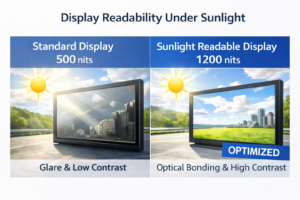
Introduction Display visibility is a critical design parameter in industrial equipment. Operators rely on graphical interfaces …

Introduction Industrial equipment increasingly relies on graphical interfaces for monitoring, diagnostics, and machine control. Modern automation …
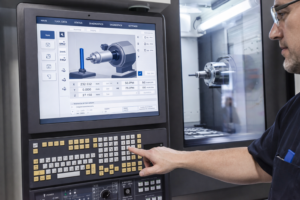
Introduction Modern CNC equipment relies on digital human–machine interfaces (HMI) to support machine operation, diagnostics, and …
Send your application details. We respond with configuration direction and next steps.