Anti-Glare vs Anti-Reflection Glass for Industrial Displays
Introduction Industrial displays are frequently deployed in environments where lighting conditions are difficult to control. Equipment …
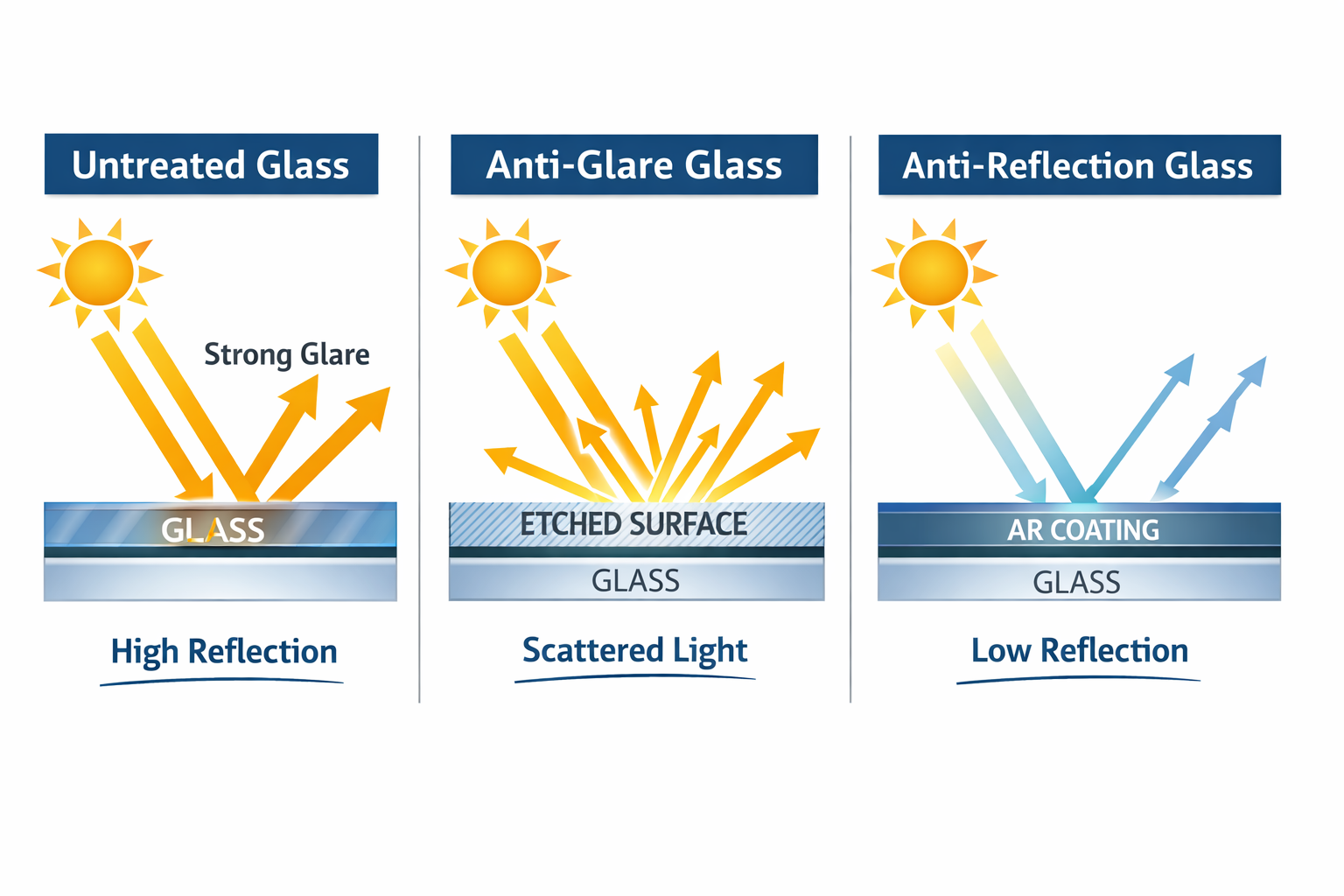
Industrial displays are frequently deployed in environments where lighting conditions are difficult to control. Equipment may be installed on factory floors with strong overhead lighting, inside transportation terminals with mixed illumination, or outdoors where displays are exposed to direct sunlight.
In these situations, reflections from the display surface can significantly reduce readability. Operators may have difficulty viewing machine parameters, diagnostic information, or graphical user interfaces when glare dominates the display surface.
For engineers designing industrial HMI systems, display visibility is not only a usability concern but also an operational reliability issue.
Two common optical treatments used to improve visibility are anti-glare (AG) glass and anti-reflection (AR) glass. Although both technologies aim to reduce the impact of reflected light, they rely on different physical mechanisms and produce different optical characteristics.
Understanding the engineering differences between these approaches is an important part of designing sunlight readable industrial displays and outdoor HMI systems.
| Feature | Anti-Glare (AG) Glass | Anti-Reflection (AR) Glass |
|---|---|---|
| Reflection control | Diffuses reflected light | Reduces reflection intensity |
| Optical mechanism | Micro-etched surface texture | Multi-layer optical coating |
| Image clarity | Slightly reduced due to diffusion | Maintained |
| Typical environments | Indoor industrial lighting | Outdoor and high-brightness environments |
| Visual effect | Matte surface appearance | Clear glass surface |
| Typical use case | Factory floors, machine panels | Sunlight readable displays |
Both technologies improve display readability, but they address different optical challenges.
Anti-glare surfaces reduce the visual distraction of reflections by scattering light, while anti-reflection coatings reduce the amount of light reflected from the display surface.
Anti-glare and anti-reflection treatments are typically applied to the cover glass layer of an industrial display module. Their purpose is to reduce reflections that interfere with display visibility.
However, the underlying mechanisms differ significantly.
Anti-glare glass is produced using a micro-etching process applied to the surface of the glass.
This process creates microscopic surface structures that scatter incoming light instead of reflecting it in a single direction. As a result, reflections appear diffused rather than mirror-like.
Typical characteristics include:
Because the surface structure diffuses light, the light emitted from the LCD panel is also slightly scattered. Fine text or small graphical details may therefore appear softer compared with untreated glass.
Anti-glare surfaces are commonly used in environments where strong directional lighting is present.
Anti-reflection glass uses multi-layer optical coatings deposited on the surface of the cover glass.
Untreated glass typically reflects approximately 4–8% of incident light per surface. AR coatings reduce this reflection through destructive interference between reflected light waves.
Depending on coating design, surface reflectance can be reduced to approximately 1–2%, which increases overall light transmission.
In many industrial displays, total transmission through the glass surface can exceed 95%, improving display contrast in bright environments.
Unlike anti-glare surfaces, AR coatings maintain image sharpness because they reduce reflections without diffusing the display light.
For this reason, AR-coated glass is frequently used in sunlight readable displays and outdoor equipment.
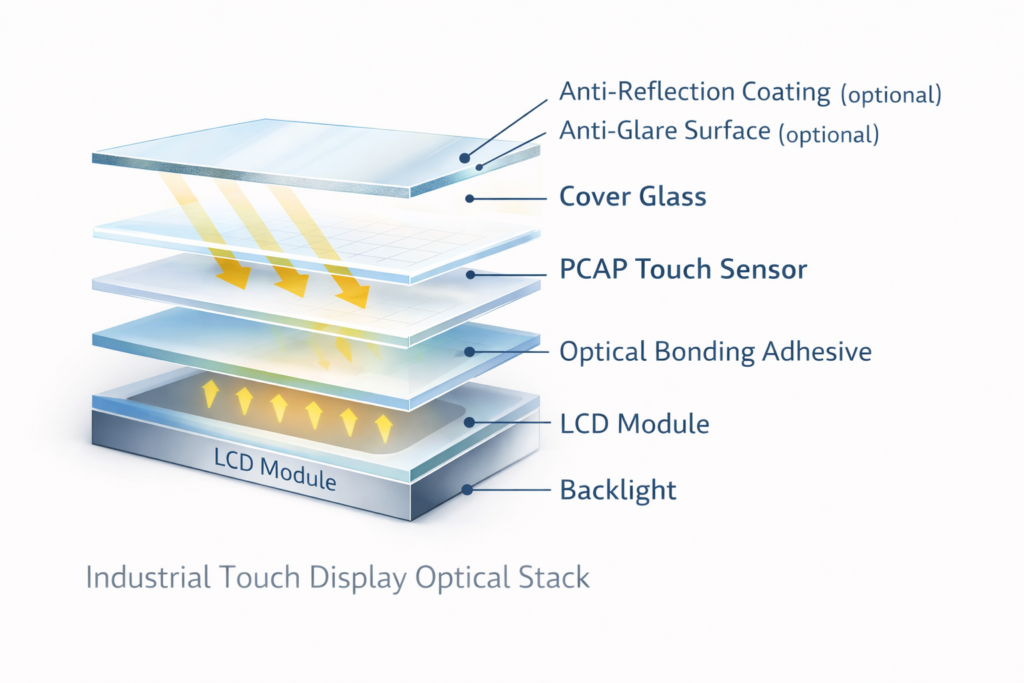
Anti-glare and anti-reflection treatments are usually integrated as part of a broader display optical stack that includes the LCD module, touch sensor, cover glass, and bonding layers.
Anti-glare glass relies on controlled surface roughness created through chemical or mechanical etching.
Typical anti-glare surfaces use a surface roughness (Ra) in the range of approximately 0.1–0.3 μm.
Surface roughness must be carefully controlled:
If the surface roughness is too high:
If the surface roughness is too low:
The appropriate surface structure depends on display resolution, viewing distance, and ambient lighting conditions.
Anti-glare glass must also remain compatible with projected capacitive (PCAP) touch systems, which require stable electrical and optical characteristics across the cover glass surface.
Anti-reflection coatings consist of several thin dielectric layers with different refractive indices.
Each layer thickness is engineered relative to visible light wavelengths so that reflected light waves partially cancel through interference.
In industrial displays, AR coatings are often used together with optical bonding in industrial displays.
Optical bonding removes the air gap between the LCD panel, touch sensor, and cover glass. Eliminating these interfaces reduces internal reflections and improves display contrast.
Integrated display stacks combining AR coatings, bonding, and touch sensors are commonly used in industrial touch screen solutions, where optical performance and system reliability must be maintained across the entire display assembly.
Selecting between anti-glare and anti-reflection glass requires evaluating several engineering factors across the complete display system.
Lighting conditions strongly influence optical performance.
In environments such as:
strong overhead lighting often creates localized reflections. Anti-glare surfaces diffuse these reflections and can improve operator visibility.
In outdoor installations, reflections are often caused by direct sunlight. In these cases, anti-reflection coatings that reduce surface reflectance typically provide better display contrast.
Anti-glare glass introduces light diffusion, which can slightly reduce perceived image sharpness.
Displays that present:
may be affected by this diffusion.
Anti-reflection coatings maintain image sharpness because they do not scatter display light.
Applications requiring precise visual detail often benefit from AR-coated glass.
Industrial equipment must tolerate frequent cleaning, environmental exposure, and mechanical interaction.
Anti-glare surfaces are typically integrated directly into the glass surface and remain stable during long-term use.
AR coatings must be designed with sufficient hardness and environmental resistance. Industrial-grade coatings are commonly evaluated using tests such as:
Durability is particularly important for outdoor equipment and public-facing interfaces.
Most industrial displays use projected capacitive (PCAP) touch technology.
Surface treatments must remain compatible with the electrical and optical characteristics of the touch system.
Important integration parameters include:
Many equipment manufacturers integrate these elements through industrial touch screen solutions, ensuring that the touch system and optical stack operate reliably together.
Anti-glare and anti-reflection glass are used in a wide range of industrial equipment.
Outdoor EV chargers operate under direct sunlight. AR coatings combined with optical bonding help maintain display contrast and readability.
Machine control panels frequently operate under strong overhead lighting. Anti-glare glass reduces reflections from ceiling lighting.
These systems commonly integrate rugged industrial touch monitors designed for continuous factory operation.
Self-service kiosks and ticketing systems operate under mixed lighting conditions. Either AG or AR glass may be used depending on installation environment.
Transportation terminals, parking systems, and access control devices often rely on integrated panel PC based HMI systems that combine computing hardware with rugged display modules.
Anti-glare glass is generally suitable when:
Anti-reflection glass is typically selected when:
In specialized equipment deployments, these optical solutions may also be integrated through custom OEM display solutions to match enclosure design, brightness requirements, and environmental constraints.
Anti-glare and anti-reflection glass both improve industrial display readability, but they address different optical challenges.
Anti-glare glass reduces glare by diffusing incoming light through a micro-etched surface. Anti-reflection coatings reduce the amount of light reflected from the display surface while maintaining image clarity.
Selecting the appropriate solution requires evaluating lighting conditions, durability requirements, and integration with the full display system.
For industrial equipment designers, these optical treatments are typically considered alongside brightness optimization, optical bonding, and touch system integration when developing reliable sunlight readable display systems.
Anti-glare glass diffuses incoming light using a micro-etched surface. Anti-reflection glass uses thin optical coatings that reduce surface reflectance and increase light transmission.
Yes. Because the surface diffuses light, anti-glare glass can slightly soften image edges compared with AR-coated glass.
In many outdoor environments, AR coatings improve visibility by reducing reflection and increasing display contrast.
Some display stacks combine lightly etched glass with AR coatings to balance glare reduction and image clarity.
Optical bonding removes air gaps between display layers, reducing internal reflections and improving contrast in high-ambient-light environments.
Introduction Industrial displays are frequently deployed in environments where lighting conditions are difficult to control. Equipment …
Introduction Displays are a critical interface component in many types of industrial equipment. They provide system …
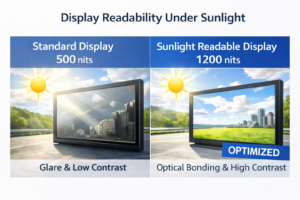
Introduction Display visibility is a critical design parameter in industrial equipment. Operators rely on graphical interfaces …

Introduction Industrial equipment increasingly relies on graphical interfaces for monitoring, diagnostics, and machine control. Modern automation …
Send your application details. We respond with configuration direction and next steps.