IPS vs TN Industrial Displays: How to Choose for Your Application
IPS vs TN — Which should you choose? Choose IPS for: multi-angle viewing, outdoor environments, touch-based …
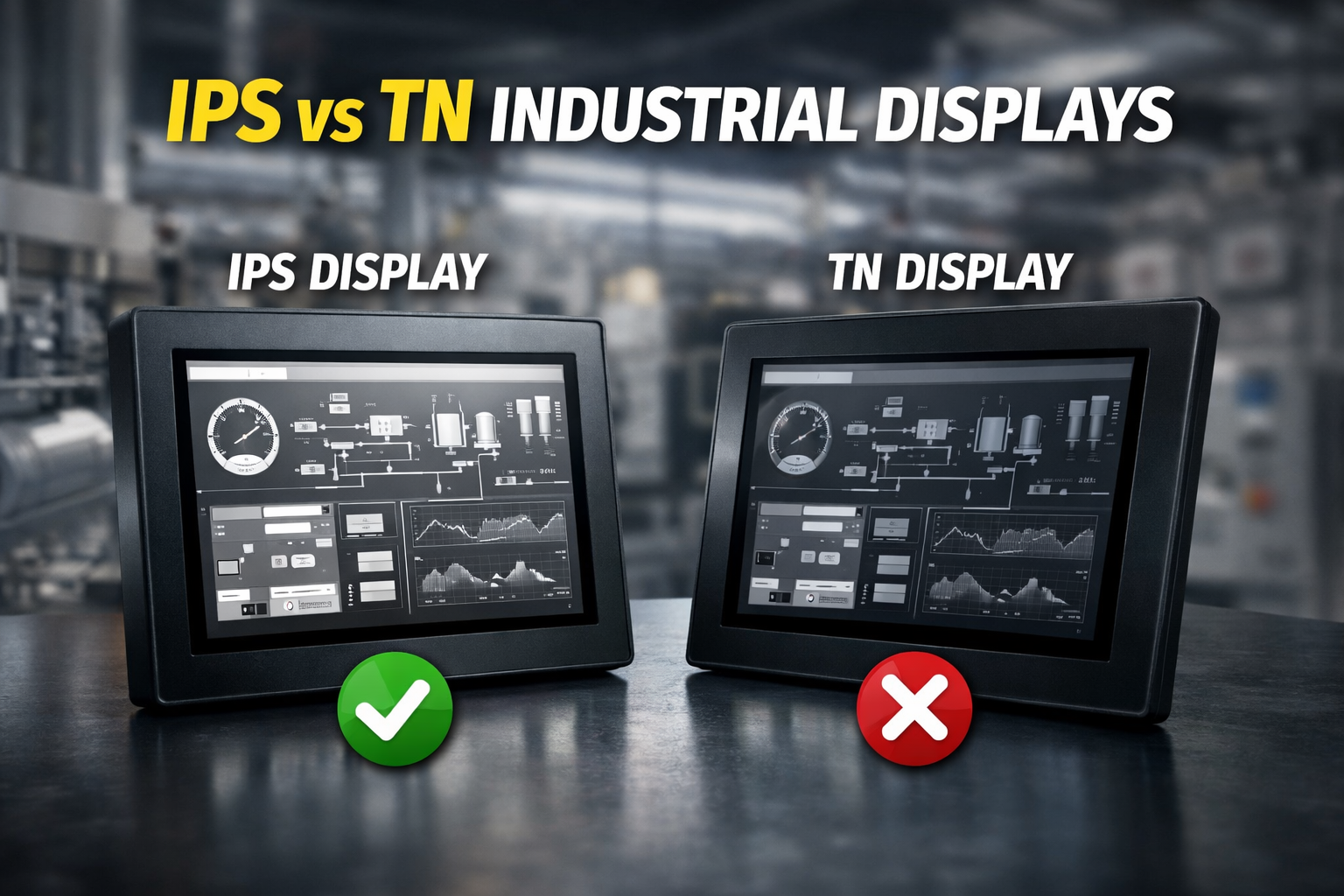
IPS vs TN — Which should you choose?
👉 IPS is recommended for most industrial HMI systems, while TN is suitable for controlled environments.
When comparing IPS vs TN industrial displays, the decision should be based on deployment conditions rather than panel specifications alone.
In industrial HMIs, kiosks, and embedded systems, display performance directly affects:
Both IPS (In-Plane Switching) and TN (Twisted Nematic) are mature LCD technologies. However, their differences in viewing behavior, optical stability, and integration performance can lead to very different results in real industrial environments. For a broader overview of how displays are selected in real systems, including interface types, enclosure design, and mounting considerations, refer to our guide on industrial display monitors.
| Parameter | IPS | TN |
|---|---|---|
| Viewing Angle | Wide (up to ~178°) | Narrow |
| Color Stability | High | Limited |
| Contrast Consistency | Stable | Angle-dependent |
| Response Time | Moderate | Fast |
| Cost | Higher | Lower |
| Typical Use | HMI, outdoor, multi-user | Fixed-position systems |
Both IPS and TN panels use liquid crystal modulation, but differ in crystal alignment:
As a result:
In real installations, displays are rarely viewed straight-on.
Typical conditions include:
IPS panels maintain consistent brightness and color under these conditions.
TN panels may show:
These effects can impact operator interpretation of data and control interfaces.
Industrial displays commonly integrate:
IPS panels are more tolerant of these layers because they maintain:
TN panels are more sensitive to viewing angle shifts, which become more noticeable after adding glass layers.
For outdoor or high-brightness environments:
IPS panels:
TN panels:
For outdoor HMIs, kiosks, or EV charging systems, IPS is generally the more reliable choice.
TN panels typically offer faster response times.
However, in most industrial applications such as:
Response time is not the limiting factor.
Modern IPS panels provide sufficient performance for these use cases.
TN panels are typically 15–30% lower in cost than IPS panels.
However, lower panel cost can introduce system-level trade-offs:
Selection guideline:
These issues often lead to either unnecessary cost or reduced usability.
The choice between IPS vs TN industrial displays should be based on how the system is actually used in the field.
IPS provides more consistent visibility and better integration with modern touch systems, making it suitable for user-facing and variable environments.
TN remains appropriate for controlled, fixed-angle applications where cost is a primary constraint.
Final selection should consider:
Is IPS always better than TN for industrial displays?
No. IPS improves visibility under varying conditions, but TN is sufficient for fixed-angle, controlled environments.
Why is IPS more expensive than TN?
IPS structures are more complex and provide more stable optical performance, increasing manufacturing cost.
Can TN industrial displays be used outdoors?
Generally not recommended due to contrast loss and poor off-axis readability.
Which panel is better for touch screen industrial systems?
IPS is typically more suitable due to stable optical performance with layered structures.
IPS vs TN — Which should you choose? Choose IPS for: multi-angle viewing, outdoor environments, touch-based …
Introduction Can a commercial LCD display be used in industrial equipment to reduce cost? This is …
Introduction In industrial system design, the industrial display monitor is not just a visualization component—it is …
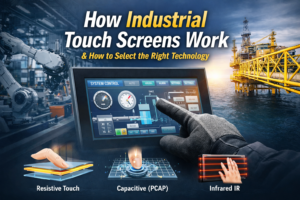
Quick Answer: How Industrial Touch Screens Work Industrial touch screens detect input using pressure (resistive), capacitance …
Send your application details. We respond with configuration direction and next steps.