How to Choose the Right Operating System for Industrial Panel PCs
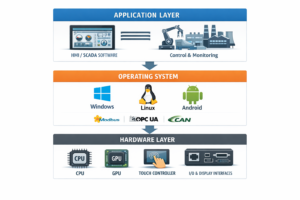
Introduction Industrial panel PCs are a core component of modern HMI (Human-Machine Interface) systems, enabling visualization, …

In industrial system design, panel PC I/O ports are a primary factor in determining how a system communicates with PLCs, sensors, networks, and peripheral devices.
They directly influence:
Panel PC I/O ports are physical interfaces such as USB, Ethernet, and serial ports that enable communication between a panel PC and external devices in industrial systems. They directly affect integration capability, reliability, and long-term maintainability.
Improper interface selection often results in protocol converters, additional failure points, and increased service costs.
From an engineering perspective, I/O planning should be aligned with the overall industrial HMI system architecture, where computing, display, and communication layers are tightly coupled.
Panel PC I/O ports are the physical and electrical interfaces that connect the embedded computing system to external equipment.
They define interaction across system layers:
In panel PC-based HMI systems, interface availability determines whether devices can connect directly or require additional gateways.
USB is commonly used for:
Engineering constraints:
Mitigation includes shielding, ESD protection, and locking connectors.
Serial communication remains widely used in industrial environments.
Advantages:
Design considerations:
Ethernet enables integration with industrial networks and remote systems.
Typical roles:
Engineering considerations:
GPIO provides basic control signaling:
These interfaces are simple and reliable but do not support protocol-level validation.
Expansion interfaces support customization in OEM panel PC designs.
Typical uses:
This allows systems to adapt to changing project requirements without redesign.
Interface selection should be based on system architecture and connected devices.
Selection guidelines:
In OEM system development, defining interfaces early reduces integration risk and avoids later redesign.
| Interface | Typical Use Case | Advantages | Limitations | Recommended Use |
|---|---|---|---|---|
| USB | Touch, peripherals | High speed, widely supported | EMI sensitivity, weak retention | Internal use, maintenance |
| RS-232 | Legacy devices | Simple, compatible | Short distance, noise sensitive | Point-to-point |
| RS-485 | PLC, fieldbus | Noise resistant, long distance | Requires termination | Industrial communication |
| Ethernet | Network, SCADA | High bandwidth, flexible | Requires shielding | System backbone |
| GPIO | Basic control | Simple, low cost | No protocol support | Status/control signals |
I/O interfaces are common ingress points for dust and moisture.
Risks:
Mitigation:
High-brightness displays increase internal system temperature.
Impact on I/O:
Thermal design should prevent heat accumulation near I/O regions.
Industrial environments introduce electromagnetic interference.
Sensitive interfaces:
More robust:
Mitigation strategies:
Vibration and mechanical stress affect long-term reliability.
Failure modes:
Design approaches:
In systems using industrial touch screen solutions:
Electrical validation is required during system integration.
Industrial systems typically operate for more than 5–10 years.
Key considerations:
Designing for lifecycle stability reduces long-term maintenance effort.
Typical field issues include:
Panel PC I/O ports should be treated as a system-level design parameter rather than a simple specification item.
Proper interface selection reduces integration complexity, improves reliability, and supports long-term operation. Poor interface planning introduces unnecessary system layers and increases failure risk.
1. Why is RS-485 widely used in industrial systems?
It provides strong noise immunity and supports long-distance communication.
2. Are USB interfaces suitable for industrial environments?
Yes, when using shielding, secure connectors, and proper cable management.
3. When should M12 connectors be used instead of RJ45?
In environments with vibration, dust, or moisture requiring sealed connections.
4. Why use dual Ethernet ports?
To separate control networks from external communication networks.
5. Can panel PC I/O be expanded later?
Yes, with expansion interfaces such as M.2 or mini PCIe.
Introduction Industrial panel PCs are a core component of modern HMI (Human-Machine Interface) systems, enabling visualization, …

Introduction In industrial system design, panel PC I/O ports are a primary factor in determining how …
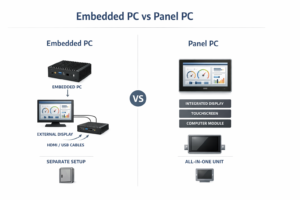
Introduction In industrial system design, selecting between an embedded PC and a panel PC is primarily …
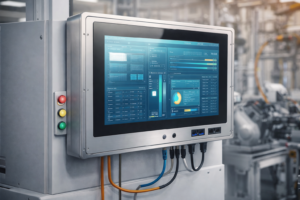
Introduction In OEM equipment development, selecting an industrial panel PC supplier is not simply a purchasing …
Send your application details. We respond with configuration direction and next steps.