Panel PC vs Industrial Computer: Architecture and Integration Differences
Introduction In industrial system design, selecting the appropriate computing architecture directly affects system reliability, integration complexity, …
In industrial system design, selecting the appropriate computing architecture directly affects system reliability, integration complexity, and lifecycle maintenance.
A common engineering decision is evaluating panel PC vs industrial computer architectures. While both provide embedded processing capability, they represent fundamentally different approaches to system integration.
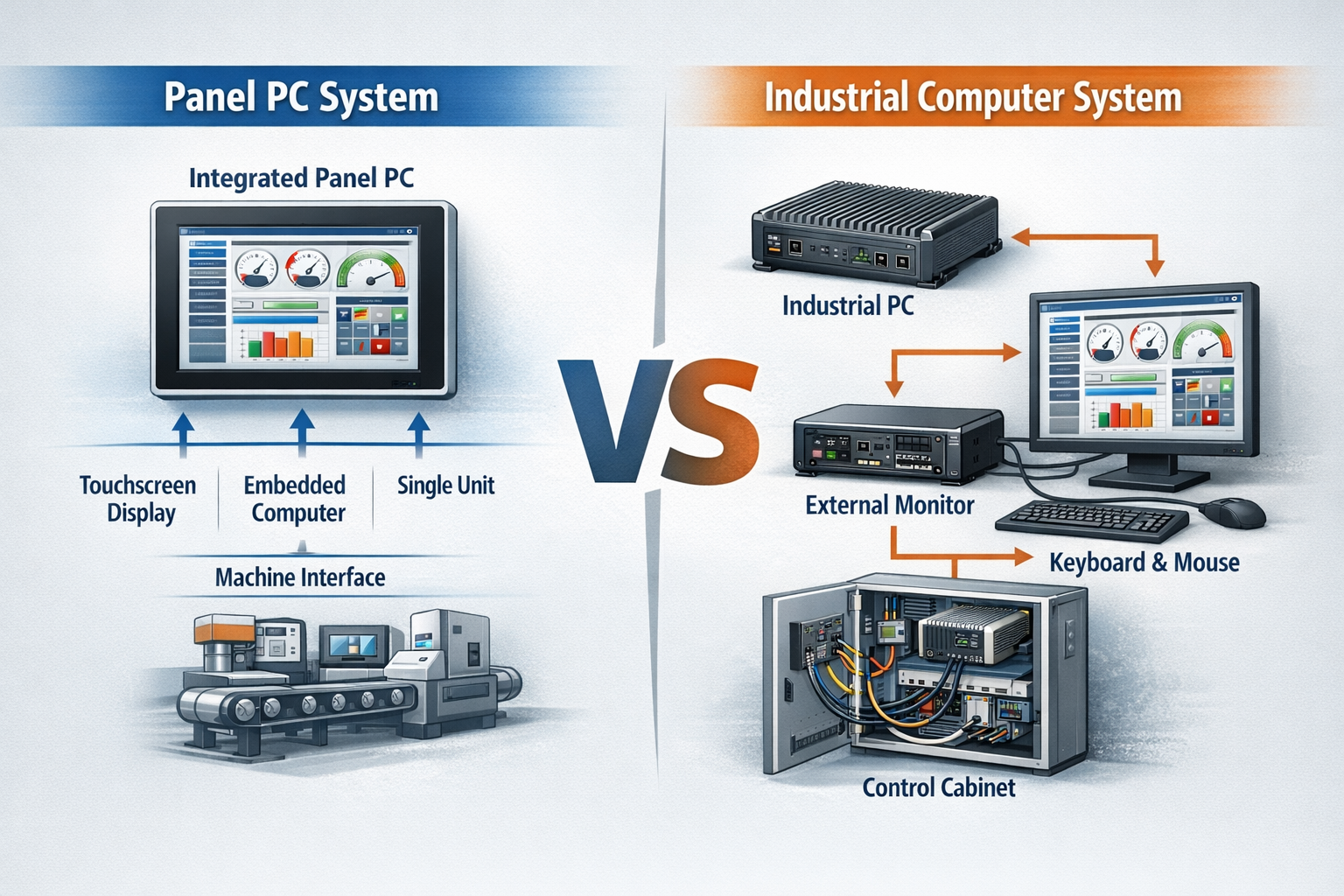
A panel PC is an integrated industrial computing device that combines display, touch interface, and embedded processing into a single unit, while an industrial computer is a modular system that requires external display and input components.
This distinction is especially relevant in industrial HMI deployments, where computing, display, and input subsystems must operate reliably under environmental and operational constraints. Panel PCs are typically implemented as distributed operator interface nodes within equipment-level control systems.
For a broader system-level understanding of how panel PCs are deployed within industrial environments, refer to the industrial HMI system architecture guide, which provides a foundational overview of panel PC integration in OEM systems.
Understanding these differences helps engineers align hardware selection with overall system architecture rather than treating computing hardware as an isolated component.
When comparing panel PC vs industrial computer, the primary difference lies in system integration level.
A panel PC integrates the following into a single enclosure:
These systems are mounted directly onto equipment panels and function as complete HMI nodes.
System characteristic:
→ Integrated, machine-level interface device
An industrial computer is a standalone computing platform that requires:
System characteristic:
→ Modular computing platform
From a system design perspective:
This architectural distinction directly impacts system deployment strategy, integration complexity, and long-term scalability.
Both panel PCs and industrial computers use similar embedded computing platforms, including:
The key difference is not the computing core, but how display, touch, and enclosure are integrated into the system.
Panel PCs integrate industrial display modules designed for:
For outdoor or high ambient light environments, sunlight-readable configurations are required. These typically include optical bonding to:
Most panel PCs implement projected capacitive (PCAP) touch due to:
This is particularly relevant in environments involving:
Industrial computers rely on external displays for touch functionality, making performance dependent on the selected monitor.
Panel PCs:
Industrial computers:
From an engineering perspective, the choice between panel PC and industrial computer is driven by environmental conditions, thermal constraints, maintenance strategy, and system complexity.
Panel PCs are designed for exposed deployment:
Industrial computers are typically installed inside enclosures, where protection depends on cabinet design.
Panel PCs typically use passive cooling:
This improves reliability but limits processing performance.
Industrial computers support:
These are better suited for compute-intensive applications.
Industrial environments introduce:
Panel PCs are validated as complete units, simplifying compliance.
Industrial computers require system-level validation when combined with external displays, cabling, and power systems.
Panel PCs simplify installation but introduce component coupling:
Industrial computers support modular maintenance:
Panel PCs reduce:
Industrial computers require:
This increases engineering effort but allows greater flexibility.
The comparison between panel PC and industrial computer is closely related to overall industrial HMI architecture design.
Panel PCs are typically deployed as distributed interface nodes at the machine level, while industrial computers are used for centralized control, data processing, or gateway functions.
Understanding this relationship helps engineers design systems that balance:
Panel PCs are widely used as machine-level HMIs:
Industrial computers are used for centralized control and data processing.
Outdoor deployment requires attention to display visibility and environmental sealing.
Panel PCs are commonly selected due to:
Applications such as ticketing and access control use:
| Aspect | Panel PC | Industrial Computer |
|---|---|---|
| Integration | High (all-in-one) | Modular |
| Installation | Simple | More complex |
| Maintenance | Coupled components | Independent components |
| Performance | Moderate | High |
| Environmental Use | Direct exposure capable | Requires enclosure |
| Upgrade Flexibility | Limited | High |
When evaluating panel PC vs industrial computer, the decision should be based on overall system architecture rather than individual component specifications.
Panel PCs reduce integration effort and support deployment in exposed environments, making them suitable for distributed HMI systems. Industrial computers provide higher flexibility, scalability, and processing capability, which are required in centralized or compute-intensive applications.
In many industrial systems, both architectures are used together—panel PCs for operator interaction and industrial computers for backend processing.
For system-level design considerations, panel PC selection should be evaluated within the broader context of industrial HMI architecture.
1. What is the main difference between a panel PC and an industrial computer?
A panel PC integrates display, touch, and computing into one unit, while an industrial computer is a modular system requiring external components.
2. Which is more suitable for harsh environments?
Panel PCs are generally more suitable due to sealed front panels and integrated construction.
3. Can industrial computers be used for HMI applications?
Yes, but they require external displays and touch interfaces.
4. Are panel PCs upgradeable?
Upgrade flexibility is limited compared to modular industrial computers.
5. How should engineers choose between them?
Selection should be based on system architecture, environmental conditions, performance requirements, and lifecycle planning.
Introduction In industrial system design, selecting the appropriate computing architecture directly affects system reliability, integration complexity, …
Introduction In industrial equipment, the display subsystem is part of a broader human-machine interface (HMI) and …

Introduction In industrial equipment design, the human-machine interface (HMI) directly affects system usability, reliability, and maintenance …

Introduction Human-machine interfaces (HMIs) are now standard components in modern industrial equipment. Displays allow operators to …
Send your application details. We respond with configuration direction and next steps.