How to Verify Industrial Touch Screen Durability Before Design Integration

Introduction In industrial equipment, a touch interface is not only a user input layer—it is a …
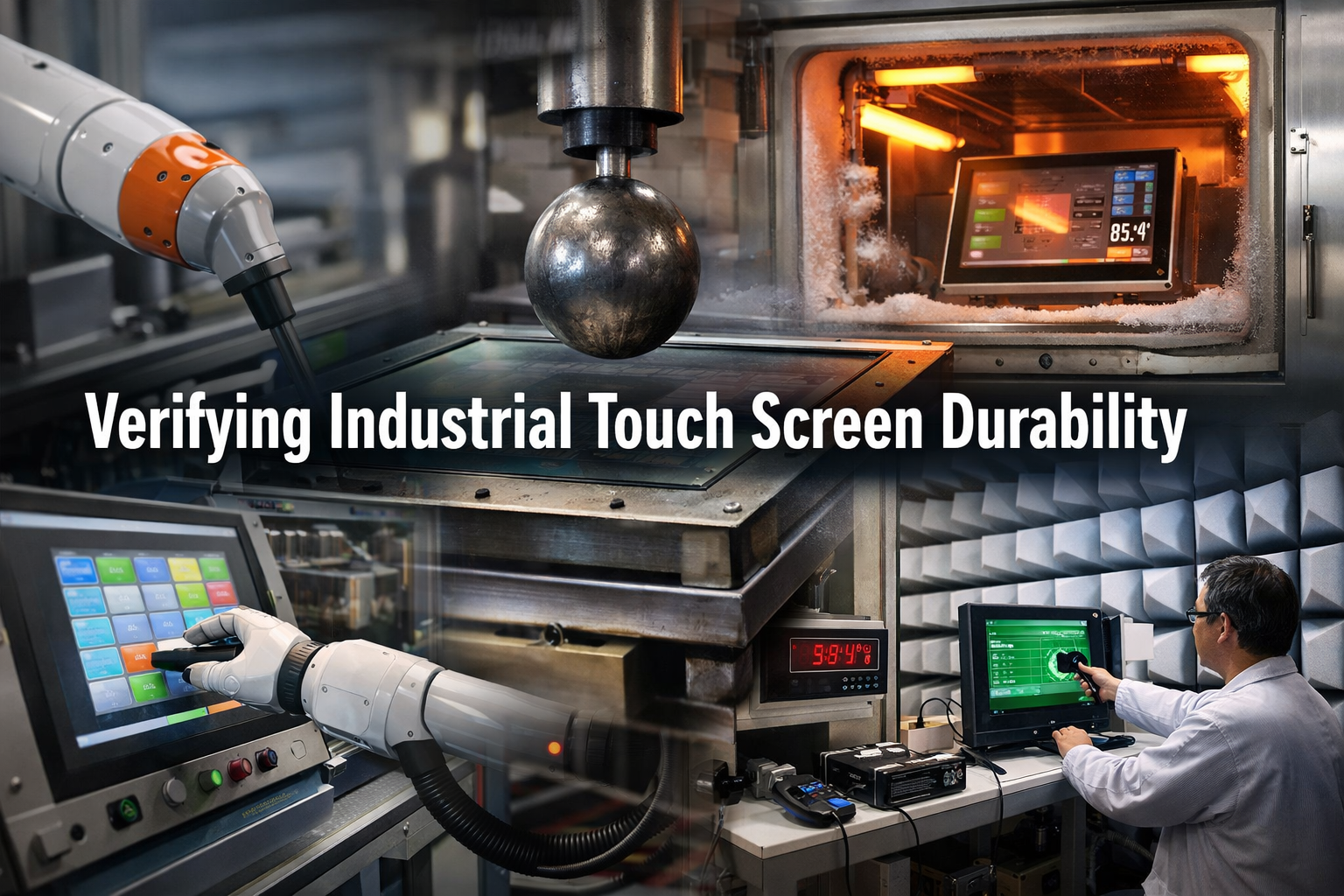
In industrial equipment, a touch interface is not only a user input layer—it is a long-term reliability component within the system.
Unlike consumer devices, industrial touch screens operate under repeated use, mechanical stress, environmental exposure, and electrical noise. Failures are often not visible at the display level. A system may continue to display images while the touch layer becomes inaccurate or unresponsive.
For OEM engineers and technical procurement teams, industrial touch screen durability must be evaluated across the full service life of the product—not just initial performance.For a broader overview of industrial touch technologies, selection criteria, and system design considerations, refer to our industrial touch screen guide.
Industrial touch screen durability is not defined by a single metric. It is the result of multiple validation dimensions working together.
It includes:
Durability applies to the full touch stack, including:
Not just the display module.
This test evaluates long-term usage through repeated touch input simulation.
Impact testing evaluates the mechanical strength of the front surface.
IK rating is directly related to front-surface durability and misuse tolerance.
Industrial systems operate under varying environmental conditions. Validation typically includes:
These tests are used to verify:
Touch interfaces are exposed to continuous physical and chemical interaction.
Typical conditions include:
Evaluation focus:
Projected capacitive touch systems are sensitive to electrical noise.
Typical interference sources:
Validation ensures:
These specifications are often confused but represent different aspects of system performance:
| Factor | Definition | Relation to Touch |
|---|---|---|
| IP Rating | Enclosure sealing (dust/water) | Not touch-specific |
| IK Rating | Mechanical impact resistance | Directly related |
| Touch Cycle Life | Input durability over time | Directly related |
IP rating depends on enclosure design at the system level.
IK rating and cycle life directly reflect touch interface robustness.
Typical reference values used in industrial projects:
These values are commonly used during specification definition and supplier comparison.
| Feature | Industrial Touch | Commercial Touch |
|---|---|---|
| Touch Lifetime | 10M+ cycles | ~1M cycles |
| Impact Resistance | IK-rated | Not specified |
| Environment | Harsh / outdoor capable | Indoor |
| EMI Stability | Designed for interference | Limited |
A common failure mode in field deployments is the use of commercial-grade touch solutions in industrial environments.
Industrial touch screen durability is strongly influenced by the controller and firmware, not only mechanical design.
These platforms are used across different application levels, with varying optimization priorities.
Controlled Indoor Environments
Examples: kiosks, office equipment
Standard Industrial HMI Systems
Examples: factory automation, embedded panels
Harsh or Outdoor Applications
Examples: EV charging stations, outdoor terminals
Key requirements:
The controller defines:
A design may pass mechanical validation but still fail in real-world conditions if the controller is not properly matched to the application.
Touch durability is a system-level outcome, influenced by:
Failures are often caused by integration issues rather than individual component defects.
Industrial touch screens are widely used in:
These applications require stable long-term operation with minimal maintenance.
Before selecting a touch solution, verify:
Without these, durability claims are difficult to verify.
Standard modules may not meet requirements when:
In these cases, a custom-designed touch solution is typically necessary.
Industrial touch screen durability is not a single specification, but a result of coordinated system design and validation.
For OEM integration, it is necessary to evaluate:
In practice, many failures are caused by mismatches between design assumptions and actual operating conditions.
A properly validated touch system reduces field failure risk, maintenance cost, and long-term operational uncertainty.
1. Is IK rating enough to evaluate durability?
No. IK rating only reflects impact resistance. Long-term touch performance requires cycle and environmental validation.
2. Can a touch screen pass testing but still fail in the field?
Yes. Failures often result from EMI, controller mismatch, or bonding degradation over time.
3. Does IP rating guarantee outdoor usability?
No. IP rating relates to sealing. Touch performance under water, temperature variation, and noise must be validated separately.
4. How critical is controller tuning?
It directly affects noise immunity, sensitivity, and long-term stability, especially in industrial environments.
Introduction In industrial equipment, a touch interface is not only a user input layer—it is a …
Introduction In industrial HMI systems, cover glass is the outermost interface between the user and the …
Introduction In industrial environments, touch interfaces must operate reliably under conditions such as glove use, moisture …
Introduction In industrial environments, a touch screen not responding is not only a usability issue—it can …
Send your application details. We respond with configuration direction and next steps.