Industrial Display Supplier Buyer Guide for OEM Equipment

Introduction Human-machine interfaces (HMIs) are now standard components in modern industrial equipment. Displays allow operators to …
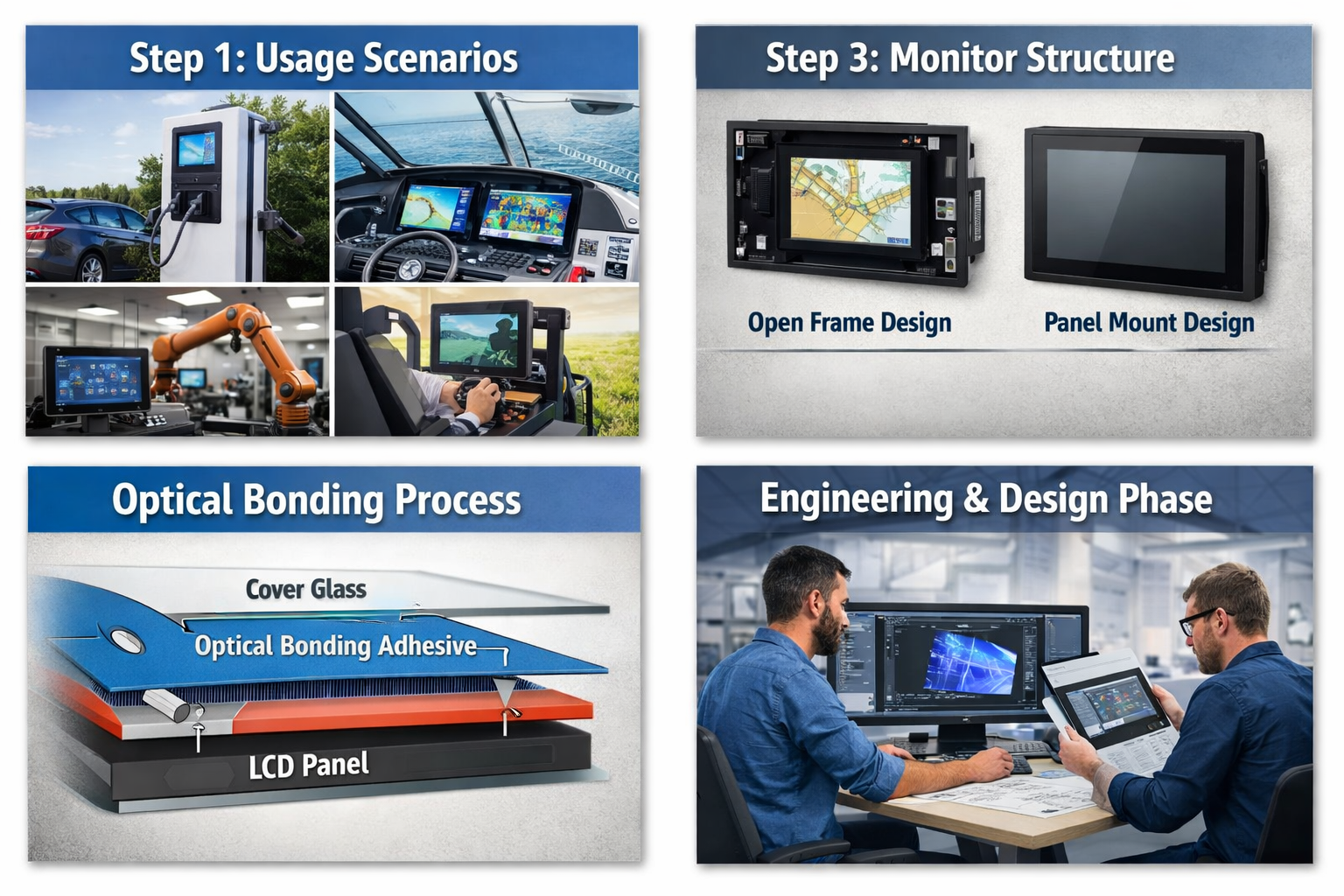
A custom sunlight readable monitor is designed to meet specific outdoor or high-ambient-light requirements that standard off-the-shelf displays cannot fully address.
In 2026, customization typically involves more than increasing brightness. It requires system-level engineering, including optical bonding, surface treatments, rugged mechanical design, environmental protection, and long-term reliability planning.
This guide explains how to customize a sunlight readable monitor step by step, helping OEMs and project teams define requirements clearly and avoid costly design mistakes.
Standard outdoor monitors may work for basic installations, but customization becomes necessary when your project involves:
Typical projects that require custom solutions include outdoor kiosks, EV chargers, industrial HMIs, transportation systems, marine equipment, agriculture machinery, and energy infrastructure.
Customization starts with understanding where and how the monitor will be used. This step influences every technical decision that follows.
Key questions include:
For example, a roadside EV charger requires very different design priorities than a marine navigation console or a factory yard HMI.
The mechanical structure determines both durability and integration compatibility.
Common design options include:
Important considerations:
A reinforced display can still fail if mounting design is overlooked.
This is the core of sunlight readability.
Brightness alone is not enough. Optical design plays an equally important role.
Optical bonding removes the air gap between the LCD and cover glass, delivering:
In 2026, optical bonding is considered standard for serious outdoor projects.
Touch performance must match both environmental conditions and user behavior.
Common options include:
Interface options typically include USB, RS232, or I²C, depending on system architecture and controller compatibility.
Outdoor readability and durability must be engineered together.
Key parameters to define:
Ignoring environmental factors often leads to premature failure—even if brightness specifications look sufficient on paper.
Before mass production, custom monitors should go through a structured validation process:
This stage ensures the design performs as expected before scaling.
Customization is not just a technical decision—it is a lifecycle decision.
Key factors include:
Well-planned customization often reduces long-term costs by minimizing field failures and redesigns.
Eagle Touch provides engineering-led customization for sunlight readable monitors and industrial touch systems, including:
To streamline project initiation, we provide a Customer Requirements Collection Form that helps capture all critical technical details early—reducing risk and development time.
Customizing a sunlight readable monitor is a system-level engineering process, not a simple brightness upgrade.
By clearly defining usage scenarios, optical requirements, mechanical integration, environmental durability, and lifecycle goals, OEMs and project teams can build outdoor display systems that remain readable, reliable, and maintainable in real-world conditions.
In 2026, successful outdoor projects are built with the environment—not against it.
Introduction Human-machine interfaces (HMIs) are now standard components in modern industrial equipment. Displays allow operators to …
Introduction Industrial displays are frequently deployed in environments where lighting conditions are difficult to control. Equipment …
Introduction Displays are a critical interface component in many types of industrial equipment. They provide system …
Introduction Display visibility is a critical design parameter in industrial equipment. Operators rely on graphical interfaces …
Send your application details. We respond with configuration direction and next steps.