What Is an Industrial Panel PC? Components, Types and Applications
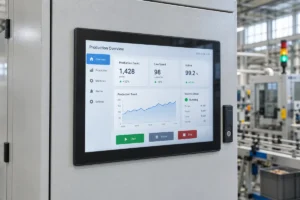
An industrial panel PC is a computer with a built-in display, usually a touchscreen, designed for …
Eagle Touch Engineering Team

There is no single best industrial panel PC manufacturer for every project.
A factory already built around Siemens automation has a different priority from an equipment manufacturer adding a SCADA operator station or MES data-entry terminal to a production line. A machine builder running TwinCAT will look at the market differently from an OEM that needs a panel PC to match an existing cabinet cutout, I/O map and software image.
That distinction matters. CPU, memory and screen size are only the visible part of a panel PC decision. The harder questions often appear after a model has been shortlisted:
This guide compares ten established industrial panel PC manufacturers. It is not a market-share ranking. The purpose is to show what each company does particularly well, where its products make sense, and when an OEM-focused supplier may be more practical than a global catalog brand.
For a detailed overview of available configurations, see our custom industrial panel PC solutions.
The list focuses on companies with a recognizable industrial panel PC product line rather than brands that mainly sell consumer all-in-one computers or touch displays.
We considered five factors:
The order below is not intended to represent revenue, shipment volume or absolute product quality. Those figures are not directly comparable across these companies.
| Manufacturer | Main Region | Relevant Panel PC Range | Strongest Fit | Typical Buying Route |
|---|---|---|---|---|
| Siemens | Germany | SIMATIC Panel PCs | Siemens automation environments | Integrated automation platform |
| Advantech | Taiwan | PPC, TPC and SPC families | Broad industrial deployment | Standard and configurable platforms |
| Beckhoff | Germany | CP2xxx, CP3xxx, CP4xxx and CP5xxx | PC-based control and motion systems | Hardware and automation ecosystem |
| Phoenix Contact | Germany | VL3 panel PCs and standalone panel PCs | Machine visualization and decentralized control | Standard automation platform |
| Axiomtek | Taiwan | GOT fanless and application-specific panel PCs | Industrial, transport and embedded applications | Standard and semi-custom systems |
| IEI Integration | Taiwan | PPC, PPC-F and PPC2-C families | Broad embedded and industrial integration | Catalog platforms and project configuration |
| Kontron | Europe | FlatClient ECO, PRO, STS and MAR | Long-life embedded and specialized environments | Standard and configurable systems |
| AAEON | Taiwan | OMNI modular HMI panel PCs | Modular HMI and edge integration | Modular platform and ODM support |
| Winmate | Taiwan | Front IP65, G-WIN, PP and stainless series | Rugged, marine, vehicle and washdown use | Application-specific rugged platforms |
| NEXCOM | Taiwan | APPC applied panel PC family | Automation, machine terminals and connected systems | Standard industrial platforms |
Siemens SIMATIC Panel PCs are a natural starting point when the machine or production line already uses Siemens controllers, engineering software and visualization tools.
Their main advantage is not simply the hardware specification. It is the fit with the wider SIMATIC environment. For factories that want a coordinated automation architecture, documented product support and a familiar engineering route, that integration can be more valuable than a lower purchase price.
Best suited for: Siemens-based production lines, process control, factory HMI and large automation programs.
Practical trade-off: A SIMATIC unit is less compelling when the panel PC is mainly a physical component inside a custom product and the project requires an unusual glass shape, enclosure, connector position or small pilot quantity. In that case, the buyer may be paying for an ecosystem that the equipment does not use.
Choose Siemens when automation compatibility leads the decision. Do not choose it only because it is a well-known name.
Advantech has one of the broadest industrial computing portfolios in the market. Its panel PC offering includes PPC all-in-one systems, TPC operator terminals and application-oriented configurations for factory and machine use.
The breadth is useful for companies that want to standardize several industrial computer formats through one supplier. Advantech can cover compact HMI terminals, higher-performance panel PCs and related embedded computing hardware without forcing the buyer to start with a niche platform.
Best suited for: factory automation, production terminals, machine control, industrial IoT and multi-site deployment.
Practical trade-off: A wide catalog does not guarantee that a standard model will match an existing cutout or product enclosure. Buyers should verify mechanical drawings, rear clearance, I/O orientation and the lifecycle of the exact configuration—not just the product family.
Advantech is a strong general-purpose shortlist when the project can work with a mature industrial platform and values broad product coverage.
Beckhoff Panel PCs are closely connected to the company’s PC-based control philosophy. The CP2xxx and CP3xxx families cover built-in and mounting-arm installations, while the newer CP4xxx and CP5xxx ranges extend the multi-touch platform.
For machine builders using TwinCAT and EtherCAT, the panel PC can serve as more than an operator interface. It can become part of the control architecture, combining visualization, PLC logic and motion tasks in a coordinated system.
Best suited for: advanced machine automation, motion control, EtherCAT systems and equipment standardized on TwinCAT.
Practical trade-off: Beckhoff’s strongest advantages depend on its control ecosystem. If the project only needs a Windows computer with a touch display, much of that value may remain unused. Mechanical and display customization should also be confirmed before the enclosure is finalized.
Beckhoff is one of the clearest choices when the panel PC is also part of the machine-control strategy.
Phoenix Contact Panel PCs are designed around industrial visualization, data processing and machine-level operation. The VL3 family includes compact panel PCs for installations where space, passive cooling and operator access matter. The company also offers standalone designs for direct machine mounting and higher-protection applications.
Phoenix Contact makes sense for customers who already use its automation, networking or control cabinet products and prefer a coordinated industrial supplier.
Best suited for: machine visualization, control cabinets, decentralized operator stations and Phoenix Contact automation environments.
Practical trade-off: Product protection ratings vary by configuration. An IP65 or IP66 front does not automatically mean that the complete unit is protected on every side. Buyers must verify the exact installation method and rating boundary.
Phoenix Contact is a stronger industrial panel PC reference than a general touch-display brand because its products are built around real automation installations.
Axiomtek’s GOT series covers compact fanless touch computers, rugged models and application-specific designs. Its portfolio is particularly useful when a buyer needs several performance levels or environmental options without moving immediately into a fully custom design.
Axiomtek also develops specialized transportation panel PCs with features such as high-brightness displays, wide power inputs, lockable connectors and railway-oriented certifications on selected models.
Best suited for: factory terminals, transport systems, embedded HMI, industrial equipment and projects that need a wider range of standard configurations.
Practical trade-off: A feature shown on one GOT model should not be assumed across the full series. Brightness, temperature range, touch type, certification and connector design must be checked against the exact part number.
Axiomtek is worth shortlisting when the application needs more specialization than a basic catalog panel PC but does not yet justify a ground-up OEM design.
IEI Integration offers PPC and PPC-F industrial panel PCs as well as higher-performance PPC2-C platforms. The company’s wider catalog includes embedded computers, industrial motherboards and edge systems, which is useful for equipment makers sourcing several computing formats.
IEI’s panel PC range covers low-power fanless units and heavier industrial platforms with more processing and expansion capability. That breadth can simplify sourcing when a product family includes both basic operator terminals and more demanding machines.
Best suited for: industrial control, embedded integration, machine interfaces, medical or edge-related equipment and OEMs needing several computer formats.
Practical trade-off: IEI maintains a large catalog, including older and end-of-life generations. Procurement teams should confirm current production status, operating-system support and the planned lifecycle of the exact model before design approval.
IEI is a practical platform supplier when catalog depth and configuration choice are more important than a single automation ecosystem.
Kontron FlatClient Panel PCs are available in different performance and mechanical versions. The range includes ECO and PRO systems, stainless-front STS models for hygiene-sensitive areas, and MAR versions for marine applications.
The FlatClient approach is valuable because it addresses different installation environments without treating every industrial project as the same. Built-in and VESA configurations, PCAP or resistive touch options and application-specific front structures are available within the wider family.
Best suited for: industrial HMI, infrastructure, transportation, marine use, hygiene-sensitive equipment and long-life embedded projects.
Practical trade-off: Specialized versions can solve demanding compliance or environmental requirements, but they may also add cost and qualification work that a normal indoor machine does not need.
Kontron is a strong European shortlist where lifecycle, documentation and specialized system design matter more than lowest initial cost.
AAEON’s OMNI series is built around modular HMI panel PCs and displays. This allows customers to select different display sizes and computing capabilities while keeping a more consistent mechanical and system concept.
AAEON also has a strong embedded and edge-computing portfolio. That makes it relevant when an HMI project may later need additional I/O, wireless functions, edge processing or a different computer module.
Best suited for: modular machine HMI, smart factory systems, edge-enabled operator terminals and projects that may need several display or performance variants.
Practical trade-off: Modularity reduces some redesign work, but it does not remove the need to confirm front dimensions, mounting, thermal limits and port access for each selected combination.
AAEON is a good choice when the buyer wants a scalable HMI platform rather than a single fixed panel PC.
Winmate has a broad range of rugged panel PCs, including front-IP65 models, G-WIN systems, chassis products, stainless-steel designs and application-specific units for marine, vehicle and washdown environments.
Its strength is environmental specialization. Buyers can shortlist different Winmate families depending on whether the priority is front protection, all-around sealing, high brightness, sunlight readability, stainless construction or rugged mounting.
Best suited for: outdoor or semi-outdoor terminals, marine systems, vehicles, food production, washdown areas and other harsh environments.
Practical trade-off: “Rugged” is not a complete specification. Verify whether the stated IP rating applies to the front only or the full enclosure, which connectors are sealed, and under what mounting conditions the rating remains valid.
Winmate should be checked early when environmental protection is one of the first design requirements rather than an option added later.
NEXCOM’s APPC family integrates industrial motherboards, touch displays and practical I/O in fanless panel PC formats. The range is aimed at automation, production monitoring and connected machine applications.
The APPC concept is straightforward: provide an all-in-one industrial terminal with front protection, several mounting methods and interfaces suitable for factory equipment. It is particularly relevant to customers who need a conventional industrial panel PC rather than a tightly coupled proprietary control ecosystem.
Best suited for: factory automation, machine terminals, production monitoring, data collection and network-connected industrial systems.
Practical trade-off: Some APPC models use earlier processor generations because industrial availability cycles are different from consumer PCs. That may be an advantage for legacy software, but new projects should confirm OS support, performance headroom and lifecycle plans.
NEXCOM is a sensible shortlist for standard industrial HMI and connected machine applications with conventional I/O requirements.
The following table is more useful than trying to name one overall winner.
| Project Priority | Manufacturers to Check First | Why |
| Existing Siemens PLC and visualization environment | Siemens | Strong fit with the SIMATIC ecosystem |
| TwinCAT, EtherCAT and PC-based motion control | Beckhoff | Panel PC and control architecture are designed together |
| Broad standard industrial platform | Advantech, Axiomtek, IEI | Large product ranges and several performance levels |
| Modular HMI across different machine sizes | AAEON, Beckhoff | Modular or multi-size panel concepts |
| Rugged outdoor, marine or vehicle installation | Winmate, Kontron, Axiomtek | Dedicated environmental and application-specific ranges |
| European automation and cabinet integration | Siemens, Beckhoff, Phoenix Contact, Kontron | Strong regional automation and support ecosystems |
| Standard machine terminal with conventional industrial I/O | NEXCOM, Advantech, IEI | Practical fanless panel PC platforms |
| Existing cabinet cutout, defined I/O, cable direction or OS image | OEM-focused supplier | Panel PC must be configured around the machine and deployment process |
A standard model is usually the safer and faster route when:
There is no benefit in creating a custom product when an established model already satisfies the real requirements. Buyers can review our standard industrial panel PC models before deciding whether customization is necessary.

OEM projects begin from the equipment and production workflow, not from the supplier’s catalog.
The panel PC may need to match an existing cabinet door, limited internal depth or defined cable path. It may also need a specific COM-port configuration, power input, connector position, startup behavior, operating-system image or connection to scanners, printers, PLCs and other production-line peripherals.
An OEM-focused supplier becomes relevant when the project needs:
That does not make an OEM supplier universally better. It means the supplier’s engineering process is better aligned with a product that cannot be designed around a fixed catalog unit.
In many production-line SCADA, MES and data-entry projects, the required computing performance is straightforward. Several standard panel PCs can run the software.
The actual integration risks are elsewhere. The unit must fit the cabinet cutout, connect reliably to the PLC network and peripherals, provide the correct COM-port mapping, start the required application after power-on and keep the same approved software environment across multiple production terminals. Cable direction and service access also matter when the rear space is already occupied by wiring ducts and control components.
A catalog model can meet the CPU requirement and still force changes to the cabinet door, bracket or internal wiring. It may also create repeated setup work if every unit arrives with a different driver or operating-system configuration. Those costs do not appear in the CPU datasheet.
This is why a datasheet comparison should never end with processor, memory and screen size. For a production-line terminal, confirm the mechanical drawing, I/O map, power-on behavior, software image, peripheral compatibility and replacement plan before approving the sample.

One drawing can expose more integration risk than ten pages of marketing specifications. Send the enclosure or cabinet-door drawing before the mechanical design is frozen.
Eagle Touch is not positioned as a replacement for Siemens, Beckhoff or Advantech. If one of their standard products already fits the machine and ecosystem, it may be the right choice.
Our role is different. Eagle Touch focuses on indoor industrial panel PC hardware for production-line equipment, industrial automation, SCADA operator stations, MES data entry, machine HMI and control-cabinet integration. In these projects, the panel PC must fit the machine and workflow—not the other way around.
Our work can include CPU-platform selection, memory and storage configuration, Windows, Linux or Android preparation, PCAP or resistive touch, panel-mount structure, front-frame and cutout review, industrial I/O, cable direction and repeat-production planning. For SCADA and MES deployments, optional system-image preparation can help keep the operating system, drivers, client software and basic settings consistent across multiple terminals. Eagle Touch supplies the panel PC hardware; SCADA or MES software, licensing and system integration remain part of the customer’s automation project unless separately agreed.
If you are already comparing two or three panel PC options, send us:
We can help determine whether a standard panel PC is sufficient or whether a custom configuration would reduce integration risk before production.
Established industrial panel PC manufacturers include Siemens, Advantech, Beckhoff, Phoenix Contact, Axiomtek, IEI Integration, Kontron, AAEON, Winmate and NEXCOM. The best choice depends on the automation ecosystem, application environment, mechanical requirements, support region and required level of customization.
An industrial panel PC is a full computer with a display and touch screen, normally capable of running Windows, Linux or another operating system and third-party software. An HMI may be a more dedicated operator terminal designed mainly to communicate with PLCs or a defined automation platform. Product terminology varies, so buyers should confirm the operating system, software environment and control responsibilities.
Confirm the MES software and operating system first, then check CPU and memory load, LAN stability, barcode scanner or printer compatibility, required COM ports, touch method, cabinet cutout, mounting depth, power-on behavior and system-image consistency. The terminal should also have a clear replacement and configuration-control plan for repeat deployment.
Yes. An industrial panel PC can run SCADA client or runtime software and serve as the operator interface for production monitoring, alarms, trends and authorized control functions. Before selecting the hardware, confirm the SCADA software and Windows or Linux version, CPU and memory requirements, display resolution, LAN architecture, required serial ports, 24/7 operating conditions and software licensing. The panel PC is the hardware platform; it is not the SCADA software itself.
Customization is justified when a standard model cannot meet the required cutout, glass design, touch performance, brightness, I/O, cable layout, mounting structure or repeat-supply plan without changing the customer’s equipment.
Provide the application, screen size, operating environment, brightness, touch method, CPU, operating system, memory, storage, I/O, power input, mounting method, enclosure drawing, target certifications, sample quantity and estimated production demand.
An industrial panel PC is a computer with a built-in display, usually a touchscreen, designed for …
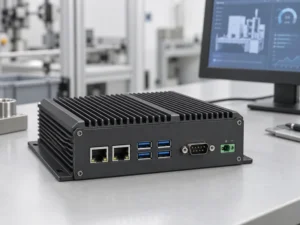
An embedded PC is a computer configured to work as part of a machine or larger …
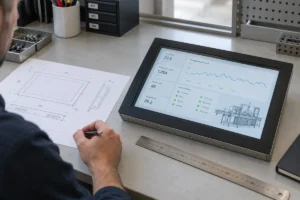
Start with the software the panel PC must run and the conditions it must fit. Then …
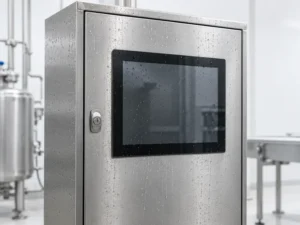
Choosing an industrial panel PC IP rating starts with two questions: what dust and water exposure …
Share your application, requirements, or current challenge. Our team will review the details and recommend a practical way forward.