Panel PC Mounting Options: VESA vs Panel Mount vs Open Frame
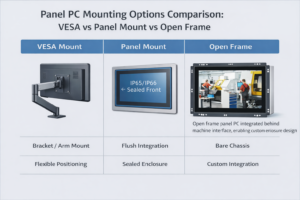
Introduction Panel PC mounting options are a key aspect of industrial panel PC system design.Selecting the …
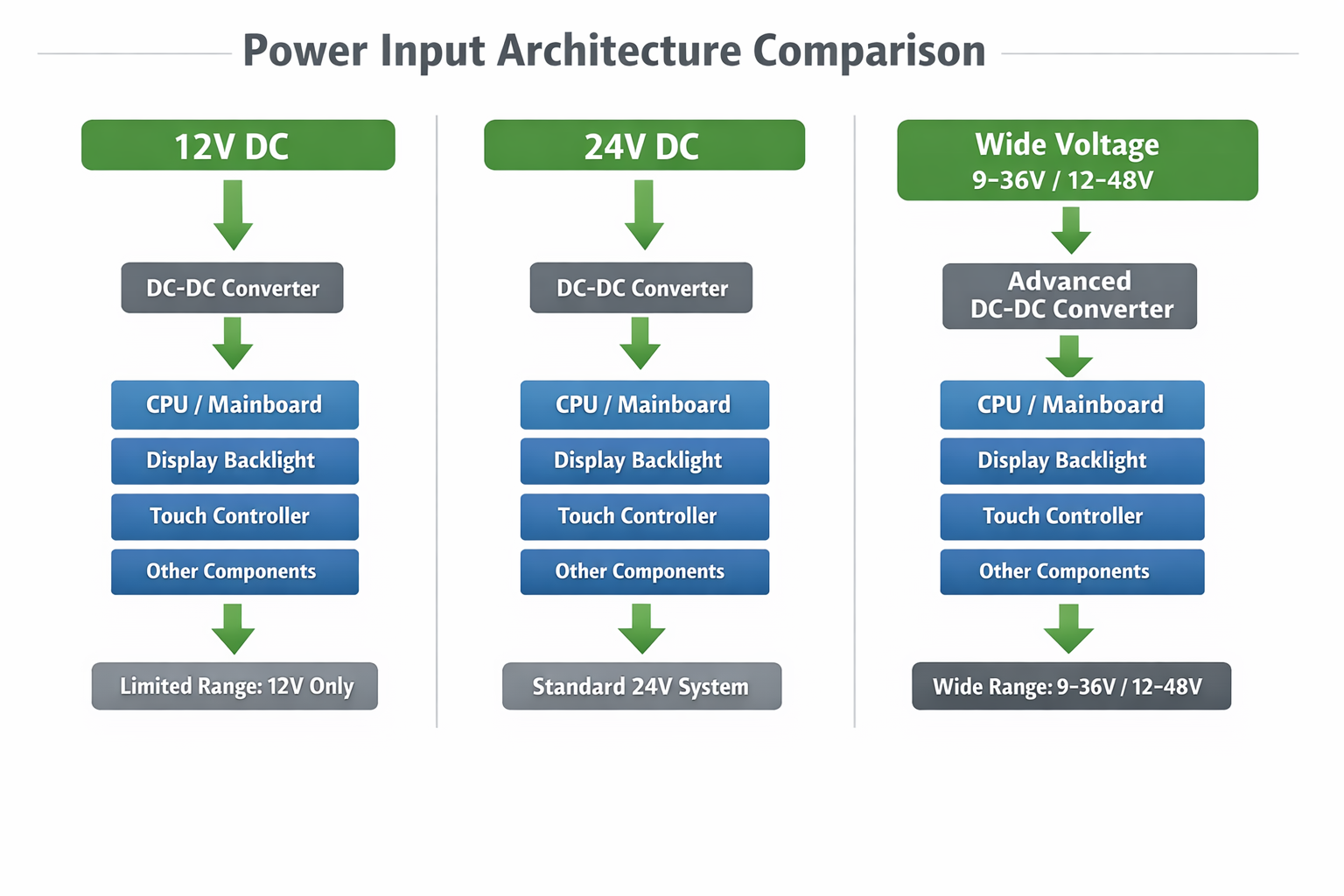
Selecting the correct power input for an industrial panel PC is not just a specification choice—it is a system-level engineering and procurement decision that directly impacts:
An incorrect power input configuration can lead to:
Industrial panel PCs are deployed across control systems, vehicles, and outdoor infrastructure where power conditions vary significantly. Selecting the appropriate input early reduces integration risk and helps prevent field failures.For a broader overview of system architecture and device selection, see our Industrial Panel PC guide.
| Power Input | Typical Use Case | Advantages | Limitations | Recommendation |
|---|---|---|---|---|
| 12V DC | Vehicles, battery-powered systems | Direct compatibility with onboard power | Sensitive to voltage drop, limited scalability | Suitable for localized or mobile systems |
| 24V DC | Industrial automation, PLC systems | Stable, standardized, widely available | Less flexible outside controlled environments | Preferred for factory systems |
| Wide Voltage (9–36V / 12–48V) | Outdoor, mobile, variable environments | Tolerates fluctuations, flexible deployment | Higher cost, more complex internal design | Suitable for multi-environment deployments |
Power input defines the acceptable voltage range and how incoming power is regulated within the system.
Industrial panel PCs rely on DC-DC conversion to provide stable power to:
The quality of this power design directly affects:
In practice, input tolerance, surge protection, and conversion efficiency are key differentiators between industrial designs.
24V DC is the dominant standard in industrial environments due to compatibility with:
Using 12V within a 24V infrastructure typically requires external DC-DC converters, increasing system complexity and potential failure points.
Industrial environments introduce electrical noise from:
Unstable input power may cause:
Wide voltage designs typically include enhanced filtering and transient protection.
Voltage drop increases with cable length and load current:
This is a common source of intermittent faults in real deployments.
Power conversion inefficiency generates internal heat:
This is particularly important for:
Power stability directly affects HMI performance:
Unstable power can degrade usability and increase operational risk.
In OEM designs, wide voltage input is commonly used to support deployment across varying power conditions without redesigning the system.
For designs with uncertain deployment conditions, wide voltage input provides greater tolerance and flexibility.
Each scenario introduces different constraints in power stability, wiring distance, and environmental exposure.
Power input selection should be treated as part of system architecture rather than a standalone specification.
Selecting the appropriate input early helps:
1. Why is 24V DC widely used in industrial systems?
Because it aligns with PLCs, sensors, and control systems, simplifying integration and maintenance.
2. When is wide voltage input necessary?
In environments with unstable power, outdoor deployment, or multi-platform requirements.
3. Can a 12V panel PC be used in a 24V system?
Only with a DC-DC converter, which adds complexity and potential failure points.
4. Does power input affect HMI performance?
Yes. Stable power is required for consistent display brightness and reliable touch response.
5. What is the safest option for uncertain deployment conditions?
Wide voltage input provides the highest tolerance and flexibility.
If power conditions or system architecture are not clearly defined, engineering evaluation can help determine the appropriate input configuration based on:
Introduction Panel PC mounting options are a key aspect of industrial panel PC system design.Selecting the …
Introduction: Why Industrial Panel Pc Power Input Selection Matters Selecting the correct power input for an …

Introduction Industrial panel PC reboot issues are often misattributed to software faults. In practice, most reboot …
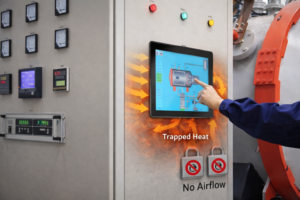
Introduction Industrial panel PCs often fail in high-temperature environments—not because of hardware defects, but due to …
Send your application details. We respond with configuration direction and next steps.