Industrial Display Supplier Buyer Guide for OEM Equipment

Introduction Human-machine interfaces (HMIs) are now standard components in modern industrial equipment. Displays allow operators to …
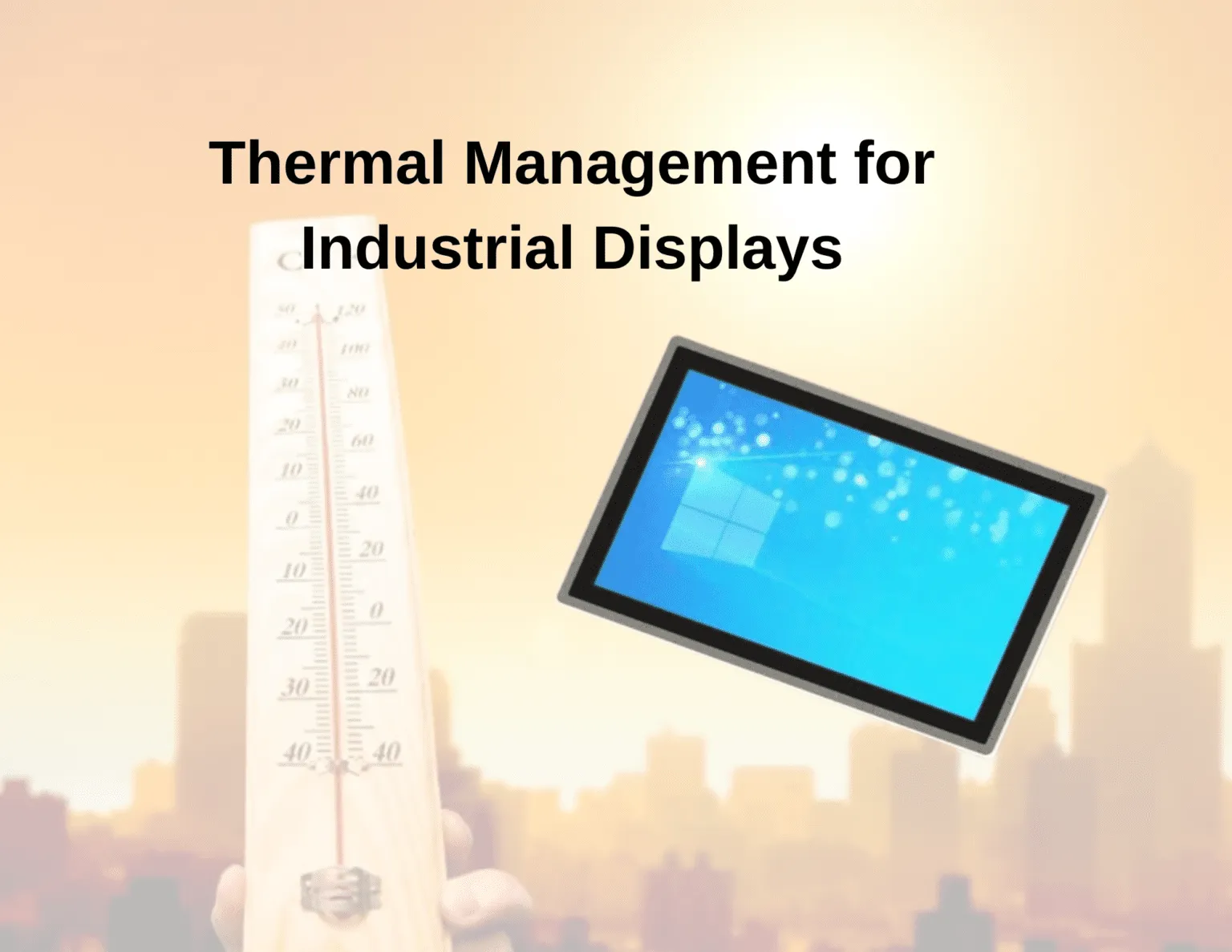
In industrial equipment, display failures rarely occur as sudden events. Most failures develop gradually as a result of long-term thermal stress accumulating during operation.
Industrial displays are commonly deployed in equipment that operates continuously, is installed in sealed enclosures, or is exposed to elevated ambient temperatures. In these environments, thermal management in industrial displays becomes a major factor affecting system reliability and operational lifespan.
Unlike consumer electronics, industrial display systems are expected to operate for many years with limited maintenance access. They are frequently integrated into:
In these deployments, airflow is often restricted and environmental conditions are less predictable.
Because of these constraints, internal temperature rise is unavoidable. The engineering challenge is not eliminating heat entirely, but ensuring that heat generation, distribution, and dissipation remain controlled and predictable throughout the device lifecycle.
Thermal stress rarely causes immediate failure. Instead, elevated temperature accelerates multiple aging mechanisms simultaneously, including:
For OEM engineers integrating industrial touch screens, industrial monitors, or panel PC displays, understanding the thermal behavior of the display subsystem is essential for achieving long-term system reliability.
Thermal management in industrial displays refers to the engineering strategies used to control internal temperatures and prevent localized overheating within the display assembly.
These strategies operate across multiple system levels:
The objective is to maintain stable operating temperatures for critical subsystems including:
Although the display is only one part of a larger electronic system, it often becomes one of the most thermally sensitive components. This is because optical components, power electronics, and signal processing circuits are integrated into a relatively compact module.
A well-designed thermal system allows internally generated heat to move through defined conduction paths and dissipate through the enclosure or surrounding structure. Without these thermal pathways, heat accumulates inside the display module and accelerates component aging.
Understanding thermal behavior begins with identifying where heat is generated within the display subsystem.
In most industrial displays, the LED backlight assembly is the dominant source of heat generation.
Display brightness is directly linked to LED drive current. Higher brightness requires increased current, which raises the LED junction temperature.
Elevated junction temperature accelerates several degradation mechanisms:
Even moderate increases in LED junction temperature can significantly reduce backlight lifetime. For this reason, high-brightness displays used in outdoor applications must manage heat carefully, as they operate under both high drive current and elevated environmental temperature.
Industrial displays typically include multiple power regulation stages such as:
These circuits operate continuously and generate localized heat on the power board.
Long-term exposure to elevated temperatures accelerates aging in nearby components, particularly electrolytic capacitors. Capacitor lifetime is strongly temperature dependent, and thermal stress in this region can eventually lead to voltage instability or reduced power delivery reliability late in the system lifecycle.
Timing controllers (TCON), display interface ICs, and signal processing components also contribute to thermal load.
Although these components generate less heat than the backlight system, they can create localized hotspots within compact PCB areas.
Without effective heat spreading, these hotspots may contribute to:
In tightly integrated display modules, these localized thermal zones often influence long-term electronic reliability.
Temperature affects several reliability mechanisms within industrial display systems.
LED backlight lifetime is strongly temperature dependent.
Higher operating temperatures increase stress on LED junctions and accelerate luminous flux decay. As a result, displays may lose brightness faster than expected even when operating within rated specifications.
Displays used for sunlight-readable or outdoor applications are particularly sensitive to this effect.
Electronic components inside the display assembly also experience accelerated aging at elevated temperatures.
Electrolytic capacitors gradually lose electrolyte over time, which reduces capacitance and increases equivalent series resistance (ESR). Semiconductor characteristics may also drift under prolonged thermal stress, affecting voltage regulation or signal integrity.
A commonly referenced engineering rule suggests that the lifetime of many electronic components roughly halves for every 10 °C increase in operating temperature. While simplified, this illustrates how sustained thermal stress can shorten system lifespan.
Industrial displays often experience repeated heating and cooling cycles during daily operation.
These cycles create mechanical expansion and contraction in:
Over long deployment periods, thermal cycling can contribute to fatigue-related failures, particularly in environments with wide ambient temperature fluctuations.
In touch-enabled systems, temperature can also influence the stability of the sensing electronics.
Projected capacitive touch controllers rely on precise signal measurements across sensor grids. Thermal drift can affect calibration stability, leading to gradual changes in touch sensitivity or accuracy.
For equipment that depends heavily on operator interaction, maintaining stable touch performance across the full temperature range is an important design requirement.
Effective thermal management requires coordinated design decisions across the display module and the system enclosure.
Many industrial displays incorporate metal rear housings or internal heat spreading plates. These structures distribute heat across a larger surface area, reducing localized hotspots.
Aluminum back covers are widely used due to their balance between:
Thermal interface materials (TIMs) improve heat transfer between the display assembly and the system chassis.
Thermal pads or compounds fill microscopic air gaps that would otherwise reduce conduction efficiency. Proper selection of interface materials ensures heat can move efficiently from the display module into the enclosure structure.
In many industrial products, the enclosure itself functions as part of the thermal system.
Metal enclosures can act as passive heat sinks by spreading heat across the chassis surface and dissipating it through natural convection.
The effectiveness of this approach depends on:
For high-brightness displays, thermal margin can sometimes be improved through brightness derating.
Operating the backlight below maximum luminance reduces LED current and lowers junction temperature. In many applications, this trade-off provides a significant increase in backlight lifetime while maintaining acceptable readability.
Thermal performance must always be evaluated within the real deployment environment.
Displays installed in sealed cabinets or kiosks may experience heat accumulation due to limited airflow.
Without ventilation or defined conduction paths, internal temperatures may rise significantly above ambient conditions.
Outdoor equipment is exposed to solar radiation, which can increase enclosure temperature well above surrounding air temperature.
This solar loading can combine with internally generated heat to create challenging thermal conditions for display systems.
Fanless systems eliminate moving parts and reduce maintenance requirements. However, they rely entirely on passive heat dissipation.
In these designs, heat conduction through structural components becomes the primary mechanism for thermal control.
Thermal management plays an important role in many industrial systems that rely on display interfaces.
Typical applications include:
EV charging stations
Outdoor charging equipment operates continuously and often experiences sealed enclosure conditions and solar heating.
Industrial automation equipment
Factory HMIs and operator panels must maintain stable performance despite elevated ambient temperatures and long operating hours.
Public kiosks and service terminals
Kiosks frequently combine high-brightness displays with sealed front panels that restrict airflow.
Smart infrastructure devices
Transportation terminals, parking systems, and access control devices require long-term reliability with minimal maintenance access.
These systems often integrate industrial touch screens, industrial monitors, or embedded panel PCs, where display thermal behavior directly affects overall system reliability.
Thermal management becomes especially important in systems with the following characteristics:
In these environments, thermal margin directly affects lifecycle cost, maintenance intervals, and long-term field reliability.
Thermal behavior is one of the most important factors determining the service life of industrial displays.
Within a display assembly, heat is primarily generated by:
Over time, elevated temperatures accelerate component aging, reduce brightness stability, and increase the likelihood of electronic drift or mechanical fatigue.
Because many industrial systems operate continuously and with limited airflow, thermal design must be considered at both the display level and the system enclosure level.
Effective thermal management combines heat spreading structures, conduction paths, enclosure integration, and appropriate operating margins.
Ultimately, the lifespan of an industrial display is not defined solely by component specifications, but by how effectively temperature is controlled under real deployment conditions.
Introduction Human-machine interfaces (HMIs) are now standard components in modern industrial equipment. Displays allow operators to …
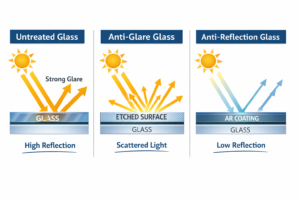
Introduction Industrial displays are frequently deployed in environments where lighting conditions are difficult to control. Equipment …
Introduction Displays are a critical interface component in many types of industrial equipment. They provide system …
Introduction Display visibility is a critical design parameter in industrial equipment. Operators rely on graphical interfaces …
Send your application details. We respond with configuration direction and next steps.