Industrial LCD Backlight Technologies: How to Choose the Right Solution for Your Application
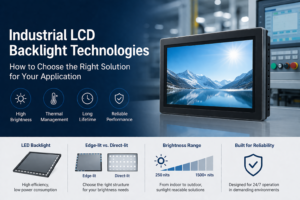
Introduction Industrial LCD backlight design directly determines display visibility, thermal performance, and long-term reliability. While LCD …
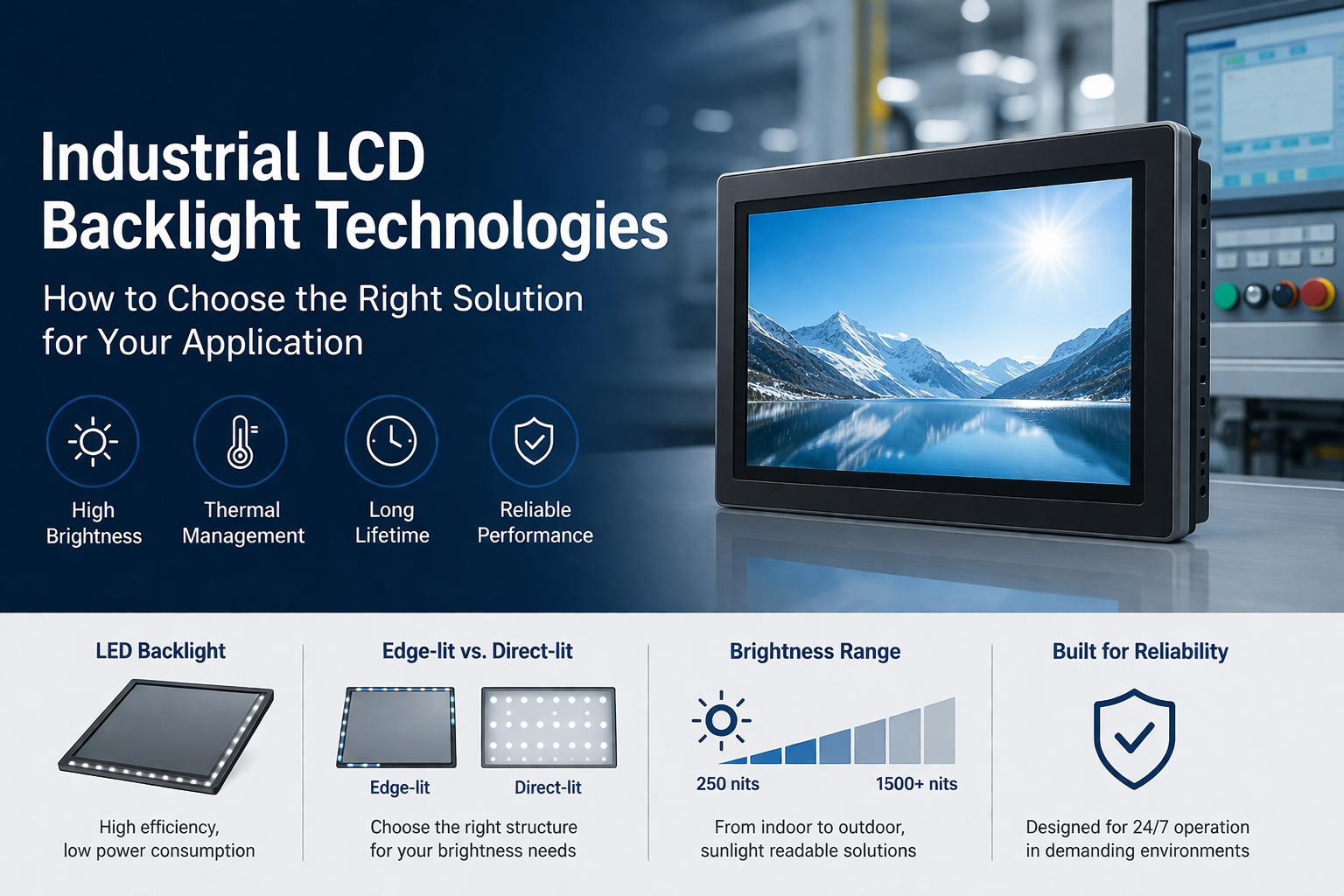
Industrial LCD backlight design directly determines display visibility, thermal performance, and long-term reliability. While LCD panels define resolution and color characteristics, the industrial LCD backlight governs usable brightness under real operating conditions.
In applications such as outdoor kiosks, EV charging stations, factory HMI systems, and embedded panel PCs, displays must operate under high ambient light, temperature variation, and continuous duty cycles.
Improper backlight selection can result in:
This article explains industrial LCD backlight technologies and provides practical selection guidelines for engineering applications.
Choosing the wrong industrial LCD backlight can lead to overheating, poor sunlight visibility, and significantly reduced system lifespan.
For a broader overview of how displays are selected in real systems, including interface types, enclosure design, and mounting considerations, refer to our guide on industrial display monitors.
An industrial LCD backlight is the illumination system located behind the liquid crystal layer. Since LCDs are non-emissive, the backlight is required to produce visible images.
Modern industrial displays primarily use LED-based backlights due to:
Key performance parameters include:
Backlight performance must be evaluated as part of the complete display system, including touch layers, cover glass, and optical bonding, all of which reduce effective brightness.
CCFL (Cold Cathode Fluorescent Lamp) backlights were used in earlier LCD systems but are now largely obsolete in industrial applications.
| Parameter | CCFL | LED |
|---|---|---|
| Brightness | Lower | Higher |
| Lifetime | Shorter | Longer (50,000+ hours) |
| Power Consumption | Higher | Lower |
| Reliability | Lower | Higher |
Engineering conclusion:
LED backlights are the standard choice for modern industrial display systems due to efficiency, controllability, and lifecycle advantages.
Industrial LED backlights are typically implemented in two architectures:
Edge-lit Backlight
Direct-lit Backlight
Selection guideline:
| Application | Recommended Backlight Type |
|---|---|
| Indoor HMI | Edge-lit LED |
| Thin embedded systems | Edge-lit LED |
| Outdoor / sunlight readable | Direct-lit LED |
| High brightness (>1000 nits) | Direct-lit LED |
Backlight brightness is a primary parameter in industrial display design.
Typical ranges:
However, brightness alone does not guarantee visibility. Effective readability depends on system-level optical performance:
Engineering insight:
Increasing brightness without controlling reflections leads to diminishing improvement in real-world visibility.
Industrial backlights typically support:
PWM is widely used due to implementation simplicity and compatibility with LED drivers. However, low PWM frequencies may introduce visible flicker.
Integration consideration:
Dimming frequency must be validated for applications involving human interaction or machine vision systems.
Thermal management is the primary constraint in high-brightness industrial LCD backlight systems.
Key factors include:
Key relationship:
Higher brightness → higher thermal load → reduced lifetime (if unmanaged)
This is particularly critical in sealed systems such as outdoor kiosks and panel PCs.
Industrial backlight lifetime is typically defined using the L70 standard, representing the time until brightness decreases to 70% of its initial value.
Typical lifetime:
Key influencing factors:
Engineering note:
For 24/7 operation, thermal derating and current control are required to maintain expected service life.
Use the following guidelines to quickly determine the correct backlight type for your application.
| Application | Recommended Backlight Solution |
|---|---|
| Factory HMI | Edge-lit LED, 300–500 nits |
| Outdoor kiosk / EV charging | Direct-lit LED, >1000 nits |
| Panel PC systems | Power-optimized LED design |
| Marine / harsh environments | High brightness with sealed and thermally managed design |
Rule of thumb:
Avoid the following issues:
These issues often result in reduced reliability and higher maintenance requirements.
Backlight performance is influenced by the complete display stack:
Each additional layer reduces light transmission, requiring higher initial backlight output.
Engineering approach:
Backlight selection should be performed at the system level rather than as an isolated component decision.
Industrial LED backlight systems are appropriate for:
Alternative display approaches may be more suitable when:
Industrial LCD backlight selection is a multi-parameter engineering decision involving brightness, thermal performance, lifetime, and system integration.
Evaluating backlight requirements early in the design phase reduces redesign risk and improves long-term system reliability.
Need help selecting the right industrial LCD backlight for your project?
Our engineering team can recommend optimized solutions based on your environment, brightness requirements, and system constraints.
1. What brightness is required for outdoor industrial displays?
Typically above 1000 nits, combined with optical bonding and anti-reflective treatment.
2. What is the difference between edge-lit and direct-lit backlight?
Edge-lit designs are thinner and more efficient, while direct-lit designs support higher brightness and better uniformity.
3. How does temperature affect backlight lifetime?
Higher operating temperatures accelerate LED degradation and reduce usable lifetime.
4. Can brightness be adjusted dynamically?
Yes, through PWM or analog dimming depending on system requirements.
Introduction Industrial LCD backlight design directly determines display visibility, thermal performance, and long-term reliability. While LCD …
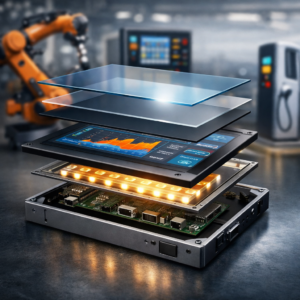
Introduction Industrial display structure directly affects system performance, reliability, and lifecycle cost in OEM equipment. Unlike …
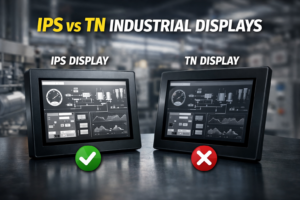
IPS vs TN — Which should you choose? Choose IPS for: multi-angle viewing, outdoor environments, touch-based …
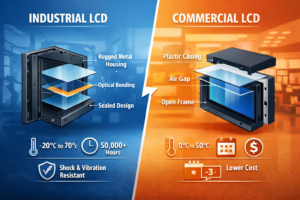
Introduction Can a commercial LCD display be used in industrial equipment to reduce cost? This is …
Send your application details. We respond with configuration direction and next steps.