What Is an Industrial Panel PC? Components, Types and Applications
An industrial panel PC is a computer with a built-in display, usually a touchscreen, designed for …
Eagle Touch Engineering Team
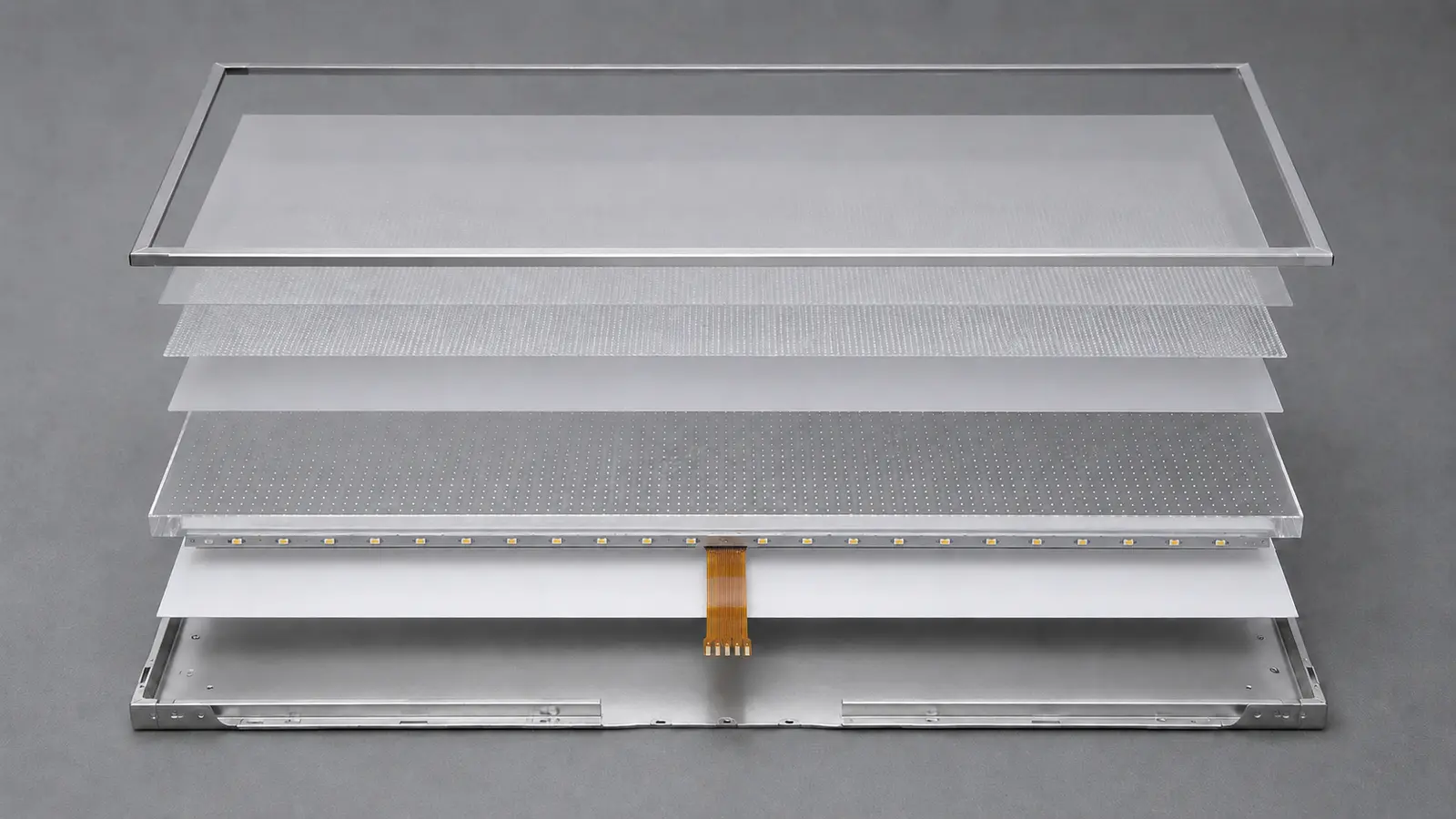
An LCD controls how much light passes through each pixel but does not produce its own light. The backlight behind it makes the image visible.
Most modern industrial TFT LCDs use LED backlights. The right choice is not simply the brightest one available. Uniformity, power, thickness, operating temperature, dimming and lifetime all affect performance in the finished equipment.
The backlight is the lighting assembly behind the TFT LCD cell. A typical edge-lit unit contains:
In a direct-lit design, the LEDs sit behind the display area instead. The backlight influences brightness, uniformity, color temperature, power, heat, thickness and service life.
For an overview of the other parts surrounding the backlight, see our industrial display structure guide.
LED is standard for new industrial TFT LCD projects. It offers a compact structure, good efficiency and straightforward brightness control.
CCFL backlights remain in older HMIs, CNC controls and other legacy equipment. A CCFL requires an inverter. An LED replacement may have a similar outline but incompatible power, brightness control or internal connections.
For a repair or retrofit, confirm the exact LCD model before replacing the panel or converting the backlight.
In an edge-lit backlight, LEDs sit along one or more edges of the light guide plate. Optical features redirect the light toward the LCD. This construction can produce a thin module.
In a direct-lit backlight, LEDs sit behind the visible area. Space is needed to blend the individual light sources and avoid bright spots, so the construction is usually deeper.
| Factor | Edge-lit | Direct-lit |
|---|---|---|
| LED position | Along the edge of the light guide | Behind the display area |
| Light distribution | Light guide plate | LED spacing and diffusion space |
| Module depth | Usually thinner | Usually deeper |
| Main design challenge | Efficient light extraction across the plate | Preventing visible LED hot spots |
| Typical use | Common across small and medium TFT LCDs | Selected larger or specially designed displays |
Neither arrangement is automatically brighter or more uniform. Results depend on LED output, optical efficiency, tolerances, temperature and current matching. A 1000-nit LCD does not automatically require a direct-lit backlight; high-brightness edge-lit panels are also available. Select by measured performance and mechanical limits, not the architecture name alone.
LCD luminance is normally stated in cd/m², also called nits. Check whether the value is typical or minimum and whether it refers to the bare LCD module or the completed touch display.
A touch sensor, cover glass and surface treatment change the light reaching the user. Optical bonding can reduce reflections, but the finished assembly still needs to be measured.
For direct sun or strong ambient light, reflection control also matters. See our guide to selecting a sunlight-readable monitor for that separate decision.
A high center reading does not guarantee an evenly lit screen. Poor backlight design can produce dark edges, bright corners, hot spots or visible bands.
Uniformity is calculated from readings taken at several positions, but formulas vary. Some manufacturers use minimum divided by maximum luminance; others use minimum divided by average. Compare values only when the measurement points, warm-up time, brightness setting and formula are known.
Inspect white and mid-gray test images after warm-up; mid-gray often reveals subtle non-uniformity more clearly.
Backlight power depends on LED quantity, string configuration, drive current and optical efficiency. More current can increase brightness, but also heat and lumen depreciation.
Ask for backlight power at the required brightness, not only the maximum power of the complete monitor. In a sealed outdoor enclosure, also consider solar load and other electronics. See outdoor industrial display overheating for the system-level issue.
Available depth can limit the construction. Edge-lit designs are usually thinner; direct-lit designs need space to mix the light. Check the complete LCD module thickness, including its frame and any customized high-brightness structure.
Two equally bright backlights can have visibly different white points. For multiple displays, replacement parts or repeat batches, specify an acceptable color-temperature range and confirm LED binning. Also check screen-area color variation, which can come from LEDs, optical films, mechanical pressure or aging.
Backlight output and efficiency change with temperature. Heat increases stress on LEDs and their driver; low temperature can change LED output, driver behavior and optical performance. The LCD temperature rating does not prove full brightness across the entire range. If that matters, request derating data and test at the actual limits.
A “50,000-hour” backlight does not switch off at hour 50,001. The figure normally marks the time until brightness falls to a defined percentage of its initial value under stated conditions.
There is no universal endpoint. One datasheet may use 50% of initial brightness, another 70% or a separate failure definition. Temperature, LED current and duty cycle also affect the result.
Before comparing two panels, check:
For a 24/7 HMI, reducing unnecessary brightness can extend useful service life.
LED backlights use PWM, analog current control or both. PWM changes LED on-time while analog dimming changes LED current. The range, minimum stable brightness and control input depend on the LCD or external driver.
With cameras or machine vision, confirm that PWM does not create banding. For day/night brightness control, see automatic dimming in industrial displays.
Use the following checklist before approving a panel or customized backlight:
| Item | What to confirm |
|---|---|
| Required luminance | Minimum and typical brightness at the finished display surface |
| Uniformity | Formula, measurement points and acceptance value |
| Backlight construction | Edge-lit or direct-lit, where relevant |
| Available depth | Maximum LCD module thickness |
| Power | Backlight power at the intended brightness |
| Color | Color temperature range and batch consistency |
| Temperature | Required operating range and any brightness derating |
| Lifetime | Hours, remaining-brightness endpoint and test conditions |
| Dimming | PWM, analog or hybrid; required dimming range |
| Duty cycle | Daily operating hours and normal brightness setting |
| Validation | Production-representative sample tested in the real enclosure |
Evaluate the sample after warm-up at the intended voltage, brightness and temperature. If touch and cover glass will be fitted, test the completed stack.
Most current industrial TFT LCDs use white LED backlights. CCFL is mainly found in older equipment and replacement projects.
Neither is universally better. Edge-lit construction is usually thinner, while direct-lit construction needs more depth. Compare actual luminance, uniformity, power, temperature and mechanical performance.
It is normally the operating time until brightness falls to a defined percentage of its initial value under specified conditions. Check the endpoint, temperature and LED current in the exact datasheet.
Sometimes, but the LED bar, driver, power supply, metal structure and thermal path may all need changes. Validate the conversion as a complete module, not a simple LED replacement.
The correct industrial LCD backlight provides the required finished-display brightness without unacceptable non-uniformity, power, thickness, heat or loss of service life. Compare specifications using the same definitions and test a representative completed display before mass production.
An industrial panel PC is a computer with a built-in display, usually a touchscreen, designed for …
An embedded PC is a computer configured to work as part of a machine or larger …
Start with the software the panel PC must run and the conditions it must fit. Then …
Choosing an industrial panel PC IP rating starts with two questions: what dust and water exposure …
Share your application, requirements, or current challenge. Our team will review the details and recommend a practical way forward.