Industrial Touch Screen Cover Glass Design Guide for OEM Systems
Introduction In industrial HMI systems, cover glass is the outermost interface between the user and the …
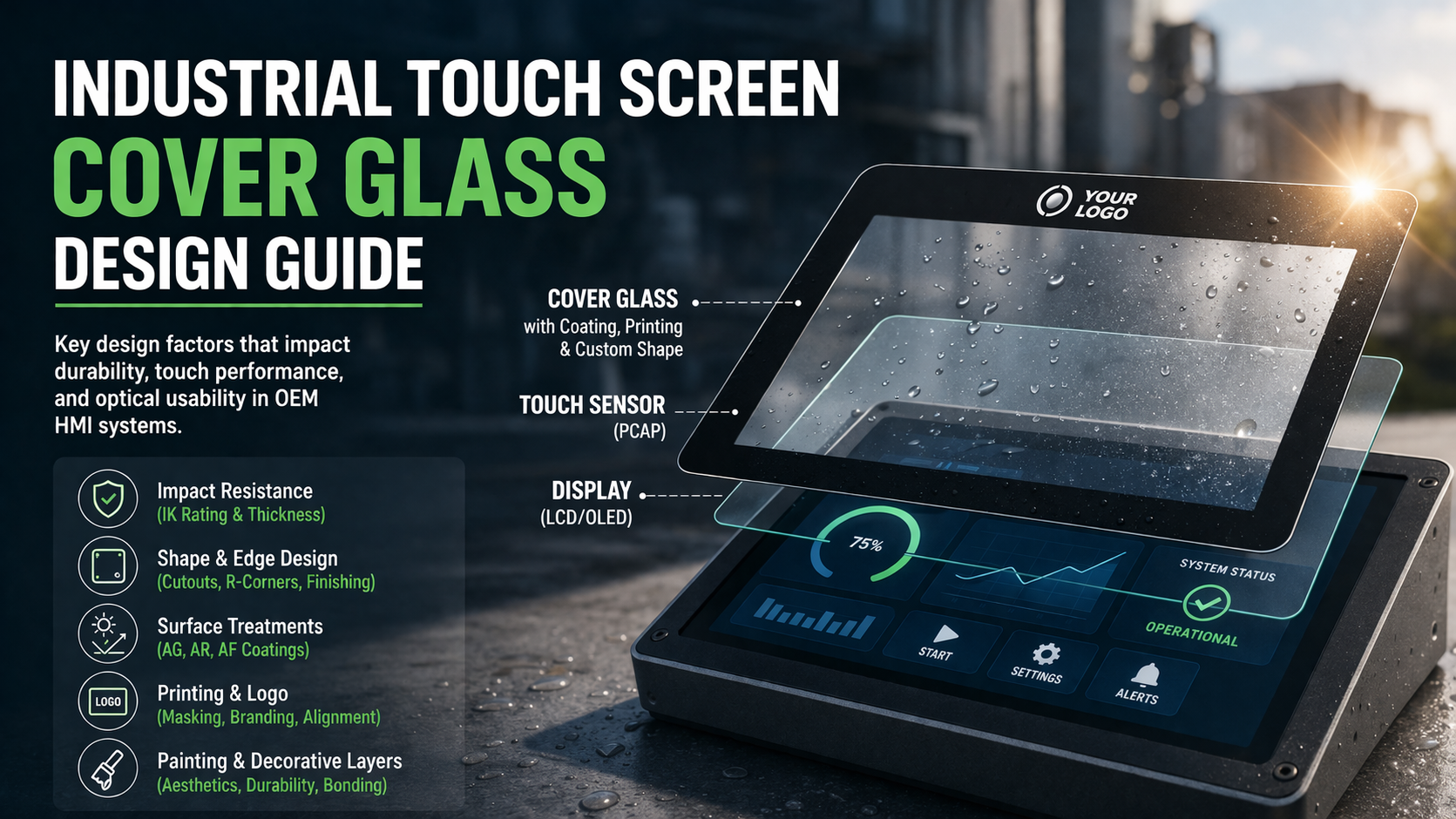
In industrial HMI systems, cover glass is the outermost interface between the user and the device. It is not only a protective layer—it is a functional engineering component that directly affects durability, touch performance, and visual usability.
For OEM applications such as automation equipment, EV charging stations, and self-service terminals, industrial touch screen cover glass must be defined based on:
Incorrect assumptions—especially around thickness or coatings—often lead to touch issues, poor readability, or mechanical failure.For a broader overview of industrial touch technologies, selection criteria, and system design considerations, refer to our industrial touch screen guide.
A common but flawed starting point is:
“Should we use 4 mm or 6 mm glass?”
This often results in overdesign and degraded usability.
Correct engineering logic:
Impact requirement → IK rating → cover glass design
IK rating (IEC 62262) defines the level of impact energy the cover glass must withstand under standardized test conditions.
| Application Type | Typical IK Level |
|---|---|
| Controlled industrial use | IK07–IK08 |
| Public / semi-outdoor systems | IK08–IK09 |
| Outdoor / vandal-prone equipment | IK10 |
Key principle:
Glass thickness, structure, and edge design must be derived from IK requirements—not chosen independently.
Typical range: 1.1 mm – 6 mm+
Engineering impact:
Critical insight:
Over-specifying thickness without defining IK requirements is a common cause of poor touch performance and unnecessary system complexity.
Industrial cover glass is typically customized and may include:
Engineering impact:
Key point:
Edge design and finishing quality often have a greater impact on durability than thickness alone.
Surface coatings determine optical usability:
Engineering trade-offs:
Practical guidance:
Outdoor applications typically require AG to suppress glare, and may combine AR or optical bonding depending on brightness and viewing conditions.
Cover glass commonly integrates:
Engineering impact:
Risks of improper design:
Printing layers must also be compatible with optical bonding processes and adhesive systems to prevent delamination or long-term visual defects.
Painting or ceramic layers are used for:
Engineering impact:
Important:
These layers are not purely cosmetic—they must meet both optical and environmental requirements.
Cover glass directly affects projected capacitive (PCAP) touch performance.
Mechanism:
Design impact:
Key insight:
Touch performance is strongly dependent on cover glass design—not just the sensor.
Cover glass determines how the display is perceived under real conditions.
Without proper design:
Key factors:
Although cover glass is a standalone component, in practice its performance depends on:
Lack of coordination often leads to:
Industrial touch screen cover glass is widely used in:
Each application requires different trade-offs between durability, usability, and optical performance.
When defining cover glass for an OEM project:
This checklist helps reduce design iteration and avoid common field failures.
Industrial touch screen cover glass is defined by interdependent design variables:
Effective design requires:
Cover glass is not a simple protective sheet—it is a critical engineering interface.
Its design directly determines:
Starting from incorrect assumptions—especially thickness—often leads to usability issues and redesign cycles.
A structured, engineering-driven approach ensures reliable and optimized system performance.
Should I choose thickness first?
No. Thickness should be derived from IK rating and system constraints.
Does thicker glass always improve durability?
It improves impact resistance but may reduce touch performance and increase integration complexity.
Is AG or AR better for outdoor use?
AG is typically required. AR may be added depending on clarity and contrast requirements.
Why is edge design critical?
Most failures occur at edges, not surfaces. Proper edge finishing is essential.
Does printing affect performance?
Yes. It affects optical uniformity, alignment, and integration with the display system.
Provide your application conditions (impact level, touch method, mounting structure), and a preliminary cover glass specification can be evaluated.
This typically includes:
Engineering response time depends on application complexity.
Introduction In industrial HMI systems, cover glass is the outermost interface between the user and the …
Introduction In industrial environments, touch interfaces must operate reliably under conditions such as glove use, moisture …

Introduction In industrial environments, a touch screen not responding is not only a usability issue—it can …
Introduction The multi-touch industrial screen is often assumed to improve usability in industrial HMI systems. In …
Send your application details. We respond with configuration direction and next steps.