Industrial Display Supplier Buyer Guide for OEM Equipment

Introduction Human-machine interfaces (HMIs) are now standard components in modern industrial equipment. Displays allow operators to …
Energy efficiency has become an increasingly important design parameter in industrial equipment. Many systems operate continuously for extended periods with limited maintenance access, making power consumption, thermal stability, and component lifetime important considerations during system design.
Industrial displays can represent a measurable portion of total system power consumption. High-brightness LCD panels used in outdoor equipment, industrial HMIs, and infrastructure terminals rely on LED backlight systems that may consume a significant share of display power.
In sealed or fanless enclosures, most electrical power consumed by the display backlight is converted directly into heat. As a result, display brightness affects not only energy consumption but also enclosure temperature and long-term reliability.
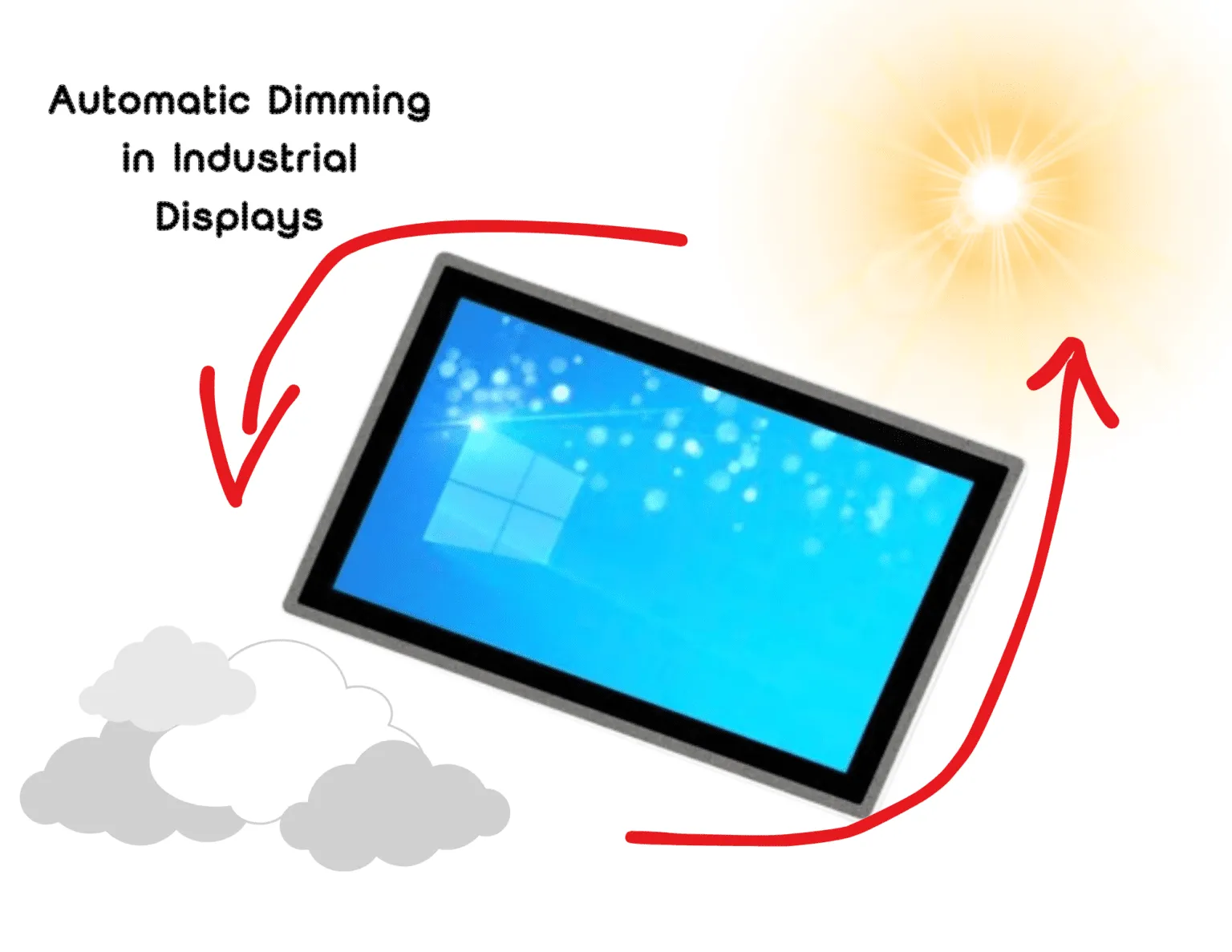
To address these challenges, many industrial displays incorporate automatic dimming and power-saving modes. These features reduce average display power consumption while maintaining readability across varying environmental lighting conditions.
However, brightness behavior in industrial systems should be evaluated at the system architecture level. Automatic brightness control may influence operator visibility, system response time, and HMI validation assumptions.
Understanding how these mechanisms work helps OEM designers integrate industrial displays more reliably into their equipment.
Automatic dimming in industrial displays is a brightness control mechanism that adjusts LED backlight intensity based on ambient lighting conditions or system operating state.
By reducing brightness in darker environments or during periods of inactivity, automatic dimming can:
This adaptive brightness behavior is particularly useful in industrial systems exposed to changing lighting conditions, such as outdoor installations or public infrastructure equipment.
Automatic dimming adjusts brightness dynamically in response to environmental lighting conditions.
Most implementations rely on an ambient light sensor that measures surrounding illumination. The display controller then adjusts LED backlight intensity to maintain sufficient contrast without applying unnecessary brightness.
For example:
This adaptive brightness behavior reduces both energy consumption and thermal load.
Power-saving modes extend brightness control by introducing additional energy management functions.
Typical mechanisms include:
In systems using embedded computers or panel PCs, display power management is often coordinated by the host operating system rather than the display hardware alone.
Industrial LCD displays rely on LED backlight assemblies driven by constant-current drivers. Brightness adjustment is usually implemented using two primary techniques.
Pulse-Width Modulation (PWM)
PWM controls brightness by switching LEDs on and off at high frequency while maintaining constant current during the active cycle. This allows a wide brightness range while maintaining stable LED color characteristics.
Analog Current Control
Analog dimming adjusts the current supplied to the LED backlight. This enables smooth brightness transitions but may reduce efficiency at very low brightness levels.
Many industrial displays combine both approaches in a hybrid dimming architecture to provide stable brightness control across a wide operating range.
PWM frequency selection is important. If the frequency is too low, visible flicker or electromagnetic interference may occur.
Automatic brightness control depends on accurate measurement of environmental lighting conditions.
Ambient light sensors measure surrounding illumination in lux and provide input to the display controller or system software.
Sensor placement significantly affects performance. If the sensor detects reflected light from the display surface or localized lighting sources, brightness adjustments may not match the operator’s viewing conditions.
In systems using industrial touch screen displays, sensors are typically positioned near the front bezel or cover glass to approximate the operator’s viewing environment.
Raw sensor measurements must be processed through brightness control algorithms before adjustments occur.
Typical implementations include:
Without these mechanisms, small variations in ambient light could cause rapid brightness fluctuations.
Proper algorithm tuning ensures that brightness changes remain gradual and predictable.
In many OEM designs, brightness behavior is coordinated by the host system rather than the display firmware alone.
For example, a machine controller may maintain full brightness during active operation and reduce brightness when the system enters an idle state.
This approach is common when industrial LCD monitors are connected to embedded computers or machine controllers.
Host-level control allows display brightness behavior to align with machine state, user interaction patterns, and power management policies.
Automatic dimming introduces dependence on sensor inputs. Industrial designs therefore include defined fallback mechanisms.
Ambient light sensors may be affected by:
Typical fallback strategies include:
These safeguards help maintain predictable display behavior even when sensor inputs become unreliable.
Industrial HMIs must remain readable under all operating conditions.
Sudden brightness changes may interfere with operator recognition or reduce contrast visibility.
In safety-related interfaces, brightness levels are often validated during system testing. Automatic brightness adjustments may conflict with those validated conditions.
For this reason, safety-critical HMIs often use fixed brightness levels.
Lighting conditions in industrial facilities may change rapidly.
Examples include:
If brightness algorithms respond too aggressively, the display may repeatedly change brightness. Adequate hysteresis and delay logic are required to stabilize brightness behavior.
Backlight power consumption contributes directly to heat generation inside sealed enclosures.
Reducing brightness lowers LED current and may reduce internal temperature and thermal stress on display components.
However, in many industrial systems, processors or power electronics generate more heat than the display itself.
System-level thermal analysis is therefore recommended before relying on brightness reduction as a primary thermal mitigation strategy.
In high-brightness industrial displays, the LED backlight can represent the largest portion of total display power consumption.
For example, a 1000–1500 nit industrial LCD display may require several times more backlight power than a display operating at moderate brightness levels.
Because of this, brightness control strategies are often considered when designing energy-efficient industrial HMI systems and outdoor display equipment.
Reducing brightness during nighttime operation or idle periods can significantly lower average system power consumption.
OEM equipment manufacturers often require configurable brightness control when specifying industrial display modules.
Brightness control may need to be integrated through system interfaces such as:
Providing flexible brightness control options allows the display subsystem to align with machine operation, user interaction patterns, and energy management strategies.
Automatic dimming and power-saving modes are most useful in systems where lighting conditions vary or operator interaction is intermittent.
Typical applications include:
These systems benefit from adaptive brightness behavior and reduced average energy consumption.
Automatic dimming performs well when:
Applications such as kiosks, EV charging stations, and infrastructure terminals commonly meet these conditions.
Some industrial systems require predictable brightness behavior.
Examples include:
In these environments, fixed brightness settings may provide more reliable operation.
Automatic dimming and power-saving modes can improve energy efficiency in industrial display systems, particularly in environments with variable lighting conditions or continuous operation.
However, brightness behavior must be evaluated within the context of the complete system architecture. Display brightness influences operator usability, enclosure thermal conditions, and system predictability.
For many OEM manufacturers and system integrators, the most reliable approach is controlled system integration. Hardware support for brightness adjustment is included, while brightness behavior is managed through system-level control logic.
Considering display power management early in the design process allows engineers to balance energy efficiency, reliability, and predictable system behavior.
Yes. Average power consumption can decrease when brightness levels are frequently reduced. The amount of reduction depends on the display brightness range and usage patterns.
Operating LEDs at lower current levels reduces thermal stress and may extend service life, depending on how often lower brightness levels are used.
Safety-related interfaces often require consistent brightness to ensure alarms and indicators remain clearly visible under all operating conditions.
Most industrial displays define fallback brightness levels and allow manual adjustment so the display remains usable even if the sensor becomes unreliable.
The LED backlight is typically the largest power consumer in an industrial LCD display. In high-brightness outdoor displays, the backlight can represent most of the display’s power consumption.
Reducing brightness during nighttime operation or idle periods can therefore significantly reduce average energy usage.
Introduction Human-machine interfaces (HMIs) are now standard components in modern industrial equipment. Displays allow operators to …
Introduction Industrial displays are frequently deployed in environments where lighting conditions are difficult to control. Equipment …
Introduction Displays are a critical interface component in many types of industrial equipment. They provide system …
Introduction Display visibility is a critical design parameter in industrial equipment. Operators rely on graphical interfaces …
Send your application details. We respond with configuration direction and next steps.