Panel PC vs Industrial Computer: Architecture and Integration Differences
Introduction In industrial system design, selecting the appropriate computing architecture directly affects system reliability, integration complexity, …
In industrial and embedded systems, interface selection is a critical design decision.
Many engineers and system integrators ask a common question:
Can a USB port function as a video input for an industrial monitor?
The short answer is: sometimes—but not in the way most people expect.
This article explains when USB can be used for video, when it cannot, and which alternatives are more suitable for industrial monitors.
A USB (Universal Serial Bus) port is primarily designed for:
Common USB use cases include keyboards, mice, storage devices, and sensors.
USB was not originally designed as a native video transmission interface like HDMI or DisplayPort.
Understanding this distinction is essential when designing industrial display systems.
A standard USB port cannot natively transmit video signals in the same way as HDMI, VGA, or DisplayPort.
However, video over USB is possible only through specific technologies and conditions, which are often misunderstood.
DisplayLink is a compression-based solution that allows video output over USB.
How it works:
Limitations for industrial use:
USB-C is often confused with standard USB.
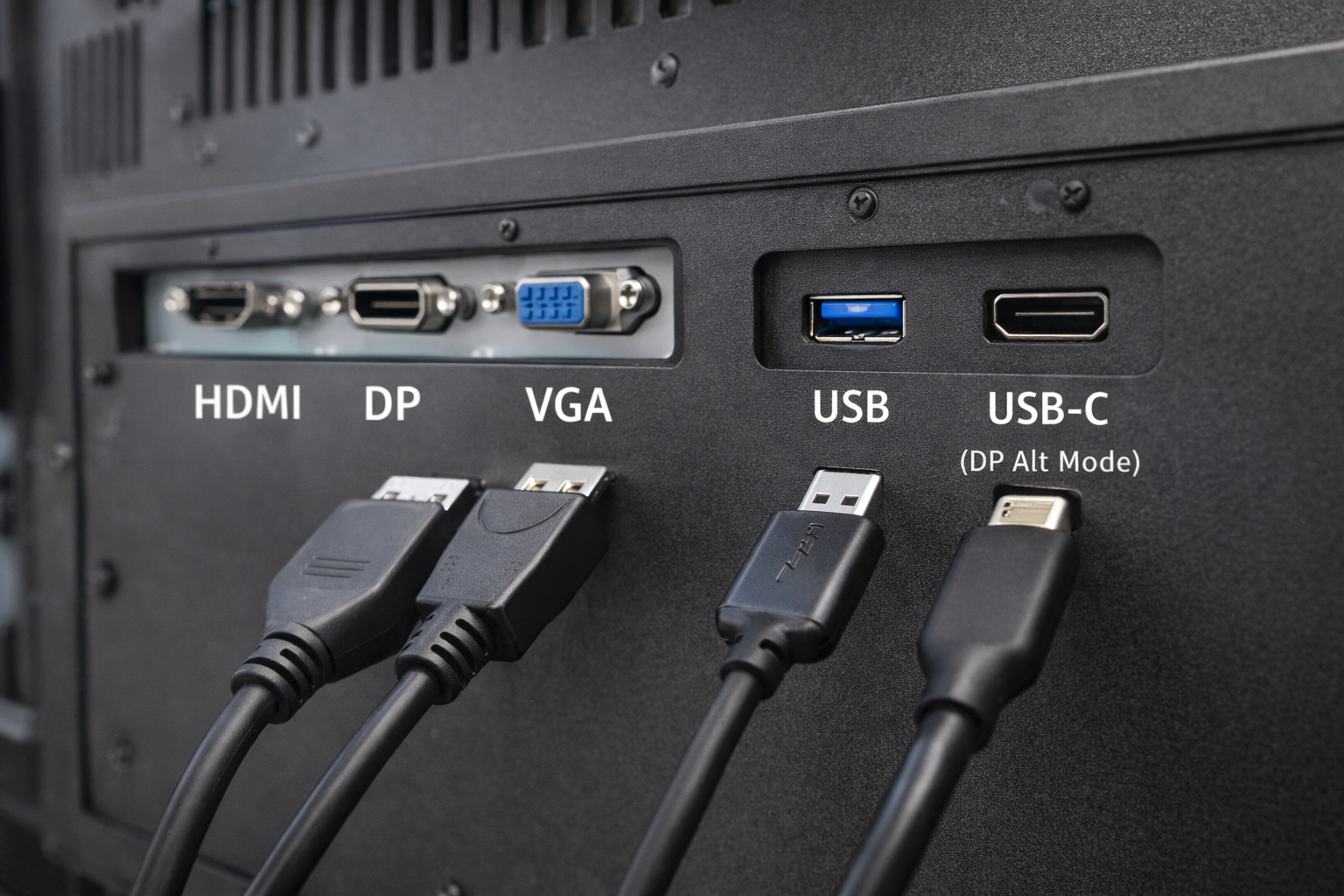
When USB-C supports DisplayPort Alt Mode, it can transmit native video signals.
Important clarifications:
For industrial monitors, USB-C video support must be explicitly specified and validated.
| Interface | Native Video | Driver Required | Industrial Reliability |
|---|---|---|---|
| USB (Standard) | ❌ No | Yes | Low |
| USB + DisplayLink | ⚠️ Software-based | Yes | Limited |
| USB-C (DP Alt Mode) | ✅ Yes | No | Moderate |
| HDMI / DP / VGA | ✅ Yes | No | High |
For most industrial applications, dedicated video interfaces remain the preferred choice.
Industrial monitors prioritize:
USB-based video solutions often introduce:
As a result, HDMI, DisplayPort, and VGA are still the standard interfaces in industrial display systems.
USB-based video is sometimes evaluated for:
Even in these cases, engineering validation is critical to avoid reliability issues.
Before selecting USB as a video interface, ask:
For most industrial projects, the answer leads back to native video interfaces.
No. Standard USB ports cannot directly replace native video interfaces.
No. Only USB-C ports that support DisplayPort Alt Mode can output video.
They may work in limited cases, but they are generally not recommended for long-term industrial deployment.
While USB technology has evolved, it is not a universal replacement for traditional video interfaces in industrial monitors.
USB-based video solutions rely on software, drivers, or specific port configurations, which introduce complexity and risk.
For stable, long-term industrial applications, dedicated video inputs such as HDMI and DisplayPort remain the most reliable choice.
Introduction In industrial system design, selecting the appropriate computing architecture directly affects system reliability, integration complexity, …
Introduction In industrial equipment, the display subsystem is part of a broader human-machine interface (HMI) and …

Introduction In industrial equipment design, the human-machine interface (HMI) directly affects system usability, reliability, and maintenance …

Introduction Human-machine interfaces (HMIs) are now standard components in modern industrial equipment. Displays allow operators to …
Send your application details. We respond with configuration direction and next steps.