What Is an Industrial Panel PC? Components, Types and Applications
An industrial panel PC is a computer with a built-in display, usually a touchscreen, designed for …
Eagle Touch Engineering Team
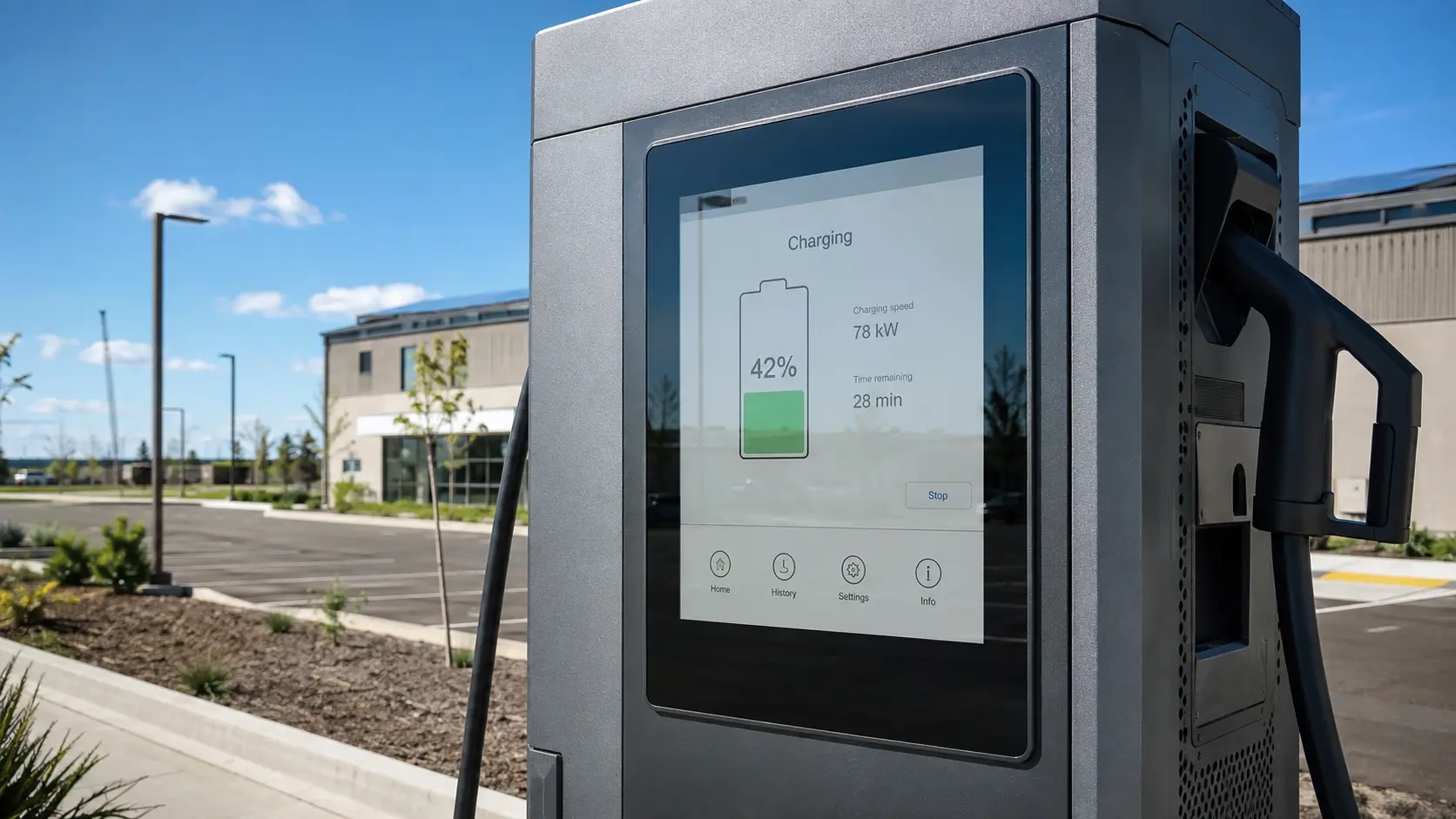
Optical bonding is not automatically necessary just because a display is described as “outdoor.” It becomes a strong engineering recommendation when the screen must remain readable in direct sunlight, the front stack is exposed to humidity and temperature cycling, or replacing a failed display in the field would be expensive.
For a shaded terminal under a canopy, with limited temperature change and easy service access, air bonding may still be the more practical choice.
The decision is not whether optical bonding is more advanced. It is whether the air gap creates an unacceptable optical or reliability risk in the finished equipment.
| Installation condition | Practical recommendation | Main reason |
|---|---|---|
| Direct sunlight for part or all of the day | Optical bonding usually recommended | Reduces internal reflection and helps preserve visible contrast |
| Outdoor EV charger, payment terminal or public kiosk | Optical bonding usually recommended | Readability and field-service cost both matter |
| Humidity plus repeated temperature cycling | Optical bonding usually recommended | Removes the air space where fogging can develop between the bonded layers |
| Thick protective glass used in front of the LCD | Review optical bonding early | The air gap can make reflection and visual depth more obvious |
| Shaded semi-outdoor installation | Air bonding may be acceptable | Lower ambient-light and condensation risk |
| Short-life equipment with easy display replacement | Air bonding may be acceptable | Lower initial cost and easier repair may outweigh the optical benefit |
| Controlled indoor HMI | Optical bonding usually unnecessary | The environment does not justify the added cost and rework difficulty |
No brightness figure, IP rating or glass thickness can decide the bonding method by itself. Review the complete front stack in its real installation environment.
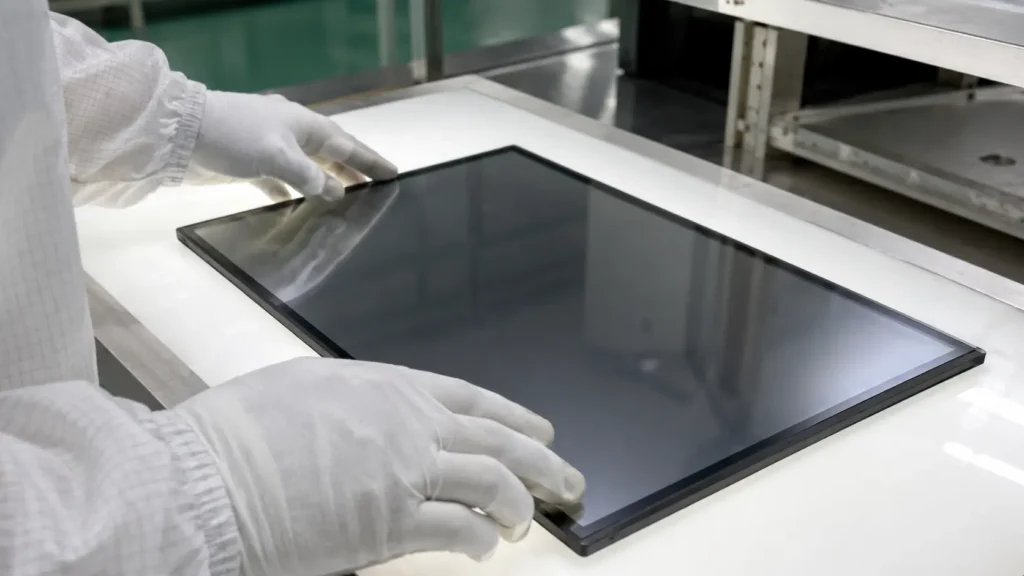
In a typical PCAP industrial display, the cover glass and touch sensor already form a touch-panel assembly. Optical bonding normally laminates that touch assembly directly to the front surface of the TFT LCD with a transparent optical adhesive, removing the air gap at that interface.
Some equipment adds another protective window in front of the completed display. If an air gap remains between that window and the display, it creates another pair of reflective surfaces. A supplier saying “optical bonding is included” does not necessarily mean every optical interface in the installed equipment is bonded.
Before approving the design, confirm:
For a detailed comparison of frame bonding, OCA and OCR, see Optical Bonding vs Air Bonding: How to Choose for Industrial Touch Displays. The first decision here is simply whether the outdoor application needs the air gap removed.
An air-bonded display contains an air interface between the LCD and the touch panel or front lens. Part of the light is reflected as it passes between materials with different refractive indices. Indoors, this may be acceptable. Under strong ambient light, those reflections lift the black level and wash out the image, leaving the operator with less useful contrast.
Optical bonding replaces the air gap with a clear material whose optical properties are closer to the surrounding layers. This reduces reflection inside the stack. It does not make the glass completely reflection-free, and it does not create brightness; it helps the available brightness reach the viewer more effectively.
This is why specifying only “1000 nits” or “1500 nits” is incomplete. Brightness and internal reflection solve different parts of outdoor readability; a bright LCD behind a poorly controlled front stack can still be difficult to read.
For the wider brightness decision—including finished-display luminance, installation angle and direct-sun conditions—see How to Choose a Sunlight Readable Monitor for Outdoor Use.
An EV charger display may face direct sun, rain, public use and large day-to-night temperature changes. The screen also sits behind a protective front structure and may be difficult to replace once the charger is deployed.
In this situation, optical bonding is normally justified. It should be selected with adequate finished-display brightness and a suitable front-surface treatment—not used as a substitute for them.
Air inside the display gap can contain moisture. When the temperature of the layers changes, fogging may appear within that gap. Once this occurs inside a sealed front assembly, it is rarely a simple field repair.
Optical bonding lowers this specific risk by eliminating the air space at the bonded interface. It does not remove moisture elsewhere in the enclosure and does not replace enclosure sealing, drainage, ventilation or humidity control.
Thick cover glass is common in public terminals and vandal-resistant equipment. When thick glass is combined with an air gap, the image can appear deeper behind the surface and internal reflections can become more noticeable.
Optical bonding often improves the optical result, but it does not create an IK rating. IK08 or IK10 performance depends on the complete front assembly, including glass type and thickness, edge support, enclosure structure and the final impact test.
Touch operation must also be validated through the final glass. Optical bonding does not replace PCAP controller tuning for thick glass, water rejection, gloves, grounding or electrical noise.
Bonded assemblies cost more and are harder to separate for repair. Even so, optical bonding may reduce total project risk when equipment is installed across many sites or when reaching the display requires opening a sealed cabinet.
Compare bonding cost with the cost of poor readability, internal fogging, rejected equipment and field replacement.
Air bonding is not a low-quality shortcut. Consider it when all or most of the following are true:
A semi-outdoor terminal under a deep canopy can therefore have a different answer from an EV charger standing in an open parking lot, even when both use the same LCD.
Optical bonding has a specific job: removing an internal air interface. It should not be used as a general claim that a display is outdoor-ready.
It does not fix:
Many failed outdoor projects contain individually acceptable components that were never validated as one finished system.
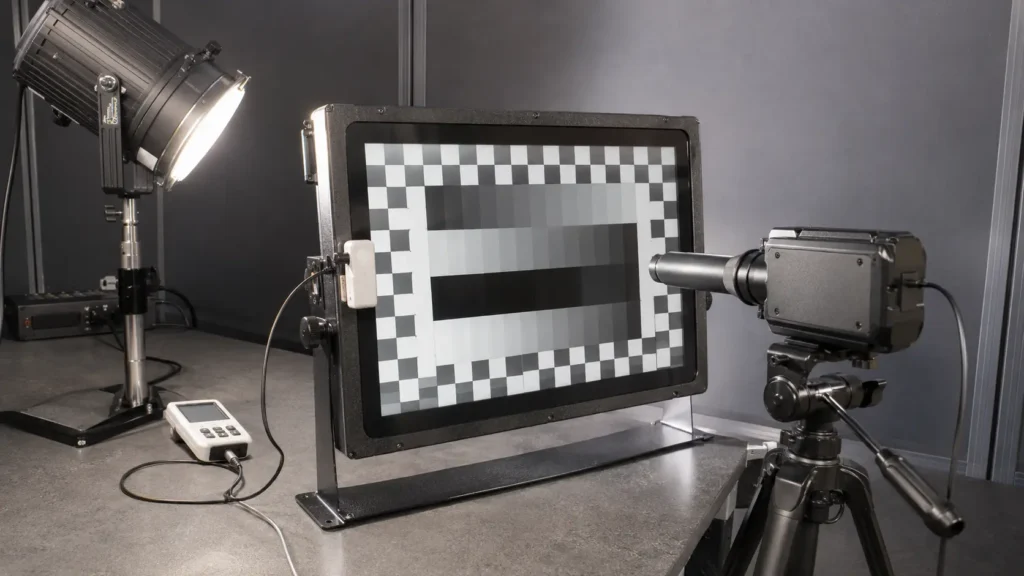
Do not approve a bonded sample from a specification sheet or indoor desk test alone. Check the completed assembly under conditions that represent the final installation.
| Verification item | What to confirm |
| Bonded interface | Identify exactly which air gap has been removed and whether another front window remains |
| Finished-display brightness | Measure or confirm luminance through the final touch panel, glass and surface treatment |
| Outdoor readability | View representative content under the expected sunlight direction and operating angle |
| Bonding quality | Inspect for bubbles, edge defects, contamination, pressure marks, mura and misalignment |
| Environmental stability | Validate the bonded assembly through the temperature and humidity conditions required by the project |
| Touch performance | Test with the final glass, enclosure grounding and required water or glove conditions |
| Front sealing | Verify the panel-to-enclosure seal separately from the optical bond |
| Service strategy | Decide whether a failed bonded assembly will be reworked or replaced as one unit |
The production sample should use the intended LCD model, touch panel, glass thickness, bonding material and mechanical support. A sample made with a different panel revision or a thinner temporary glass does not validate the final stack.
Optical bonding should be decided before the front structure is frozen, but after the real environment is understood.
For direct-sun, humid or difficult-to-service outdoor equipment, it is usually a reliability requirement. For shaded, mild and easily repairable installations, it may be unnecessary cost.
Our view is straightforward: do not add optical bonding because “outdoor” appears on the project description. Add it when the remaining air gap creates a measurable readability, fogging or field-service risk—and verify the result on the complete display, not on the bare LCD.
If you are evaluating an outdoor touch monitor, provide the LCD size, required brightness, sunlight exposure, cover-glass thickness, touch conditions, operating temperature, sealing method, mounting structure and expected quantity. These details are enough to judge whether air bonding remains acceptable or optical bonding should be included before the mechanical design is released.
No. A shaded semi-outdoor display with limited humidity risk and easy service access may use air bonding. Direct sunlight, temperature cycling and difficult maintenance make optical bonding more valuable.
The brightness figure alone cannot answer that question. A 1000-nit LCD may still suffer from internal reflection. Review the finished display under the actual ambient-light condition.
No. It removes the air gap at the bonded optical interface. IP protection depends on the complete enclosure, gasket, adhesive, joints, connectors and installation method.
No. Bonding may improve optical integration and contribute to a stronger laminated stack, but IK10 must be achieved and verified by the complete front structure.
An industrial panel PC is a computer with a built-in display, usually a touchscreen, designed for …
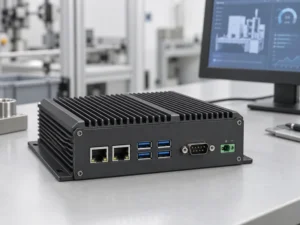
An embedded PC is a computer configured to work as part of a machine or larger …

Start with the software the panel PC must run and the conditions it must fit. Then …

Choosing an industrial panel PC IP rating starts with two questions: what dust and water exposure …
Share your application, requirements, or current challenge. Our team will review the details and recommend a practical way forward.